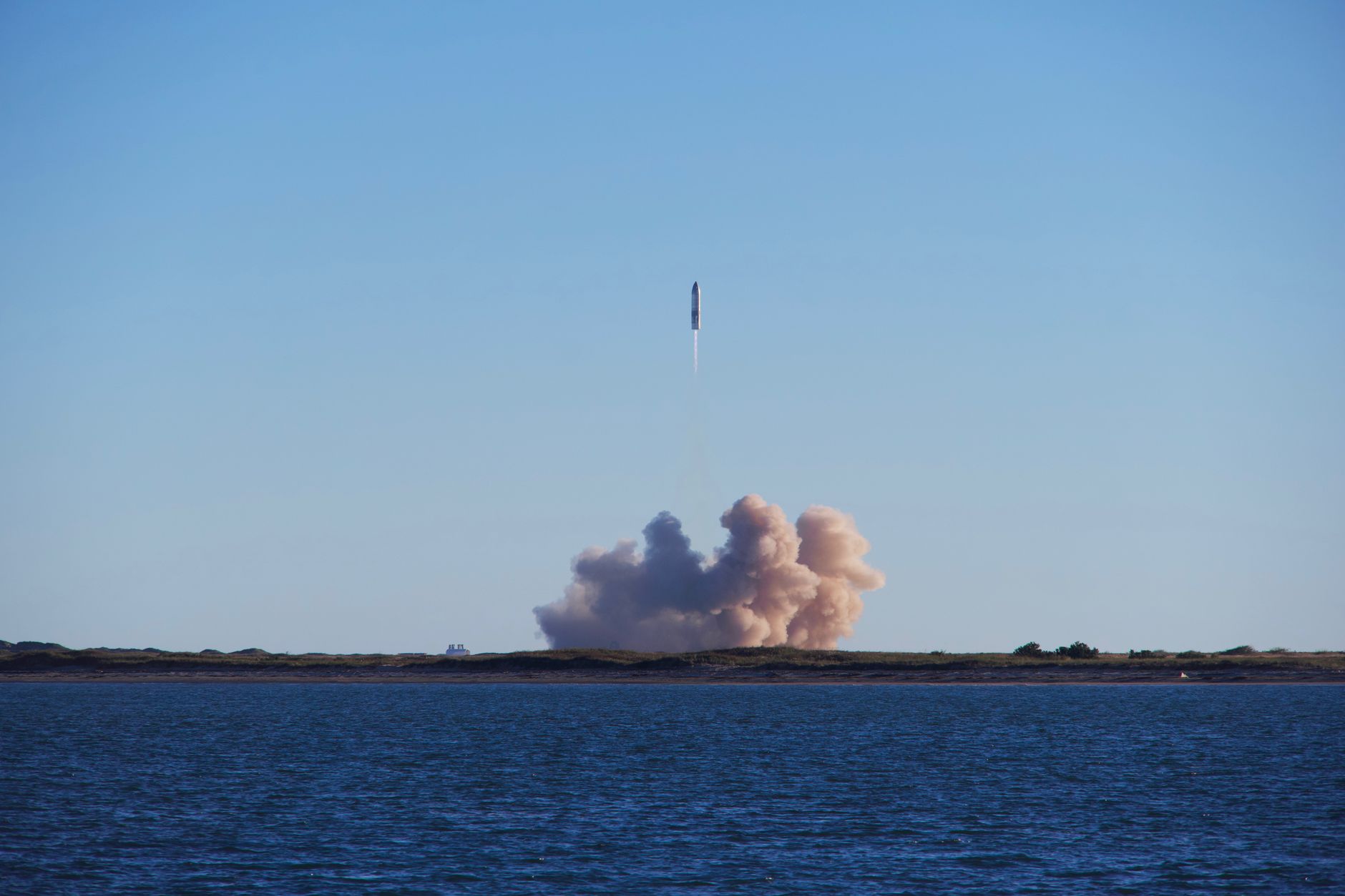
SpaceX announced that its Starship vehicle completed its first orbital flight on Monday, delivering 26 of the company’s newest generation of Starlink broadband satellites into low‑Earth orbit. The launch, designated Flight 14, was the 14th test of the 407‑foot‑tall (124‑meter) launch system and the first to reach orbital velocity rather than the sub‑orbital trajectories used on earlier attempts.
Launch details
The mission lifted off from Starbase, Texas, at 8:49 a.m. EDT (7:49 a.m. local time; 12:49 UTC). Thirty‑three methane‑fueled Raptor engines ignited, delivering up to 18 million pounds of thrust to propel the rocket skyward. The launch pad sits just north of the U.S.–Mexico border, and the vehicle climbed eastward over South Texas, breaking the sound barrier and entering the stratosphere.
After the initial ascent, the Super Heavy booster stage separated from the Starship upper stage. The booster performed a rapid high‑altitude turnaround and then returned toward the Texas coast, executing a controlled splashdown in the Gulf of Mexico a few minutes later. The upper stage continued its ascent, shutting down its Raptor engines a little more than eight minutes into flight.
Orbital achievement and satellite deployment
Unlike prior flights, which were intentionally limited to sub‑orbital paths that would bring the vehicle back into the atmosphere, Flight 14 was directed to achieve low‑Earth orbit. The upper stage’s extra thrust enabled it to reach the required orbital speed, marking the first time Starship completed a full orbit around the planet.
Inside the payload bay, SpaceX carried 26 next‑generation Starlink satellites. The satellites are larger than those that fit aboard the Falcon 9 launcher, so they were flat‑packed for transport. Once the Starship reached the appropriate altitude, a system of pulleys and cables ejected the satellites from the payload deployer, a process likened to a Pez dispenser dispensing candy. The satellites were released one by one into orbit, expanding the Starlink broadband constellation.
Implications for SpaceX’s commercial ambitions
The successful orbital flight demonstrates the operational potential of Starship as a heavy‑lift vehicle capable of delivering large payloads to orbit in a single launch. By moving beyond sub‑orbital tests, SpaceX signals readiness to use the system for commercial missions, including the deployment of future Starlink satellites that are too large for the Falcon 9 platform.
Achieving orbital velocity also validates the performance of the Raptor engines and the integrated launch architecture, both critical for SpaceX’s broader plans to offer low‑cost, high‑capacity launch services. The ability to recover the Super Heavy booster via splashdown further supports the company’s reusable‑launch model, which aims to reduce launch costs over time.
While the flight concluded with the upper stage completing its mission, the event underscores SpaceX’s continued investment in expanding its satellite internet network and its pursuit of a fully reusable launch system. The deployment of 26 new Starlink units adds capacity to the broadband service, potentially increasing revenue streams tied to the constellation’s global coverage.
SpaceX officials have not disclosed additional details about future orbital flights, but the successful execution of Flight 14 suggests that the company is positioning Starship for a range of commercial and scientific missions that require large payloads and rapid turnaround.

Norman Pearlstine is the Executive Editor and Co-Founder at News Raise. With over two decades of experience across financial journalism, corporate governance, and market analysis, Norman leads the editorial direction and ensures strict adherence to journalistic accuracy and ethics.