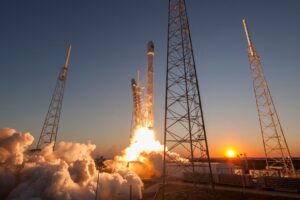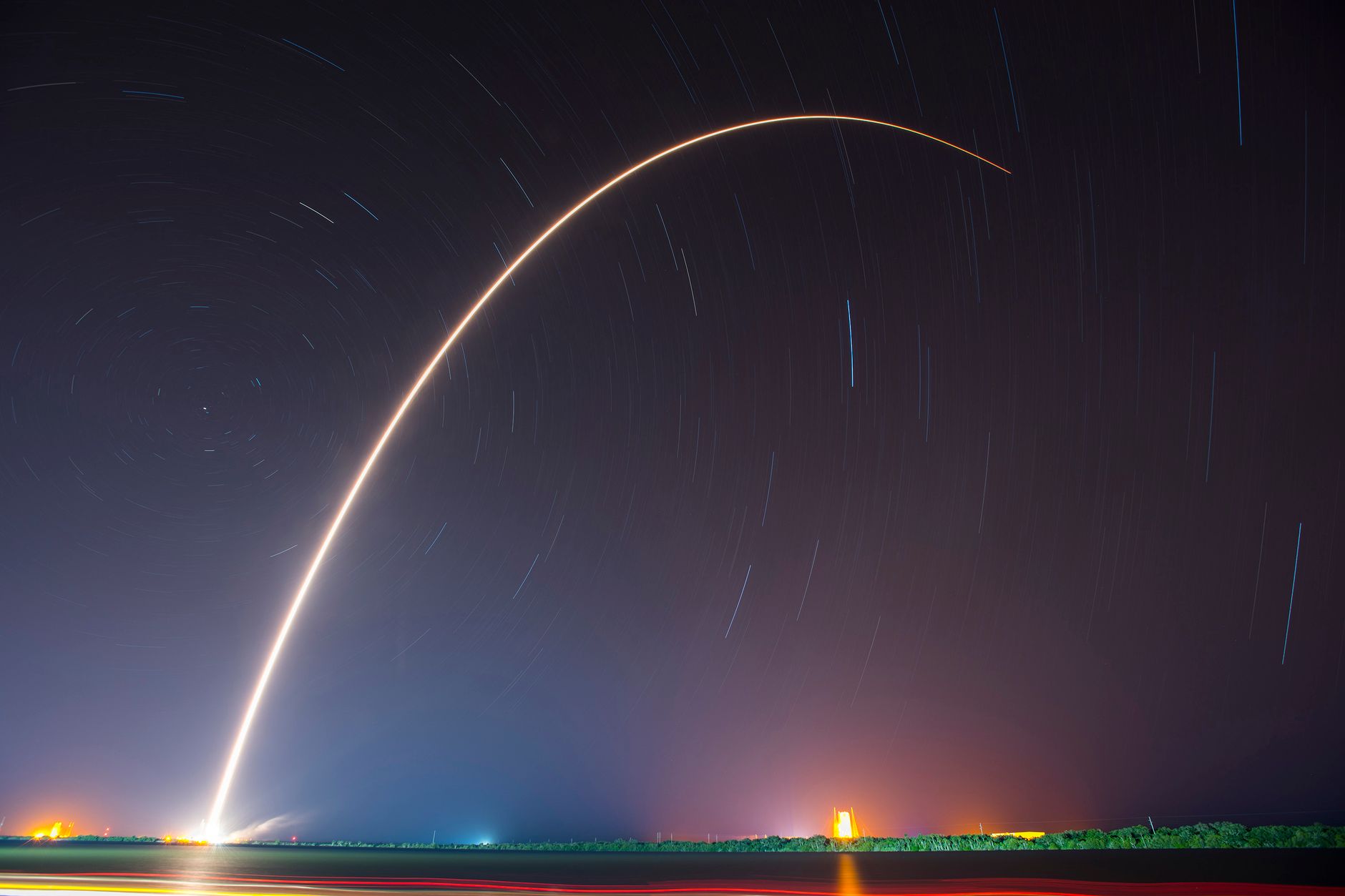
SpaceX ended one of its busiest days ever with a midnight launch of a Falcon Heavy from Launch Complex 39A at NASA’s Kennedy Space Center. The rocket lifted off at 11:54 p.m. ET on Thursday, carrying NROL‑97, a classified payload for the National Reconnaissance Office (NRO). This mission marked the first time the NRO flew on a Falcon Heavy after 22 prior missions on Falcon 9, and it was the inaugural NRO contract awarded under the National Security Space Launch Phase 3 Lane 2 agreement signed in 2025.
Booster performance and rapid turnaround
Approximately eight minutes after liftoff, the two side boosters—identified as B1104 and B1072—touched down at Landing Zones 1 and 2 on Cape Canaveral Space Force Station. Their landings generated double sonic booms that were heard across Brevard County. B1104 was on its second flight, while B1072 was on its fourth. Both boosters had most recently flown on August 30 on NASA’s Nancy Grace Roman Space Telescope mission, making the NROL‑97 flight the quickest turnaround between Falcon Heavy missions to date.
The central core, designated B1106, was expended in the Atlantic Ocean to allow the payload to reach a high‑energy orbit. The mission’s fairing had previously been used on the NROL‑95 launch in July, according to SpaceX’s mission page.
Record‑setting day of landings
Earlier on the same Thursday, Falcon 9 booster B1101 returned to Landing Zone 40 after delivering the Crew‑13 astronauts to the International Space Station. A second Falcon 9 then launched the Transporter‑18 rideshare from Vandenberg Space Force Base, carrying 130 payloads. Together, these operations gave SpaceX four successful booster recoveries in a single day—a first for the company.
The side‑booster landings also marked what may be the final use of Landing Zone 1. SpaceX first landed an orbital‑class booster at this site in December 2015, but the lease on the former Launch Complex 13 expired in 2025 as the company shifted its Florida landings to newer pads at its own launch complexes. With Landing Zone 40 already occupied by the Crew‑13 booster, SpaceX re‑activated LZ‑1 for one more night. Launch‑tracker Next Spaceflight listed NROL‑97 as the final expected landing at the historic site.
Beyond the record, NROL‑97 adds to SpaceX’s rapidly expanding portfolio of national‑security missions. Since mid‑August, the company has flown four Space Force missions from Vandenberg, several of which are believed to have carried Starshield satellites. Those contracts have pushed SpaceX’s Pentagon business for 2026 past $8 billion. In related news, Elon Musk was named this week to help lead the Pentagon’s Project Meridian study on the future of warfare.
The Florida double‑header also stood out because the Space Coast recorded only one launch in September, as SpaceX continues to transition more of its East Coast infrastructure toward the Starship system. Starship achieved its first orbital flight on Flight 14 just three days before the Falcon Heavy launch.

Steve Lopez is a Senior Editorial Columnist and Health & Public Policy reporter for News Raise. Steve focuses on healthcare advancements, medical technologies, and public health policies.