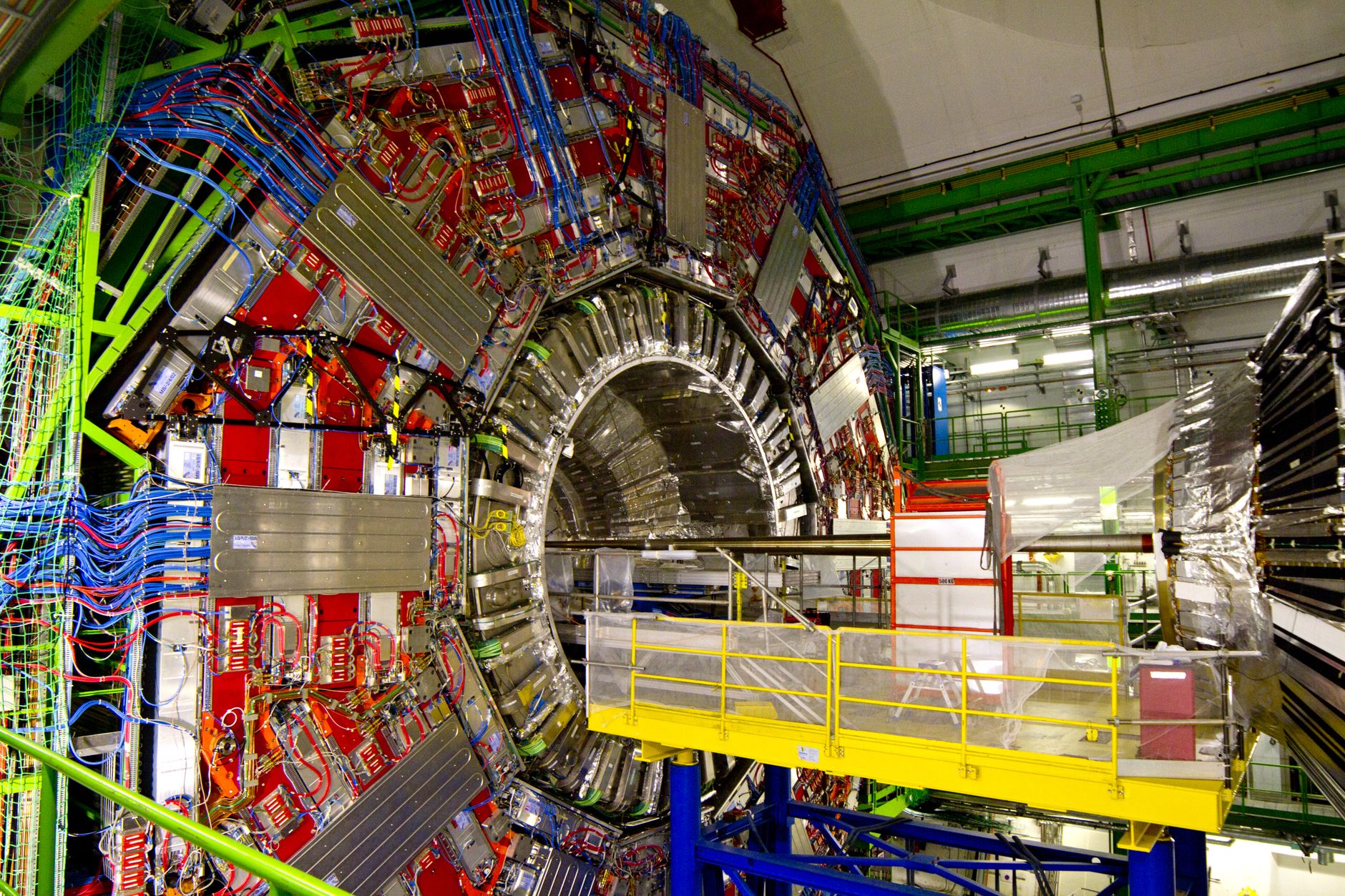
Physicists using the STAR detector at Brookhaven National Laboratory’s Relativistic Heavy Ion Collider (RHIC) have reported an unexpected dip in the way particles emerge from collisions of gold nuclei, a pattern that could signal the elusive “critical point” of nuclear matter.
Collision program and the observed anomaly
In the experiment, beams of gold ions were accelerated to velocities approaching the speed of light and smashed together. For the lowest‑energy runs, the team employed a fixed‑target configuration, directing a beam onto a thin gold foil inside the detector to achieve the highest possible density of matter. Over the course of the study roughly one billion collisions were recorded at center‑of‑mass energies ranging from 3 to 7.7 GeV per nucleon pair, the bottom of RHIC’s operating range.
For each event the researchers measured the transverse momentum of charged particles – the component of motion perpendicular to the beam direction – and examined how the momenta of particle pairs fluctuated together. Such correlations reflect collective properties of the hot fireball created in the collision, including its temperature and flow. As the collision energy is varied, the strength of these correlations was expected to change smoothly.
Instead, the STAR data revealed a pronounced reduction in the correlation strength around the middle of the scanned energy interval, followed by a rise at higher energies. The dip deviates from a smooth trend anchored by earlier high‑energy measurements with a statistical significance of five standard deviations (5σ), meaning the probability of the pattern arising from random fluctuations is about one in 3.5 million.
Why the dip matters
The observed non‑monotonic behavior aligns with theoretical expectations for a critical point in the phase diagram of quantum chromodynamics (QCD), the theory describing quarks and gluons. Near such a point, the heat capacity of the medium would increase sharply, making the fireball’s temperature more resistant to change and thereby weakening the momentum correlations.
“If the matter approaches a critical point or a phase change, we would expect to see those correlations change in an unusual, non‑smooth way as we vary the collision energy,” said Rutik Manikandhan, a postdoctoral scholar at The Ohio State University and co‑author of the study. The team’s findings therefore provide a tantalizing hint that the conditions probed at RHIC may be close to the QCD critical point, a landmark that would separate a smooth crossover from a first‑order phase transition in nuclear matter.
Computer simulations that omit a critical point reproduced the overall energy dependence but failed to generate the dip, further supporting the notion that the effect is not a trivial artifact of the analysis. However, the authors caution that alternative mechanisms unrelated to critical phenomena could also influence the fluctuations, and additional evidence is required before a definitive claim can be made.
Implications and next steps
The results have relevance beyond the laboratory. The quark‑gluon plasma created in these collisions mimics the state of the universe a few microseconds after the Big Bang, and understanding its equation of state – the relationship among pressure, temperature and density – informs models of early‑universe evolution and the interior of neutron stars.
Future work will focus on extracting the specific heat of the hot matter from the same correlation data and comparing it with first‑principles lattice QCD calculations. The team also plans to test the dip against a broader suite of theoretical models and to combine it with other observables, such as fluctuations in the number of produced protons, to build a more comprehensive picture.
“Only when different measurements agree can we say confidently whether a critical point exists,” Manikandhan emphasized. The present observation, while not proof, offers a new precise benchmark for theorists and a promising direction for the ongoing search for the QCD critical point.

Steve Lopez is a Senior Editorial Columnist and Health & Public Policy reporter for News Raise. Steve focuses on healthcare advancements, medical technologies, and public health policies.