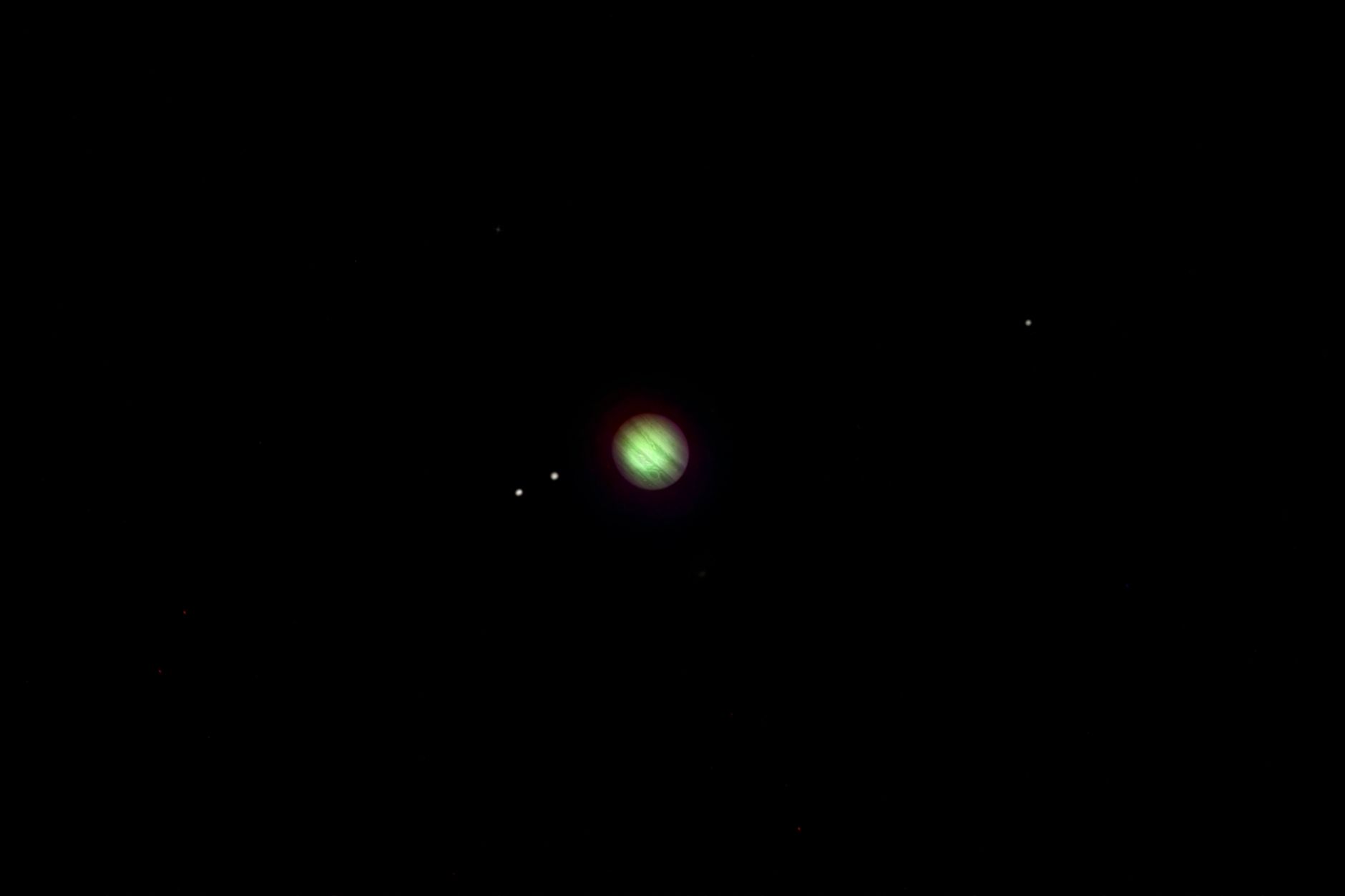
On Tuesday, Oct. 6, a thin crescent Moon moved directly between Earth and Jupiter, temporarily hiding the gas giant from view. The full occultation was visible across a broad swath that included North America, Western Africa and the Atlantic Ocean, where observers saw the Moon pass precisely in front of Jupiter.
What the occultation looked like
Because the Moon was only about 20 % illuminated, many skywatchers outside the central path saw the bright crescent just a few degrees away from Jupiter, an effect created by parallax. The phenomenon causes nearby celestial objects to appear in slightly different positions depending on the observer’s location on Earth. As a reference, a clenched fist held at arm’s length spans roughly 10 degrees of sky.
Photographers capture the event
Amateur astronomer Peter Zay documented the occultation from North Carolina. He captured Jupiter shining in the sky moments before it disappeared behind the lunar crescent. In an email to Space.com, Zay explained that his approach avoids compositing multiple exposures, insisting on “authentic captures.” He said planning—gear, weather, location and timing—was essential, yet the event still pushed optical limits.
Zay also photographed Jupiter as it emerged from the Moon’s night side. He noted the challenge of balancing the brightness of the Moon’s sunlit surface with that of Jupiter’s four large moons—Io, Europa, Ganymede and Callisto. The resulting image shows lunar craters, earthshine and background stars, with Jupiter and its moons centered as they left the Moon’s shadow.
In Pennsylvania, Josh McCollum used a Skywatcher 400P Flextube Dobsonian telescope paired with a Celestron C11 Schmidt‑Cassegrain to view the rendezvous from Emmaus. He reported that atmospheric conditions were less than ideal, but he could still see Ganymede, the solar system’s largest moon, above Jupiter as the occultation neared totality. According to McCollum, Europa and Io were the first to reappear from behind the Moon, followed by the silhouette of the Moon itself as Jupiter re‑entered the night sky.
Another contributor, a user known as EricTheCat, posted images taken from Minnesota. He described the event’s altitude progression—from 6 degrees at the start to 15 degrees above the horizon at the end—and chose exposure settings that emphasized the moons and earthshine rather than finer surface detail.
Why the event matters
Lunar occultations of bright planets are relatively rare and offer a vivid illustration of orbital mechanics. They also provide a natural laboratory for testing observational techniques, as photographers must manage stark contrasts between a dim crescent Moon and the brilliance of a planet and its satellites. The Oct. 6 event sparked a surge of shared images on social media and invited amateur astronomers to submit their own photos to Space.com.
For those interested in capturing similar phenomena, Space.com recommends consulting roundups of the best cameras and lenses for astrophotography, as well as guides to selecting telescopes and binoculars suited for night‑sky exploration.

Steve Lopez is a Senior Editorial Columnist and Health & Public Policy reporter for News Raise. Steve focuses on healthcare advancements, medical technologies, and public health policies.