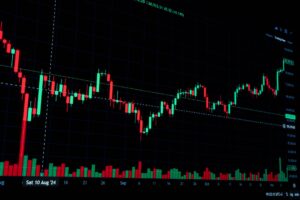
Most Asian share markets experienced a downturn on Monday, influenced by renewed doubts surrounding the Middle East peace process. This uncertainty contributed to a rise in oil prices and bond yields, prompting investors to anticipate a greater possibility of increased U.S. interest rates.
Market Movements and Influences
In Asia, MSCI’s broadest index of Asia-Pacific shares outside Japan eased by 0.4%. However, Japan’s Nikkei index managed a slight gain of 0.7%, following a significant climb of nearly 8% the previous week that pushed it to all-time highs. In contrast, South Korea’s market fell by 0.9% after an 11% surge last week, driven by demand for semiconductor stocks.
Futures markets also indicated a cautious outlook. S&P 500 futures declined by 0.5%, while Nasdaq futures lost 0.7%. In Europe, EUROSTOXX 50 futures dropped 0.5%, DAX futures decreased by 0.3%, and FTSE futures dipped 0.1%.
The price of oil saw an increase due to geopolitical tensions. Brent crude futures rose 1.1% to $81.43 a barrel, though still considerably below its May peak. U.S. crude firmed by 2.7% to $78.70 a barrel, maintaining a position above the $67 level it held before recent conflicts began. These movements were partly attributed to Iran’s announcement of closing the Strait of Hormuz, with tracking sites showing a reduction in vessel traffic.
Investor Expectations on Interest Rates
Treasury markets remained under pressure following a recent hawkish stance from the Federal Reserve. This has led markets to price in a 75% probability of a U.S. rate hike as early as September. Futures currently suggest 38 basis points of tightening by the end of the year. The yield on 2-year notes climbed 4 basis points to 4.2276%, marking its highest level since early 2025.
Fabio Bassi, head of cross-asset strategy at JPMorgan, commented on the outlook, stating that while their baseline expectation is for patience and a first hike in the latter half of 2027, the margin for error and tolerance for further inflation are limited, posing risks of earlier rate increases. Bassi remains constructive on risk assets, citing improving labor markets that could support higher rates for longer, benefiting Quality Growth, Large Cap, and Tech sectors, with potential upside risks for the S&P target reaching 8,000.
Further underscoring the risk of tighter monetary policy, the Federal Reserve’s preferred core inflation gauge is scheduled for release on Thursday. It is forecasted to rise slightly to 3.4% in May.
Political Developments
In separate political news, sterling eased amid reports that Prime Minister Keir Starmer was reviewing his political future. This follows a significant election victory for rival Andy Burnham, which has prompted calls from within the governing Labour Party for Starmer’s resignation. U.S. President Donald Trump also posted claims about Starmer’s potential resignation and reiterated threats against Iran, even as Vice President JD Vance engaged in talks with Iranian officials under an interim peace deal.

Mitchell Landsberg is a Senior Technology Correspondent at News Raise. He covers consumer electronics, artificial intelligence, software developments, and digital privacy trends.