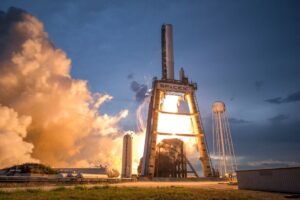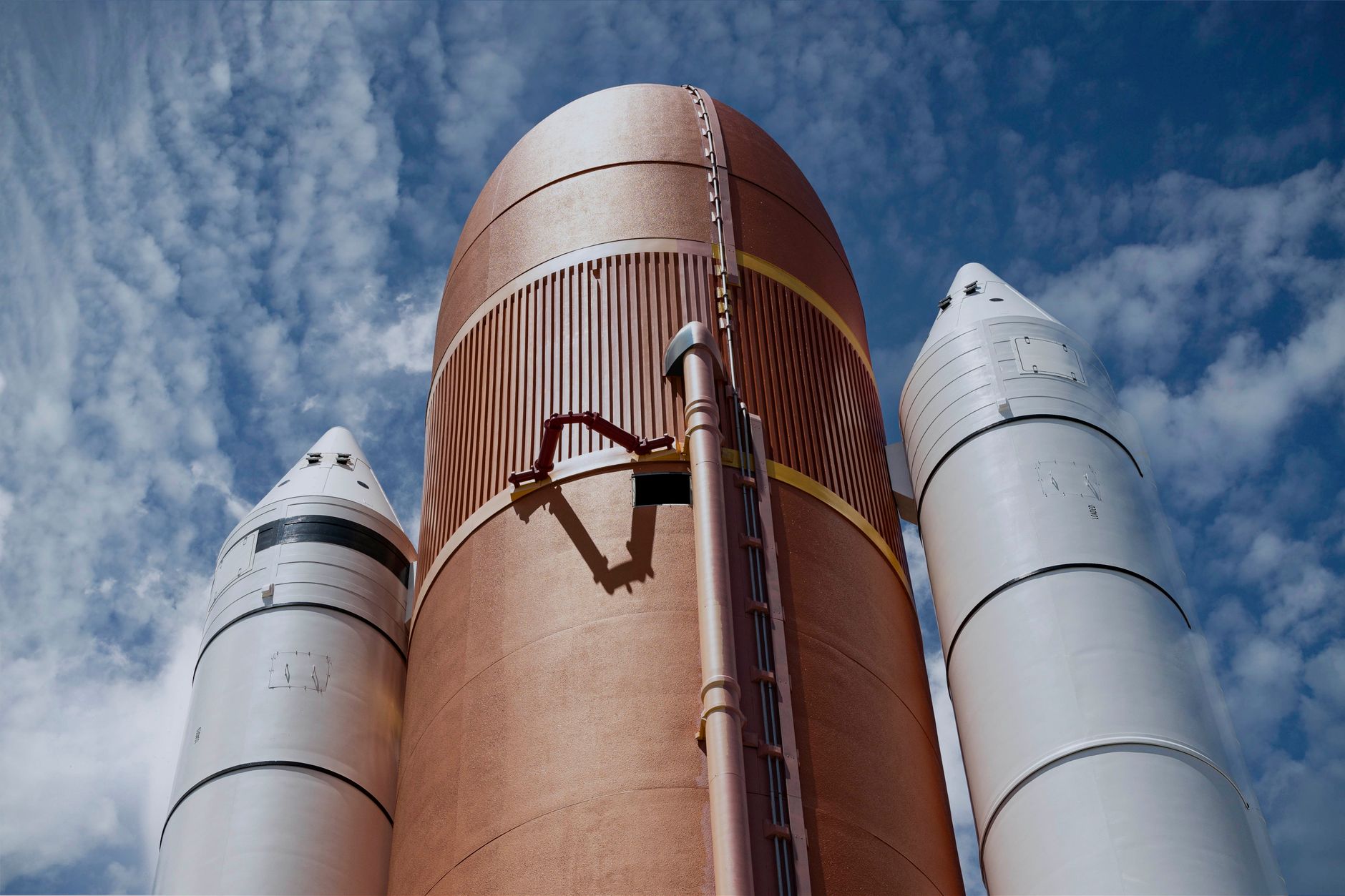
SpaceX’s Starship V3 produces roughly 18 million pounds of thrust at liftoff, more than twice the 7.6 million pounds of thrust generated by the Saturn V rocket that carried humans to the Moon.
This significant difference in thrust highlights the scale of the Starship, but it does not necessarily indicate the vehicle’s readiness for a mission to Mars. Despite completing its 13th integrated test flight on July 24, 2026, SpaceX has yet to demonstrate a crucial capability: ship-to-ship refueling in orbit.
Thrust Comparison
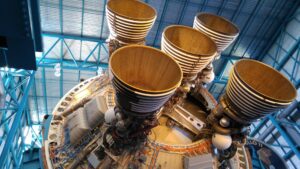
The Saturn V rocket, which stood 111 meters tall, was powered by five kerosene-burning F-1 engines and could place approximately 118 tonnes into Earth orbit. In contrast, the Starship V3, which is about 124 meters tall, uses 33 methane-burning Raptor 3 engines, generating approximately 18 million pounds of thrust at liftoff.
The ratio of the Starship V3’s thrust to the Saturn V’s thrust is roughly 2.4, demonstrating the significant difference in the power of the two vehicles. However, thrust alone does not determine a vehicle’s readiness for a mission to Mars; other factors such as payload, reliability, efficiency, and mission completion are also crucial.
Ship-to-Ship Refueling
SpaceX has not yet demonstrated the ability to refuel a Starship in orbit, a capability that is essential for a mission to Mars. The company has, however, conducted a test in which a Starship transferred liquid oxygen between two of its own tanks during a flight in March 2024. This test was an important fluid-management test, but it did not involve a tanker or a second ship, and it did not demonstrate the ability to refuel in orbit.
A full demonstration of ship-to-ship refueling would require two successful launches, with a target Starship and a tanker entering compatible orbits and navigating relative to each other. The two vehicles would then need to dock and transfer propellant, a process that involves connecting transfer lines, controlling orientation, and maintaining pressure differences.
Challenges and Requirements
The development of the Starship is a complex process that involves overcoming numerous technical challenges. The vehicle must be able to survive re-entry, fly again, support a crew for months, and depart Earth orbit with enough propellant to reach another planet.
SpaceX’s plan for a mission to Mars involves launching tanker variants separately, which would deliver methane and oxygen to a depot or directly to the mission ship, allowing it to leave low Earth orbit with replenished tanks. The exact number of tanker launches depends on the evolving vehicle, payload, destination, and how much propellant each flight can deliver.

Mitchell Landsberg is a Senior Technology Correspondent at News Raise. He covers consumer electronics, artificial intelligence, software developments, and digital privacy trends.