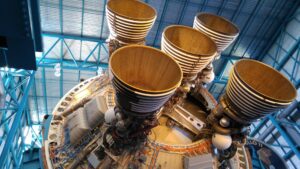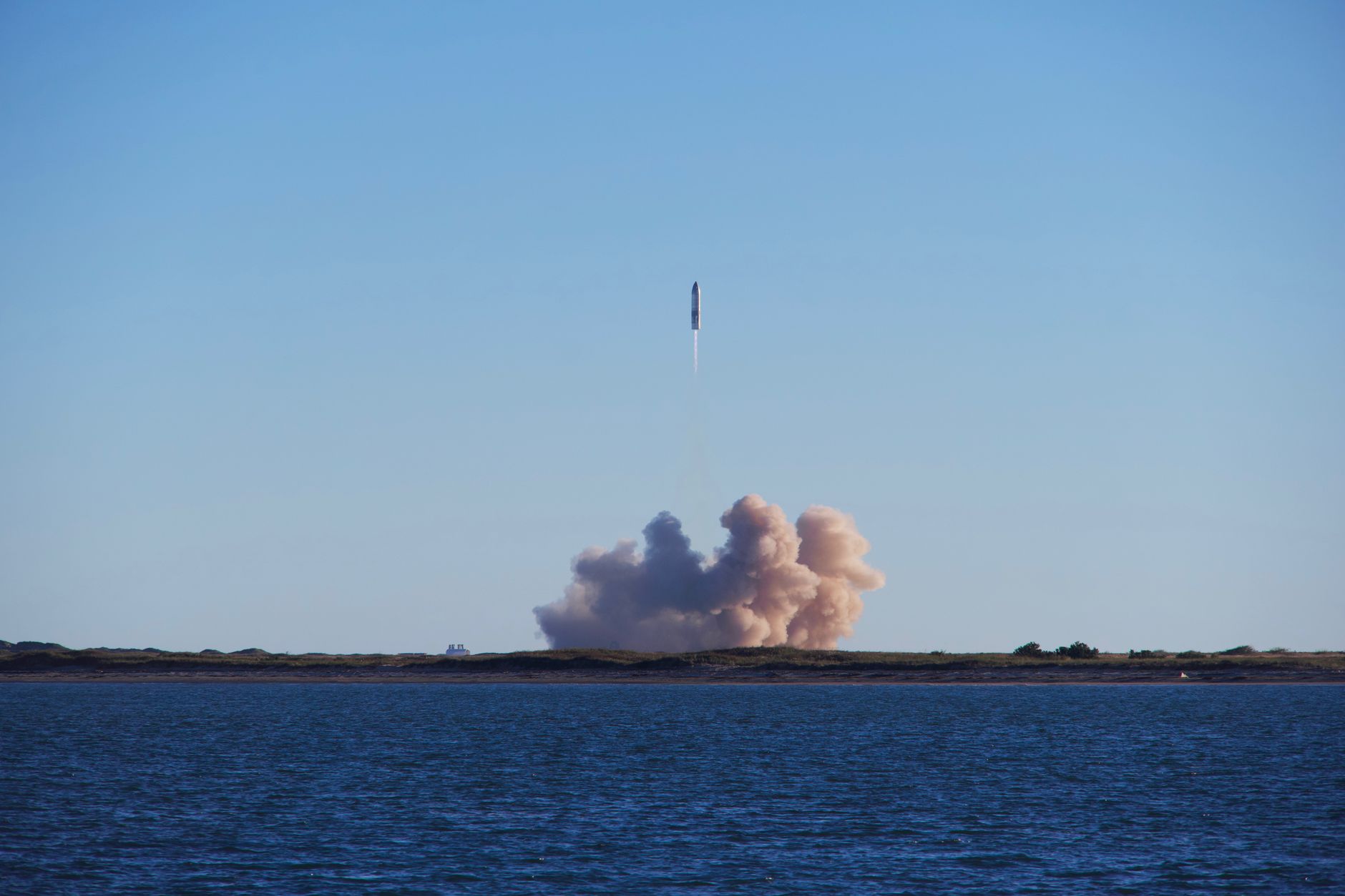
SpaceX’s Starship rocket is a marvel of modern engineering, producing approximately 74.4 million newtons of thrust at liftoff, roughly twice the force of the Saturn V rocket that sent humans to the Moon. This massive thrust is generated by 33 Raptor 2 engines, each producing around 2,260 kilonewtons of thrust, making Starship the most powerful rocket ever built.
The Super Heavy booster, the first stage of the Starship, is powered by these 33 engines and contains 3,400 tonnes of liquid methane and liquid oxygen. During the first stage of ascent, all 33 engines burn continuously for approximately 166 seconds, consuming around 20 tonnes of propellant per second at peak flow. After this stage, the second stage, the Starship spacecraft, separates and continues to orbit under its own six Raptor engines, while the Super Heavy booster reverses course and returns to the launch site.
Reusability: The Key to Revolutionizing Spaceflight
What sets Starship apart from other rockets is its reusability. Both stages of the rocket, the Super Heavy booster and the Starship spacecraft, are designed to return to Earth and be reused. The Super Heavy booster returns to its launch site and is caught in mid-air by two enormous mechanical arms, known as “Mechazilla” or the “chopsticks.” This catch mechanism allows the booster to be reused without the need for landing legs, which would add weight and subtract from payload capacity.
The catch itself is a precise process, with the booster decelerating using its own engines during a landing burn, hovering briefly near the tower, and then being gripped by the mechanical arms. This process typically takes less than a minute. SpaceX has successfully caught a returning Super Heavy on three occasions, demonstrating the feasibility of this technique.
Implications for Spaceflight
The ability to catch and refly the Starship rocket has significant implications for spaceflight. If successful, it could make rockets economically comparable to airplanes, with the potential for multiple flights per week. This would drastically reduce the per-flight cost, making space travel more accessible and affordable. SpaceX’s stated design target is a full stack turnaround measured in hours to a few days, which could revolutionize the way we approach space exploration.
The potential applications of this technology are vast, from sending humans to Mars to refuelling spacecraft in orbit and building lunar bases. While there are still engineering problems to be overcome, the framework is now in place for a rocket that can produce twice the thrust of Saturn V and be caught and refly within days. If successful, this could change the economics of spaceflight and enable a new era of space exploration.

Helene Elliott is the Lead Science & Space Reporter at News Raise. She reports on aerospace missions, astrophysics discoveries, quantum research, and environmental technology.