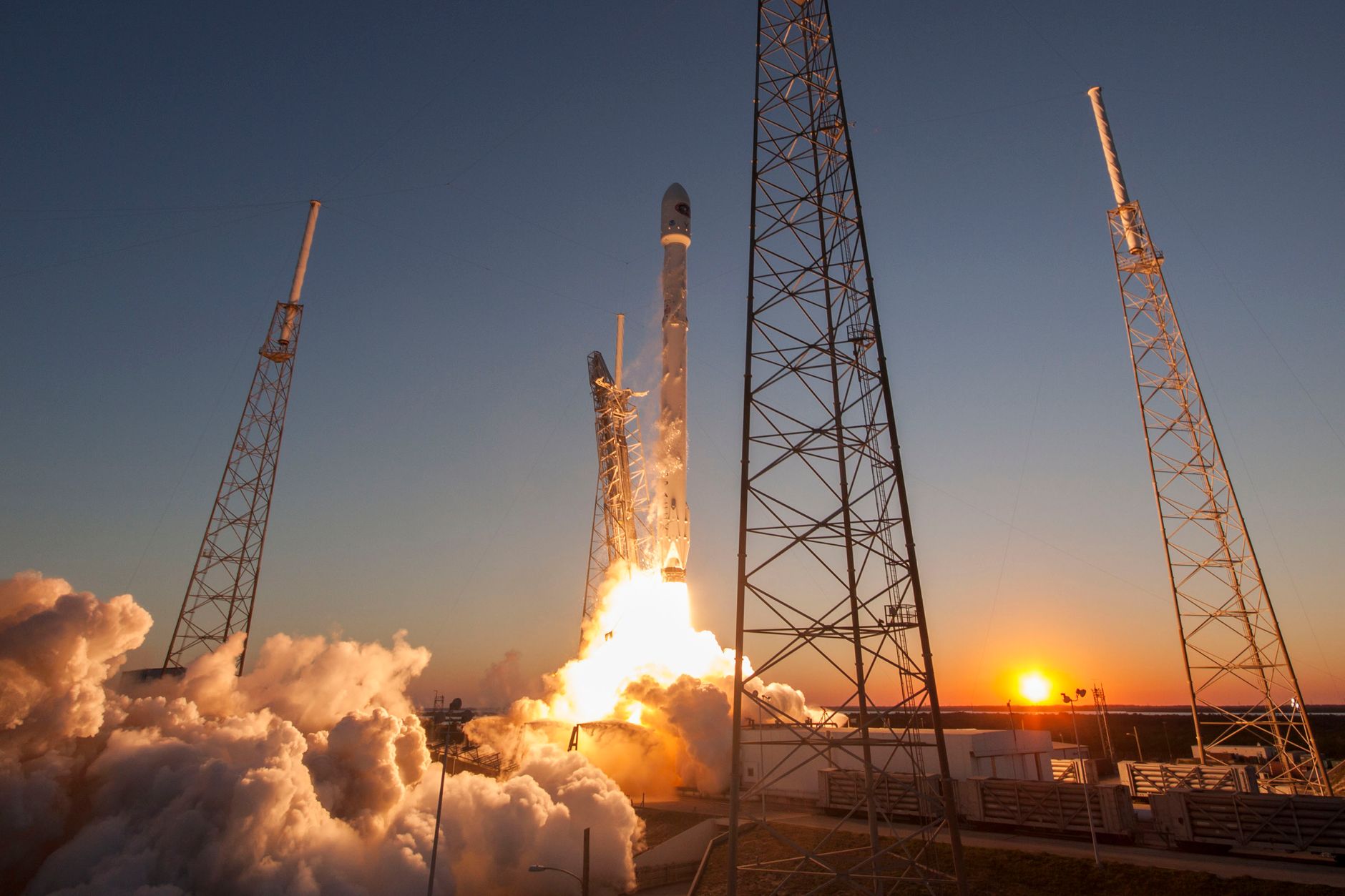
On Thursday night, a SpaceX Falcon Heavy rocket rose from Launch Complex 39A at NASA’s Kennedy Space Center, carrying a classified payload for the National Reconnaissance Office (NRO). The mission, identified as NROL‑97, launched at 11:54 p.m. EDT (0354 UTC) and followed a north‑easterly trajectory off Florida’s Space Coast.
Falcon Heavy configuration and mission background
This launch represents the first time the NRO has employed the heavy‑lift Falcon Heavy, a vehicle that combines three Falcon 9‑derived boosters with an upper stage and a payload fairing. Powered by 27 Merlin 1D engines, the rocket performed its 14th flight overall. While the NRO has previously flown 22 payloads on Falcon 9 rockets, NROL‑97 is the inaugural heavy‑lift mission under the agency’s 2025 contract awarded through the National Security Space Launch Phase 3 Lane 2 competition.
Booster reuse and recovery
The core stage, serial number B1106, was a new unit and was expended during the flight. The two side boosters, however, were previously flown on the Roman Space Telescope launch just a month earlier. Booster B1104 was on its second flight, while B1072 completed its fourth mission. After separation, both boosters returned to Cape Canaveral Space Force Station, landing at Landing Zones 1 and 2 amid loud sonic booms. Landing Zone 1 had been reinstated for this mission after being swapped out for LZ‑40 at Space Launch Complex 40; LZ‑40 had earlier in the day received the booster returning from the Crew 13 mission (B1101).
Payload fairing and broader launch day activity
The payload fairing that protected the NRO satellite had previously been used on the NROL‑95 mission in July, illustrating SpaceX’s practice of reusing flight hardware. NROL‑97 was part of a busy launch schedule for SpaceX on the same day. In addition to the Crew 13 mission, the company launched the Transporter 13 rideshare from its West Coast pad at Vandenberg Space Force Base, deploying 130 secondary payloads. The simultaneous recovery of four boosters—two from Falcon Heavy and two from the Crew 13 flight—marked the first occasion the company landed four boosters in a single 24‑hour period.
SpaceX confirmed the successful touchdown of the Falcon Heavy side boosters in an update posted at 12:21 a.m. EDT (0421 UTC). The mission’s classified nature means few specifics about the satellite are public, but the launch underscores the growing reliance of U.S. intelligence agencies on commercially provided heavy‑lift capabilities.
Significance for U.S. space operations
By employing Falcon Heavy for a spy‑satellite launch, the NRO diversifies its launch options beyond the traditionally used Falcon 9, potentially expanding payload capacity and flexibility for future national security missions. The successful reuse of boosters and fairings also highlights SpaceX’s cost‑saving strategies, which could influence procurement decisions in upcoming NSSL contracts.

Steve Lopez is a Senior Editorial Columnist and Health & Public Policy reporter for News Raise. Steve focuses on healthcare advancements, medical technologies, and public health policies.