NASA scientists are focusing on a set of unusual formations on the Martian surface that resemble potato chips, seeking to determine how they formed and what they are made of. The investigation was announced on NASA’s Curiosity blog on Nov. 11, and it follows a recent drilling campaign at a site the team has nicknamed “Nazca.”
Investigation of chip‑shaped formations
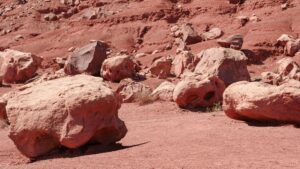
The Nazca drill site lies in a region where the bedrock contains a series of disk‑shaped, or in a broader view, potato‑chip‑shaped crystal forms. Images released by NASA show irregular, curled structures embedded in the rock, some clearly reminiscent of thin, curved chips. The rover’s team has identified these features as a priority for further study, stating that a key objective is to “better characterize these chip‑shaped features.”
Instruments and planned analyses
Samples collected from the Nazca drill hole have been delivered to Curiosity’s Sample Analysis at Mars (SAM) instrument, an onboard laboratory designed to assess the chemical makeup of Martian material. In addition, the rover is slated to employ its ChemCam instrument, which uses a laser to vaporize a small portion of a target and then analyzes the emitted light to infer composition. ChemCam will focus on a crystal‑shaped formation that the team has nicknamed “Colca.”
Scientists also plan to use the Mars Hand Lens Imager (MAHLI), a camera mounted on Curiosity’s robotic arm, to photograph the crystal formations at night. MAHLI’s white‑light and ultraviolet LED lamps will illuminate the targets, allowing high‑resolution imaging under both visible and UV illumination. The NASA blog noted that “ChemCam LIBS observations were planned for each sol including a cluster of crystal forms, a resistant layer in the side of the Nazca block and a dark float rock.”
After completing these observations, the rover is expected to leave the Nazca drill site and resume its southward route as part of its scheduled Friday plan, continuing its broader exploration of the Martian terrain.
Broader context of solar‑system exploration
The chip‑shaped formations are among the latest geological curiosities being examined as NASA and other agencies expand their study of Mars and the wider solar system. In a separate discovery announced last month, astronomers using Chile’s Vera C. Rubin Observatory identified a potential dwarf planet beyond Pluto, designated 2026 ED138. Early estimates place its diameter between 370 and 930 miles, suggesting it could rank among the largest dwarf planets found in the distant reaches of the solar system.
Both the Martian crystal study and the distant dwarf‑planet detection illustrate the ongoing effort to understand planetary formation processes, surface chemistry, and the diversity of objects that orbit our Sun. As Curiosity continues its mission, the data gathered from the Nazca site may shed light on whether the chip‑shaped structures are the result of mineral crystallization, erosional processes, or other geological phenomena unique to Mars.
Fox News Digital contacted NASA for additional comments about the formations and whether similar features have been observed previously, but the agency has not provided further details at this time. The scientific community will be watching the forthcoming analysis from SAM, ChemCam, and MAHLI closely, as the results could refine models of Martian geology and inform future exploration strategies.

Helene Elliott is the Lead Science & Space Reporter at News Raise. She reports on aerospace missions, astrophysics discoveries, quantum research, and environmental technology.