Physicists at the University of Queensland have proved that gravity can be used to convey information, sending the word “gravity” through a solid brick wall. The team repurposed a 1950s elevator, moving its 1.8‑ton counterweight between two floors to encode binary digits, while a gravimeter placed in an adjacent bathroom recorded the minute changes in local gravitational acceleration.
Experiment design and execution
The experiment relied on the fact that every mass creates a gravitational field that cannot be blocked by any material. By shifting the heavy counterweight about 70 centimetres (28 inches) from a sensitive gravimeter, the researchers produced two distinct gravitational signals representing binary 0 and 1. The detector, installed behind a brick wall, was able to differentiate the two positions despite the signal being only roughly five‑billionths of Earth’s gravitational acceleration.
To transmit the word “gravity,” the team used a seven‑digit binary code for each of the seven letters, plus additional bits to mark the start and end of the message, totaling 49 bits. At a rate of one bit per minute, the transmission required approximately one hour. “Our lift was snail‑paced—it’s from the 1950s,” explained physicist Andrew White in a university statement.
Context, limitations and future prospects
The Queensland study follows earlier non‑electromagnetic communication attempts, such as the 2012 Fermilab neutrino experiment that sent data through 240 metres of rock using a particle accelerator and a massive detector. Compared with that effort, the gravity experiment employed only an ordinary moving mass and a commercially available gravimeter, but it also highlighted gravity’s inherent weakness. The signal diminishes with the square of distance, making long‑range transmission challenging.
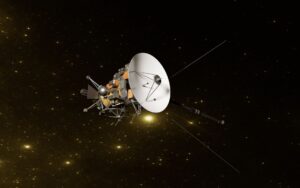
Researchers calculated that faster machinery and improved detectors could raise the data rate to about 15 bits per minute, and that quantum sensors combined with heavier moving masses might extend the practical range to roughly 500 metres. Even under optimistic scenarios, gravity‑based communication would remain far slower than conventional methods; NASA’s Voyager 1, for example, communicates faster despite being a light‑day away.
Co‑author Matthew Davis acknowledged the current impracticality of the technique, noting, “At the moment, it’s very hard to imagine how it could be practically useful… [The experiment is] theoretically interesting enough that it was worth doing.” Nonetheless, the unblockable nature of gravity could find niche uses, such as signaling to sealed nuclear bunkers or other facilities where radio waves cannot penetrate.
The full findings were published in the journal Science Advances, marking a proof‑of‑concept that gravity itself can act as a carrier of information, even if practical applications remain speculative.

Steve Lopez is a Senior Editorial Columnist and Health & Public Policy reporter for News Raise. Steve focuses on healthcare advancements, medical technologies, and public health policies.