Researchers at the European Space Agency announced Tuesday the discovery of the most distant quasar ever recorded, a luminous object that existed merely 630 million years after the universe’s birth. The find, made using ESA’s Euclid space telescope, pushes the known frontier of quasar observations back to a time when the cosmos was only about five percent of its current age.
Discovery and Identification
The quasar, officially catalogued as J1504+6252 and colloquially called Dún Aonghas, was first spotted by Euclid and later examined with a suite of ground‑based and additional space‑based observatories. The research team, led by a German astronomer, detailed the results in the journal Astronomy and Astrophysics. According to the data, the light we now receive left the object roughly 13.1 billion years ago, providing a direct glimpse into the early universe.
What Makes a Quasar
A quasar is the intensely bright core of an active galaxy, powered by a supermassive black hole that devours surrounding gas, dust, and other material. As the infalling matter spirals into an accretion disk, it heats to extreme temperatures and emits energy that can outshine the host galaxy by hundreds or even thousands of times. This extraordinary luminosity allows quasars to be seen across billions of light‑years, making them valuable probes of the universe’s formative epochs.
Implications for Early Black‑Hole Growth
Co‑author Silvia Belladitta, affiliated with the Max Planck Institute for Astronomy and the INAF Bologna Observatory, explained that quasars serve as beacons for studying how the first galaxies assembled and how their central black holes attained massive sizes. Julien Wolf of the European Southern Observatory, the lead author of the study, emphasized that the newly found quasar demonstrates how quickly massive objects can emerge. He noted that the black hole powering Dún Aonghas already weighed about 360 million times the mass of the Sun, despite forming only 630 million years after the Big Bang.
The discovery bolsters theories suggesting that some supermassive black holes originate from the direct collapse of enormous gas clouds, followed by rapid accretion of additional material. The existence of such a massive black hole at this early stage challenges models that rely solely on slower, incremental growth.
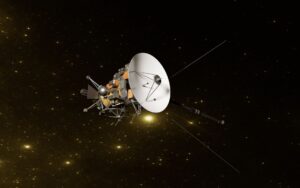
Beyond its immediate scientific impact, the finding underscores Euclid’s broader mission. While the telescope is primarily designed to investigate dark matter—the invisible substance that binds galaxies—and dark energy, the force driving cosmic acceleration, its sensitivity also enables the detection of faint, distant objects like Dún Aonghas.
As astronomers continue to analyze the quasar’s spectrum and surrounding environment, the data are expected to refine our understanding of the timeline of galaxy formation, the behavior of early supermassive black holes, and the conditions prevailing in the universe’s first few hundred million years.

Helene Elliott is the Lead Science & Space Reporter at News Raise. She reports on aerospace missions, astrophysics discoveries, quantum research, and environmental technology.