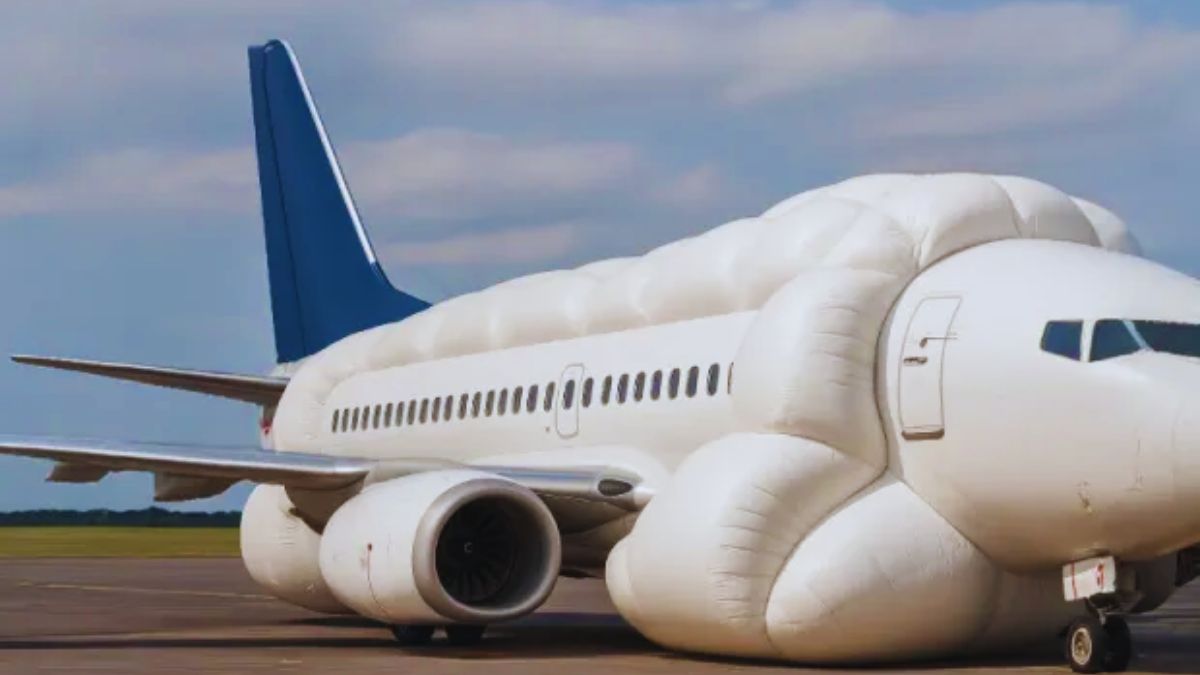
The baffling project came about after the catastrophic Air India crash that killed 260 people.
A groundbreaking concept in aviation safety has emerged from the minds of two young engineers from the Birla Institute of Technology and Science (BITS), Dubai campus. Their project, named “REBIRTH”, introduces an AI-powered crash survival system that could potentially make airplanes “crash-proof.” The innovation was sparked by the Air India crash tragedy in Ahmedabad earlier this year, which claimed 260 lives.
Born from Tragedy
The horrific crash in June 2025 left a lasting impact on survivors, families, and aviation enthusiasts alike. For the designers, Eshel Wasim and Dharsan Srinivasan, the horrific heartbreak turned into determination, which they wanted to utilize for the mankind to gain from.
“Project REBIRTH was born not in a lab, but from grief,” the project description notes stated. After witnessing the devastating aftermath of the crash, the engineers questioned why survival systems beyond traditional safety measures did not exist. This thought led to extensive research and design, ultimately giving shape to their bold idea.
How Does Project REBIRTH Work?
The concept revolves around Artificial Intelligence (AI) detecting imminent crashes – specifically situations where pilots can no longer prevent a disaster from occurrence. At this critical moment, REBIRTH’s safety mechanisms activate automatically. According to visuals shared by the team, here’s how it functions:
- AI Crash Detection: The system identifies when a crash is unavoidable in extreme cases.
- Deployment of External Airbags: Giant airbag-like shields inflate around the aircraft, forming a protective cocoon and helping in crash prevention.
- Impact Absorption: The airbags, filled with shock-absorbing fluids, reduce the force of collision.
- Reverse Thrust Technology: This helps to decelerate the aircraft mid-air and thereby reducing crash speed while landing.
- Smart Liners & Rescue Signals: These help to enhance passenger protection and aid in post-crash rescue.
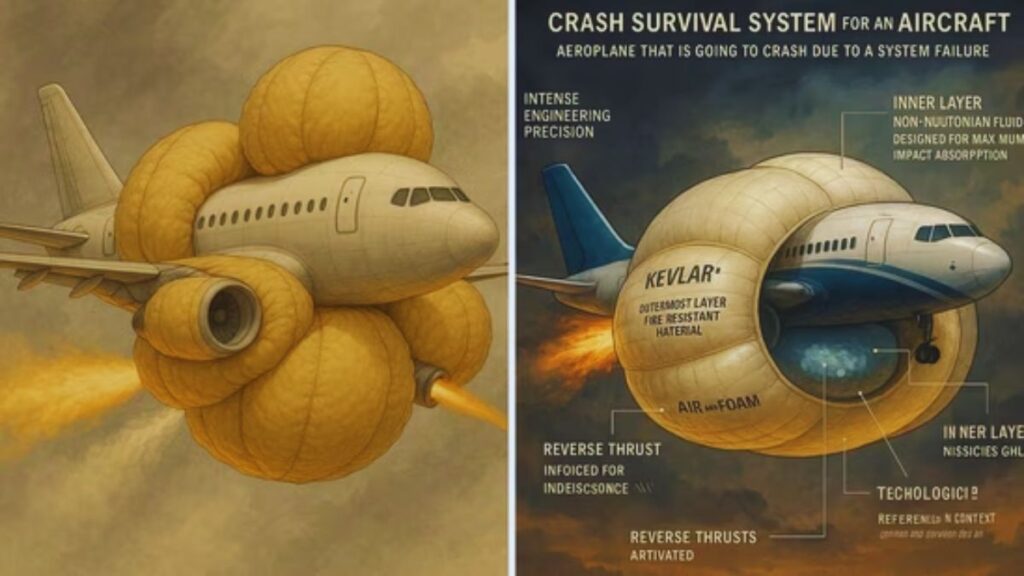 In essence, the system aims to transform a fatal crash into a survivable landing, offering passengers a second chance.
Reaction to the Innovation
The idea has sparked a wide range of reactions online. Some users praised the engineers’ vision and creativity, while others questioned the practicality of installing such a system in commercial aircraft. Critics have labeled this super-ambitious project as ‘bizarre’ and ‘impossible’, while supporters have emphasized the importance of innovation born from empathy and grief.
Despite the mixed reviews, the engineers have already submitted their invention to the prestigious James Dyson Award, a global competition celebrating design and innovation.
What Lies Ahead?
Wasim and Srinivasan are now working towards building functional prototypes of REBIRTH. Their next step is to test its key components – AI crash detection, airbags, seat liners, reverse thrust, and rescue signaling—in controlled laboratory environments.
The team’s long-term goal is ambitious but clear: to integrate this hype-project into the aviation industry and make air travel significantly safer. “REBIRTH is more than engineering—it’s a response to grief,” the creators said. Their vision highlights an important question: Should air travel focus only on preventing crashes, or also on survival after failure?
With Project REBIRTH, the young engineers propose a bold solution—a future where even the worst-case scenario may not mean the end.





Be First to Comment