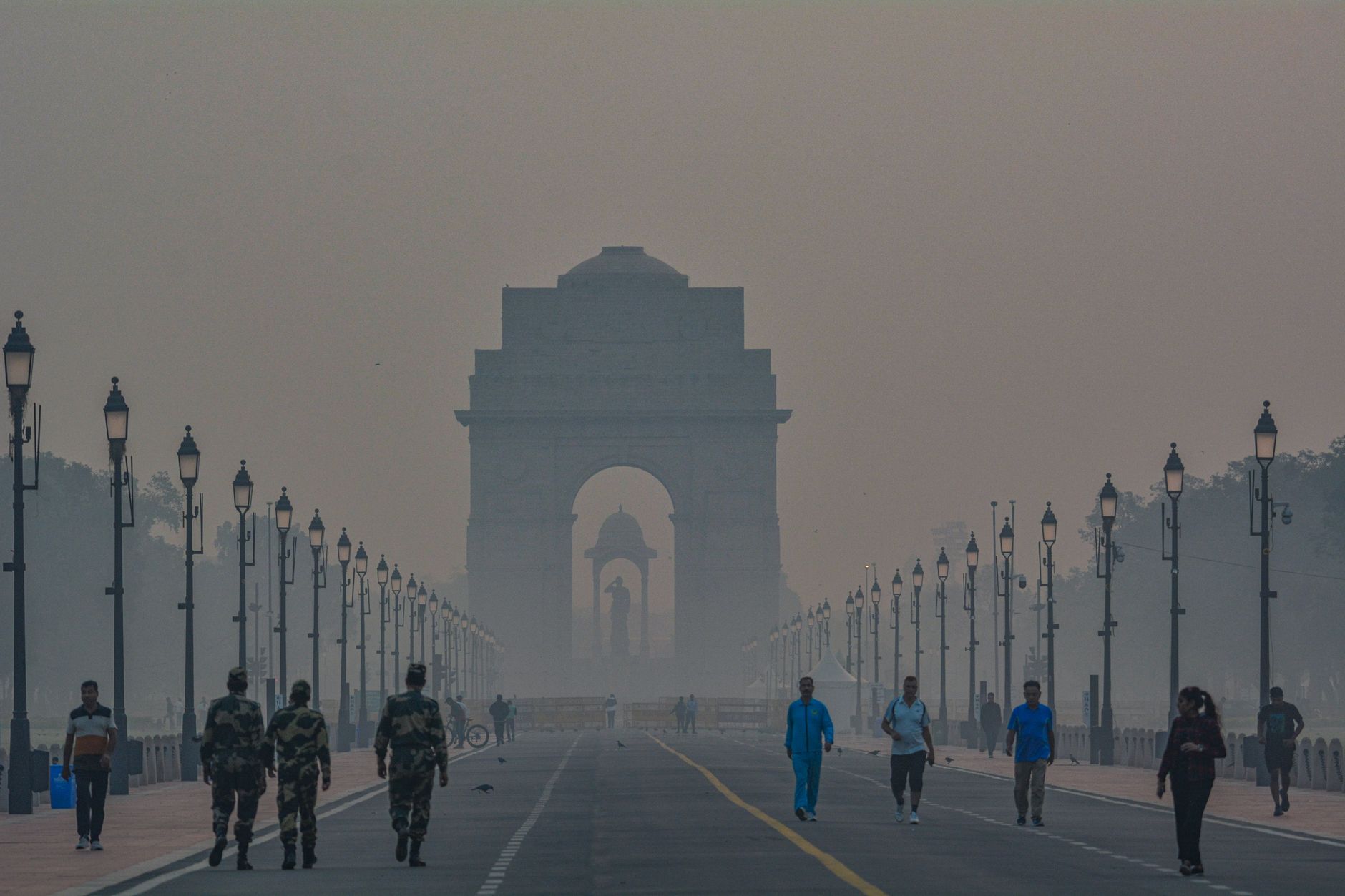
New Delhi continued to grapple with hazardous air conditions on Saturday, as the city’s Air Quality Index (AQI) settled at 367, placing the entire metropolitan area in the “very poor” category. A greyish haze lingered over the capital, and monitoring data showed that at least 17 stations registered AQI values in the severe range.
Current readings and short‑term outlook
The Central Pollution Control Board (CPCB) released a 24‑hour average AQI bulletin at 4 p.m., confirming the city‑wide figure of 367. Earlier on Friday morning, Delhi briefly crossed the 400‑point threshold, a level designated as “severe,” before easing to the very poor range by late afternoon. The most polluted locations at 4 p.m. on Saturday were the Indian Institute of Technology‑Delhi (IIT‑Delhi) and the north campus of Delhi University, each recording an AQI of 439.
Other monitoring sites that posted severe readings included ITO (435), NIH Narela (433), Pusa (431), Burari Crossing (431), Delhi Technological University (DTU) (422), Jawaharlal Nehru University (JNU) (415), NSIT Dwarka (413), NSUT Jaffarpur (412), Commonwealth Sports Complex (411), Punjabi Bagh (409), Bawana (408), CRRI Mathura Road (403), Jahangirpuri (401) and Vivek Vihar in Lajpat Nagar (401). In total, seventeen stations fell into the severe category, underscoring the breadth of the problem across the National Capital Region (NCR).
The Air Quality Early Warning System projects that the very poor classification will persist through Tuesday, indicating that the current deterioration is not a short‑lived spike but part of a longer winter‑season trend.
Rainfall unlikely to bring relief
The India Meteorological Department (IMD) has indicated a possibility of very light rain or drizzle in isolated areas on Sunday. However, experts caution that such modest precipitation is insufficient to meaningfully lower pollutant concentrations. Gufran Beig, founder of the System of Air Quality and Weather Forecasting and Research (SAFAR) and chair professor at the National Institute of Advanced Studies (NIAS), explained that light rain during winter does not effectively cleanse the atmosphere. He warned that high moisture levels can actually promote chemical reactions between gaseous pollutants and suspended particles, leading to the formation of secondary aerosols.
According to Beig, only intense and sustained rainfall has the capacity to wash out pollutants in the winter months. The current forecast of isolated, light showers therefore offers little hope for immediate improvement in air quality.
Sources of pollution driving the crisis
Real‑time source apportionment data from the Indian Institute of Tropical Meteorology identified biomass burning as the dominant contributor to Delhi’s fine particulate matter (PM2.5) during the early morning hours of Saturday. Between 1 a.m. and 9 a.m., activities such as stubble burning, use of domestic solid biofuel, dung cakes and firewood accounted for 25.5 % of PM2.5 concentrations.
Secondary organic aerosols (SOA) were the next largest source, representing 23.6 % of the particulate load. Vehicles contributed 17.4 % of PM2.5, reflecting the ongoing impact of traffic emissions. Emissions from mixed combustion processes—such as industrial furnaces and generators—added another 12.6 %, while secondary inorganic aerosols (SIA) accounted for 10.7 %.
Waste burning, which includes municipal refuse, plastic and rubber, made up 6.8 % of the measured PM2.5, whereas emissions from firecrackers were almost negligible at 1.4 %.
Secondary organic aerosols form when volatile organic compounds released by sources like vehicles, industry, solvents and vegetation react with other atmospheric constituents, creating additional particulate matter. Similarly, secondary inorganic aerosols develop when gases such as sulphur dioxide, nitrogen oxides and ammonia undergo chemical transformations, producing sulphates and nitrates that contribute to haze.
November’s record so far shows twelve days classified as very poor and two days as poor, highlighting a persistent pattern of unhealthy air throughout the month.
Overall, the combination of ongoing biomass burning, vehicle emissions, and complex atmospheric chemistry has kept Delhi’s air quality entrenched in the very poor category, despite the prospect of light rain. Without substantial and sustained mitigation measures, the city is likely to face continued health risks associated with high levels of fine particulate matter.






Be First to Comment