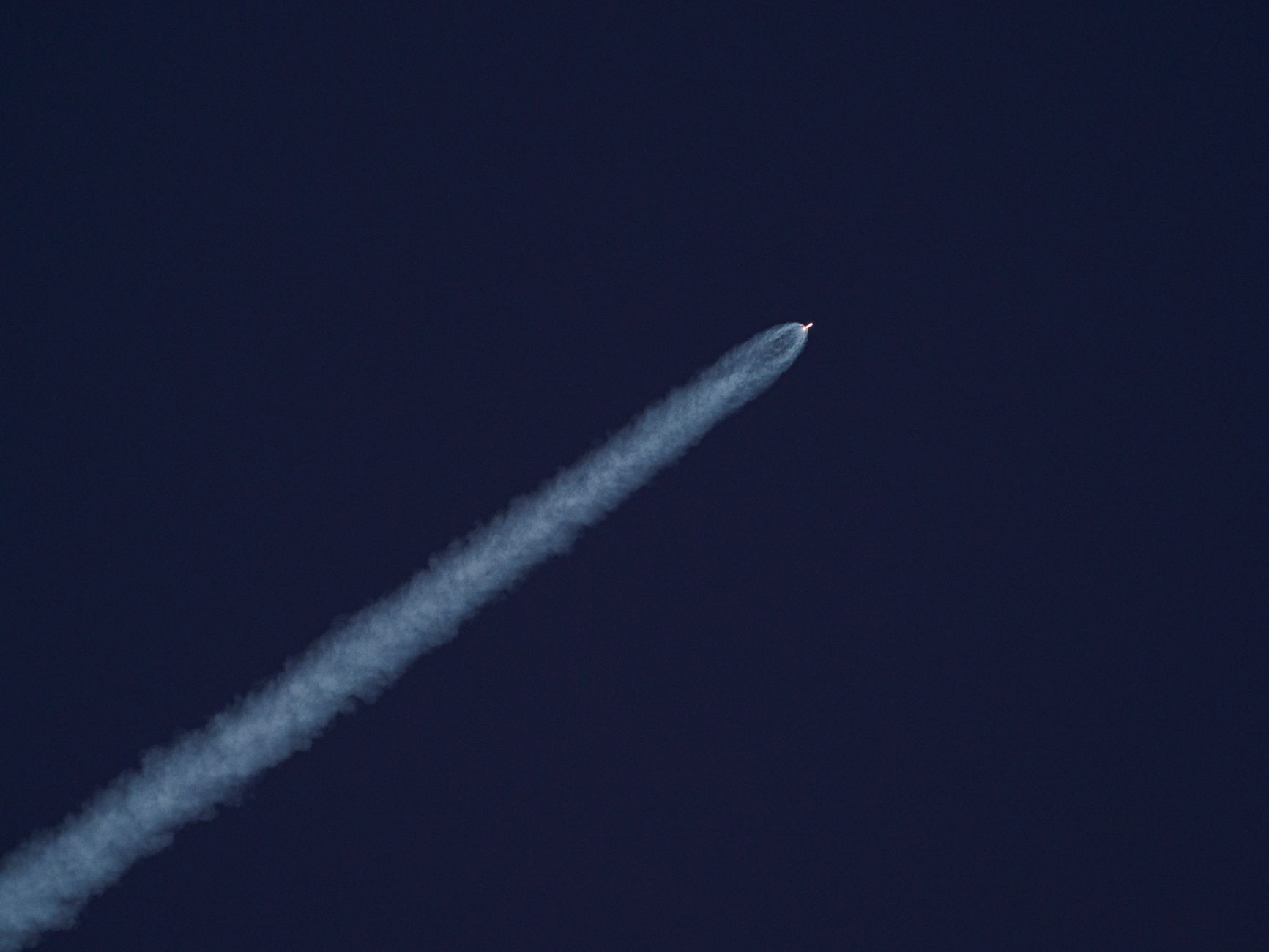
Tonight, a SpaceX Starlink mission is expected to generate a striking visual effect that some observers are calling a “space jellyfish.” The phenomenon occurs when sunlight catches the exhaust plume of a rocket during twilight or early‑morning conditions, creating an illuminated, jellyfish‑shaped cloud that can be seen from the ground.
How the “jellyfish” forms
When a Falcon 9 rocket lifts off, its exhaust contains water vapor that quickly cools as it ascends into the upper atmosphere. The drop in temperature causes the vapor to crystallize into tiny ice particles that trail behind the vehicle. If the launch takes place during evening twilight, the sun’s rays can strike these ice crystals roughly 40 seconds after liftoff, causing the plume to glow.
Depending on the time of day, the illuminated plume may appear white or take on a rainbow‑like iridescence. Morning launches tend to produce white‑colored “jellies,” while twilight launches can display a broader spectrum of colors. The resulting shape resembles an otherworldly jellyfish drifting against the darkening sky.
Tonight’s launch details
The upcoming mission, designated Starlink 17‑49, is scheduled for 8:00 PM PDT. The rocket will enter sunlight about 40 seconds after ignition, a timing that aligns with the conditions needed for a space jellyfish. The launch will be conducted from one of SpaceX’s two U.S. sites – either the Florida launch complex or the Southern California base – both of which have previously produced similar visual displays.
Space Jellyfish Alerts, a website that tracks the likelihood of such events, has indicated a strong chance that tonight’s launch will generate the effect. However, the site also cautions that local sky brightness, such as light pollution or moonlight, could reduce visibility for observers in California.
Context and recent SpaceX news
The anticipated visual display comes amid a busy week for SpaceX. On Tuesday, the company reported its first earnings update since its market debut in June, revealing a 92 % increase in revenue despite a $541 million loss in the second quarter. The following day, a fragment of a SpaceX rocket reportedly struck the Moon at high speed.
Wednesday also saw SpaceX’s share price fall nearly 14 % after the firm disclosed a substantial rise in spending on artificial‑intelligence initiatives. On Thursday, Elon Musk – SpaceX’s founder and the world’s first trillionaire – announced plans for “Terafab,” a joint Tesla‑SpaceX semiconductor megafactory in Grimes County, Texas, outside Houston. The first phase of the project is projected to cost $16.8 billion, and Musk described the venture on X as “stunningly beautiful” and likened it to a “sci‑fi city.”
In addition to the man‑made spectacle, Californians can also look forward to the annual Perseid meteor shower later this week, offering another natural night‑sky highlight.
For those hoping to catch a glimpse of the space jellyfish, experts recommend finding a location with minimal artificial lighting and keeping an eye on the sky shortly after the launch’s 8:00 PM PDT start time. Detailed, location‑specific predictions are available on the Space Jellyfish Alerts website.

Steve Lopez is a Senior Editorial Columnist and Health & Public Policy reporter for News Raise. Steve focuses on healthcare advancements, medical technologies, and public health policies.