Scientists have announced the discovery of the first known adult Tyrannosaurus rex trackway, a series of four massive footprints preserved in North Dakota. The find, detailed in the Journal of Vertebrate Paleontology, adds a rare behavioral snapshot to the extensive skeletal record of the iconic Cretaceous predator.
Discovery and Significance
The trackway was uncovered in 2025 by Kent Hups, a science teacher at Northglenn High School who also serves as an amateur fossil sleuth. Hups, listed as a co‑author on the study, described the find as a product of “curiosity, passion and careful observation.” The research team, which includes Tyler Lyson, senior curator of vertebrate paleontology at the Denver Museum of Nature & Science, emphasizes that footprints capture moments of movement that bones alone cannot reveal.
Prior to this discovery, only isolated T. rex footprints—unearthed in New Mexico and Montana—had been attributed to the species, and none represented a continuous adult trackway. The rarity of such evidence stems from the differing preservation requirements for tracks versus bones, as well as the tendency of tracks to be eroded or overwritten by later activity.
Trackway Details and Implications
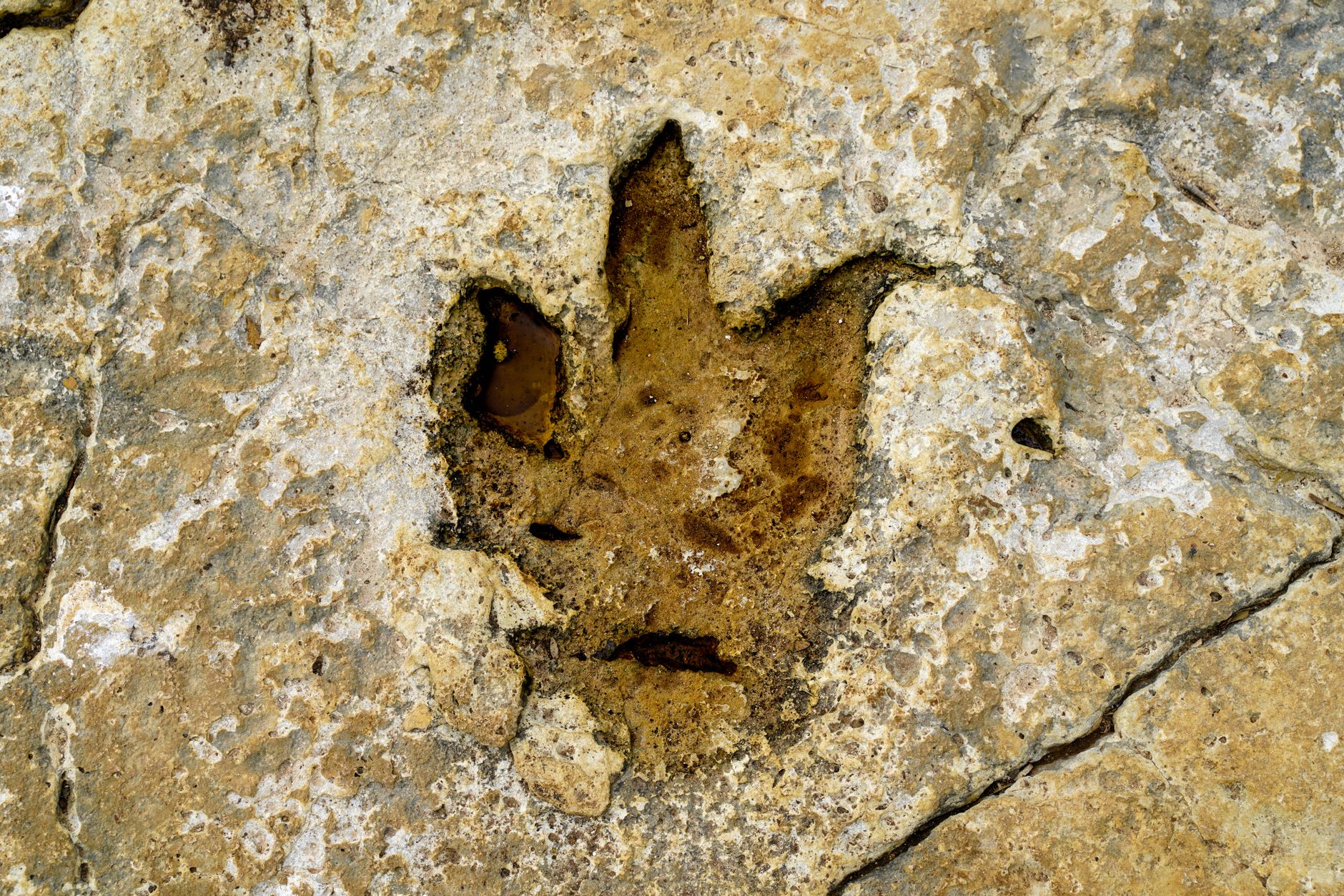
The newly documented path extends roughly 7 meters (23 feet) and contains four footprints, each about 1 meter (3.2 feet) long and up to 0.80 meters (2.6 feet) wide. The impressions are cemented by calcium carbonate, preserving their shape despite heavy weathering. Measured stride length averages around 4 meters (13.1 feet), leading the authors to calculate a walking speed of 1.5 to 2 meters per second (3.3 to 4.5 miles per hour). This pace is comparable to, though slightly faster than, average human walking speed, suggesting the animal was moving at a moderate, unhurried gait.
Based on the age of the surrounding sediment—estimated at 66.5 million years, just before the Chicxulub impact—and the size and morphology of the prints, the team concludes that an adult T. rex is the most plausible trackmaker. The study notes that even well‑preserved tridactyl (three‑toed) tracks can be difficult to assign definitively because of morphological similarities between large carnivorous theropods and some herbivorous ornithopods.
While the steep “gumbo” butte that overlays the site may limit further excavation, three of the footprints are slated for removal and transport to the Denver Museum of Nature & Science for conservation and display. The researchers also reference a 2014 PLOS ONE paper that described a trio of concurrent tracks made by smaller tyrannosaurids, hinting at possible group behavior among some members of the family.
Overall, the North Dakota trackway supplies a tangible link to the locomotion of one of the last non‑avian dinosaurs to roam the Earth, offering a rare glimpse into its daily life just before the mass extinction event that ended the Cretaceous period.

Steve Lopez is a Senior Editorial Columnist and Health & Public Policy reporter for News Raise. Steve focuses on healthcare advancements, medical technologies, and public health policies.