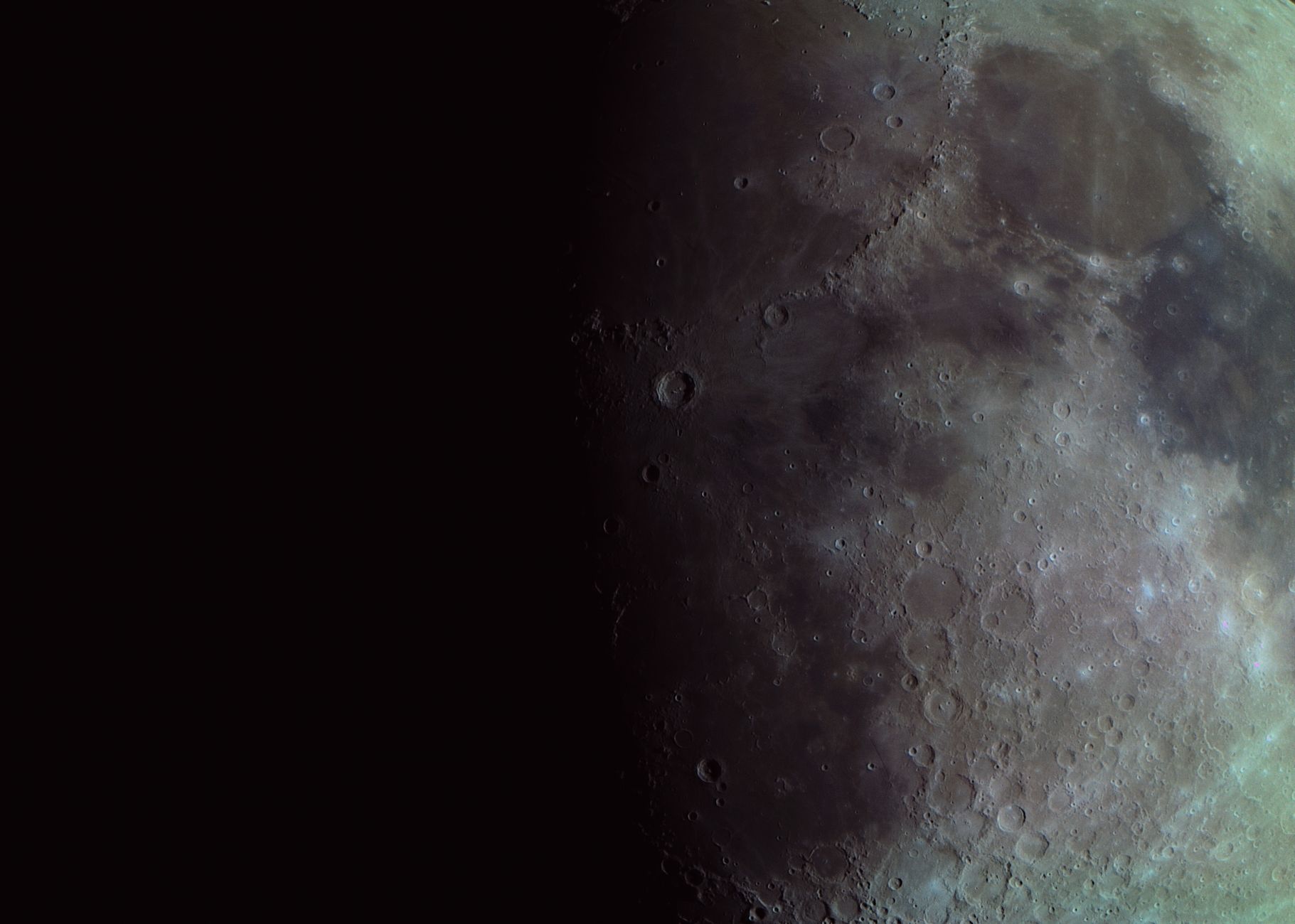
A bright, newly formed crater on the Moon’s eastern edge has been confirmed as the largest fresh impact ever recorded since systematic monitoring began. The feature, measuring about 728 feet (222 meters) across and 141 feet (43 meters) deep, was created by a space rock roughly the size of a three‑to‑six‑story building that struck between 11 April and 22 May 2024. Researchers first noticed the impact in images taken by NASA’s Lunar Reconnaissance Orbiter (LRO) and later named the formation McGetchin crater in honor of the late Apollo‑era scientist Dr. Thomas McGetchin.
Discovery of the McGetchin Crater
Although the impact occurred in early 2024, it went unnoticed until October 24 2025 when Robert Wagner, an image‑processing specialist at Intuitive Machines, was reviewing side‑by‑side LRO images that highlight unusual changes in brightness or darkness. Wagner recalled stopping his work to investigate the anomalous spot, describing it as “by far the most obvious impact debris pattern” he had ever seen. Subsequent analysis with the orbiter’s Narrow‑Angle Camera provided the high‑resolution data needed to measure the crater’s dimensions and assess the surrounding terrain.
Thermal observations from LRO’s Diviner instrument revealed a “cold spot” extending roughly four miles (6.4 kilometers) around the crater, where nighttime temperatures are about 16 °F (9 °C) cooler than adjacent areas. Lead author Tyler Powell of Johns Hopkins Applied Physics Laboratory explained that fresh impacts often generate such cold spots by disturbing the regolith, creating a fluffier surface layer that retains less heat.
Lunar Reconnaissance Orbiter’s Role
Launched in 2009, LRO has become a cornerstone of lunar science, employing seven instruments to map temperature, composition, topography and radiation. Orbiting at an altitude of about 60 miles (97 kilometers), the spacecraft’s cameras capture detailed imagery that enables scientists to track at least 1,000 new impact craters and 100,000 other surface changes, including landslides and crashed landers. Roughly 140 small craters—each about 30 feet (9 meters) wide—form annually from meteoroids roughly 43 inches (109 centimeters) across.
Mark Robinson, principal investigator for the LRO Camera and a co‑author of the study, expressed ongoing amazement at the orbiter’s output, noting that even after 17 years of operation, the data continue to reveal unexpected features. The team’s workflow involves software that flags any shift in lighting or shadows; each detection is manually reviewed to separate genuine impacts from false positives.
Implications for Future Exploration
Crater‑production models suggest an impact of this magnitude should occur on the Moon only once every 132 years, making McGetchin a statistically rare, “once‑in‑a‑lifetime” observation. Prior to this discovery, the largest contemporary lunar crater identified was about 230 feet (70 meters) in diameter. The event underscores that the Moon remains an active environment for impacts, a factor that must be considered as agencies like NASA develop long‑term human presence under the Artemis program.
Understanding the frequency and energy of such impacts helps refine risk assessments for future habitats, habitats, and infrastructure. Jeff Andrews‑Hanna of the University of Arizona, who was not involved in the study, likened the impactor’s size to the Chelyabinsk meteor that exploded over Russia in 2013. While an object of that size would cause limited damage on Earth, its direct strike on the lunar surface would be a noteworthy event for any nearby astronauts.
The discovery of McGetchin crater illustrates how continuous high‑resolution monitoring can capture transient geological processes on other worlds. As the LRO mission continues, scientists anticipate identifying additional fresh craters, each offering a natural laboratory for studying impact dynamics, regolith behavior, and the broader evolution of planetary surfaces.

Helene Elliott is the Lead Science & Space Reporter at News Raise. She reports on aerospace missions, astrophysics discoveries, quantum research, and environmental technology.