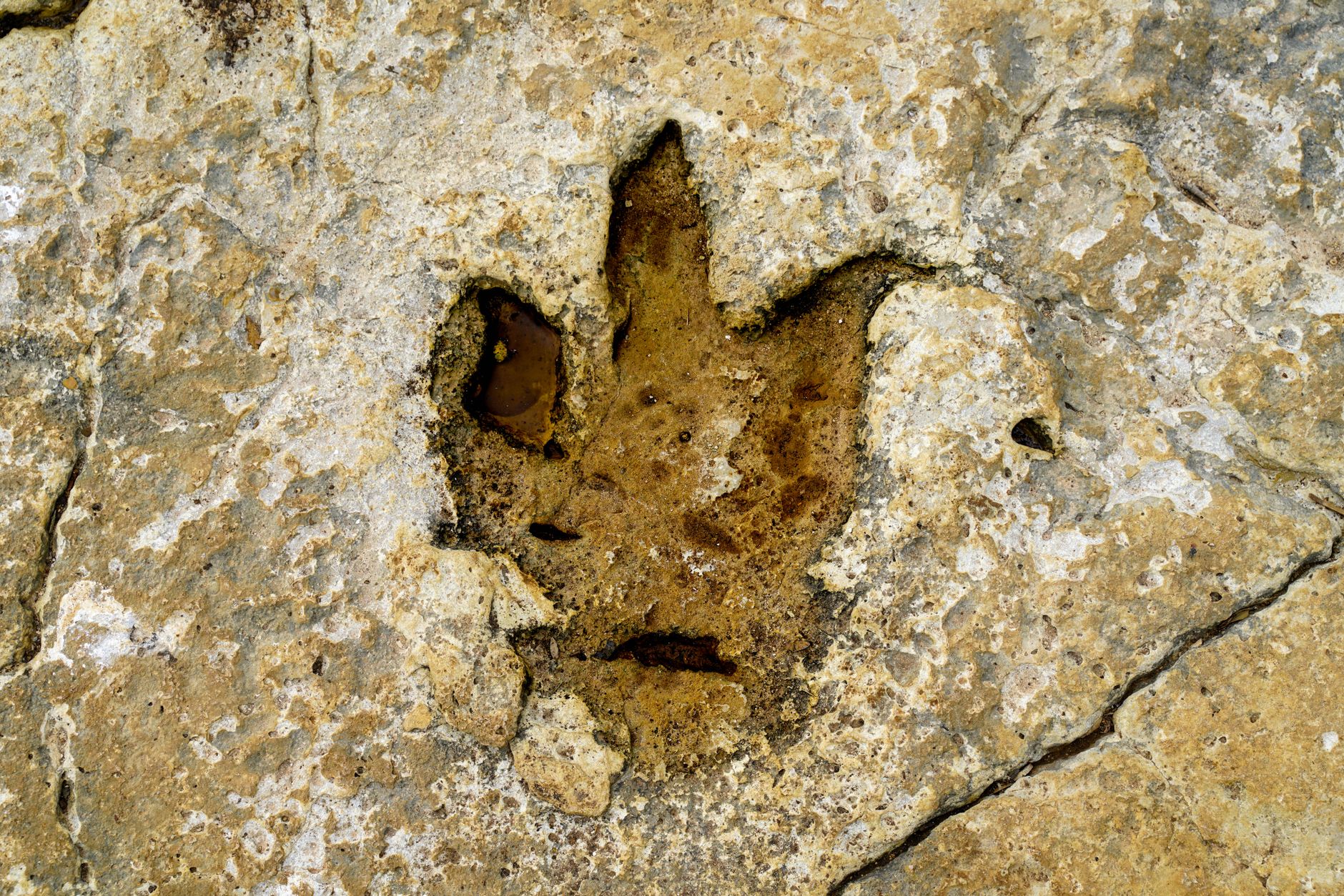
Paleontologists have identified the first known trackway created by an adult Tyrannosaurus rex, consisting of four three‑toed footprints preserved in the Upper Cretaceous Hell Creek Formation of North Dakota. The prints, found alongside T. rex bones, date to roughly 66.5 million years ago, placing the animal just half a million years before the Chicxulub impact that ended the age of dinosaurs.
Discovery and Preservation
While isolated juvenile T. rex prints have been reported, adult prints are exceedingly scarce because they are easily eroded or destroyed. The new trackway was uncovered by Tyler Larson and his research team while excavating in the Badlands. The footprints were preserved as natural casts: after the massive dinosaur pressed its feet into soft mud and sand, the depressions filled with sand that later cemented into calcium‑carbonate concretions. These harder casts survived while the surrounding mudstone and sandstone eroded away, leaving a clear, though partially cracked, record of the animal’s steps.
According to the researchers, the trackway stretches nearly 23 feet (7 meters). Each footprint measures about three feet (approximately 0.9 m) in length and 23–31 inches (0.6–0.8 m) in width. One print is slightly longer than the others, likely because the heavy animal sank into the soft sediment, causing the imprint to spread outward.
What the Tracks Reveal
Digital scans of the casts allowed the team to reconstruct the footprints in three dimensions, determining stride length, pace angle and overall gait. The animal covered roughly 13 feet (4 m) per stride and moved at an estimated speed of 5 to 6.5 feet per second (1.5–2 m s⁻¹). Such calculations are possible because trackways capture a living creature in motion, offering data on locomotor capabilities that skeletal remains alone cannot provide.
Larson emphasized the difficulty of linking tracks to specific species, noting that “footprints are not feet” and that sediment behavior can alter the final shape of an imprint. Nevertheless, the co‑occurrence of T. rex bones, the size of the prints, and the distinctive three‑toed morphology strongly support an adult T. rex as the trackmaker. No other theropod of comparable size inhabited North America during the Late Cretaceous, reinforcing this identification.
Prior to this find, only a single isolated footprint in New Mexico had been tentatively assigned to T. rex, and another three‑toed print preserved in siderite from the same formation remained unconfirmed because its largest toe was missing. The new trackway therefore represents the most complete adult T. rex locomotion evidence yet discovered.
Implications and Future Work
The discovery adds a critical data point for understanding how the apex predator moved across its environment. It also provides a rare glimpse into the behavior of a creature that lived just before the mass extinction event. The researchers note that additional excavation could expose more of the trackway and potentially reveal finer details of foot anatomy or locomotor patterns. However, a substantial overburden of rock above the site may limit further digging.
Future studies may compare these findings with tracks of contemporary herbivores such as Edmontosaurus, a hadrosaur that also walked on three toes but produced markedly smaller prints. By contrasting the footprints of predator and prey, scientists hope to refine models of Cretaceous ecosystems and the dynamics that governed them.
Overall, the North Dakota trackway underscores the value of ichnofossils—trace fossils that capture a moment of life—as complementary evidence to skeletal remains, enriching our picture of the iconic Tyrannosaurus rex.

Steve Lopez is a Senior Editorial Columnist and Health & Public Policy reporter for News Raise. Steve focuses on healthcare advancements, medical technologies, and public health policies.