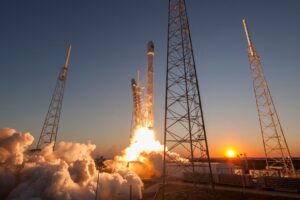
On October 1, SpaceX flew its Transporter‑18 rideshare mission from California’s Vandenberg Space Force Base, sending 130 payloads into low‑Earth orbit. Among the manifest was a prototype satellite for Google’s Project Suncatcher, an artificial‑intelligence constellation the company plans to operate in orbit. The launch occurred at 2:32 p.m. EDT (18:32 GMT), cutting through the typical coastal fog that blankets the launch site.
The Falcon 9’s first stage completed a controlled return to Vandenberg about 7½ minutes after liftoff, marking the booster’s 25th flight and landing safely on the ground pad. The upper stage then ignited to place the payload stack into a low‑Earth orbit, beginning an 11‑minute deployment window that started roughly 54.5 minutes after liftoff.
Google’s Project Suncatcher Pathfinder
The most high‑profile payload on Transporter‑18 was a pathfinder spacecraft for Project Suncatcher. The satellite’s purpose is to evaluate how Google’s tensor processing units (TPUs)—the core computing hardware for the AI constellation—perform in the space environment. Specific performance metrics include the TPUs’ resistance to space radiation and the efficiency of heat dissipation generated by the chips. Data gathered by the pathfinder will inform the design of the full Suncatcher network, which aims to provide AI‑driven services from orbit.
Other AI‑Focused and Servicing Satellites
Transporter‑18 also carried Cowboy Space’s Reason‑1 satellite, which is intended to demonstrate power‑beaming technology. In a September 28 post on X, Cowboy Space explained that Reason‑1 will test the use of a high‑power laser to transmit energy from low‑Earth orbit to a ground‑based receiver, a capability it describes as essential for future space‑based data centers.
In addition, Starfish Space launched its first Otter servicing satellite. The Washington‑based firm announced on September 24 that the Otter vehicle represents a “big moment” for the company, reflecting years of development aimed at affordable and readily available satellite servicing. The Otter is expected to perform on‑orbit servicing tasks for customers, expanding the emerging market for satellite maintenance.
Payload Mix and Broader Launch Context
The remaining payloads on the manifest were a heterogeneous collection of cubesats, microsats, hosted payloads, two spacecraft equipped with re‑entry vehicles, and four orbital transfer vehicles. The latter group carried 41 of the payloads for later deployment, extending the mission’s operational timeline beyond the initial 11‑minute window.
While Transporter‑18 did not break SpaceX’s record for the most payloads launched on a single flight, it approached the benchmark of 143 payloads set by the company’s Transporter‑1 mission in January 2021. The day was especially busy for SpaceX: earlier that morning the company launched the Crew‑13 astronaut mission for NASA from Florida’s Space Coast, and it plans to loft the NROL‑97 national‑reconnaissance payload for the U.S. National Reconnaissance Office later that night on a Falcon Heavy.
Overall, the successful launch and booster recovery demonstrated SpaceX’s continued ability to provide flexible rideshare services for a wide range of customers, from large tech firms testing AI hardware in space to emerging satellite‑servicing startups seeking to validate new capabilities.

Helene Elliott is the Lead Science & Space Reporter at News Raise. She reports on aerospace missions, astrophysics discoveries, quantum research, and environmental technology.