In a seminar held on November 3, the LHCb Collaboration at CERN presented evidence for an exceptionally rare particle decay that has eluded detection for more than four decades. The decay involves a neutral Bd meson, composed of a beauty (bottom) quark and a down antiquark, transforming into a pair of muons—one muon and one antimuon. According to the preprint released on arXiv, the observation reaches a statistical significance of 3.2 sigma, corresponding to roughly a 0.3 % probability that the result is a statistical fluke.
Rare Decay Observed
The Bd → μ⁺μ⁻ transition is predicted to occur only once in about ten billion decays of the meson, a frequency far lower than the odds of winning a lottery. Detecting it required the Large Hadron Collider beauty (LHCb) experiment to collect data over multiple runs, combining fresh data from 2024 and 2025 with earlier records gathered between 2011 and 2018. The collaboration attributes the breakthrough to a recent upgrade that dramatically increased the collision detection rate and the use of machine‑learning algorithms that improve the signal‑to‑noise ratio for such scarce events.
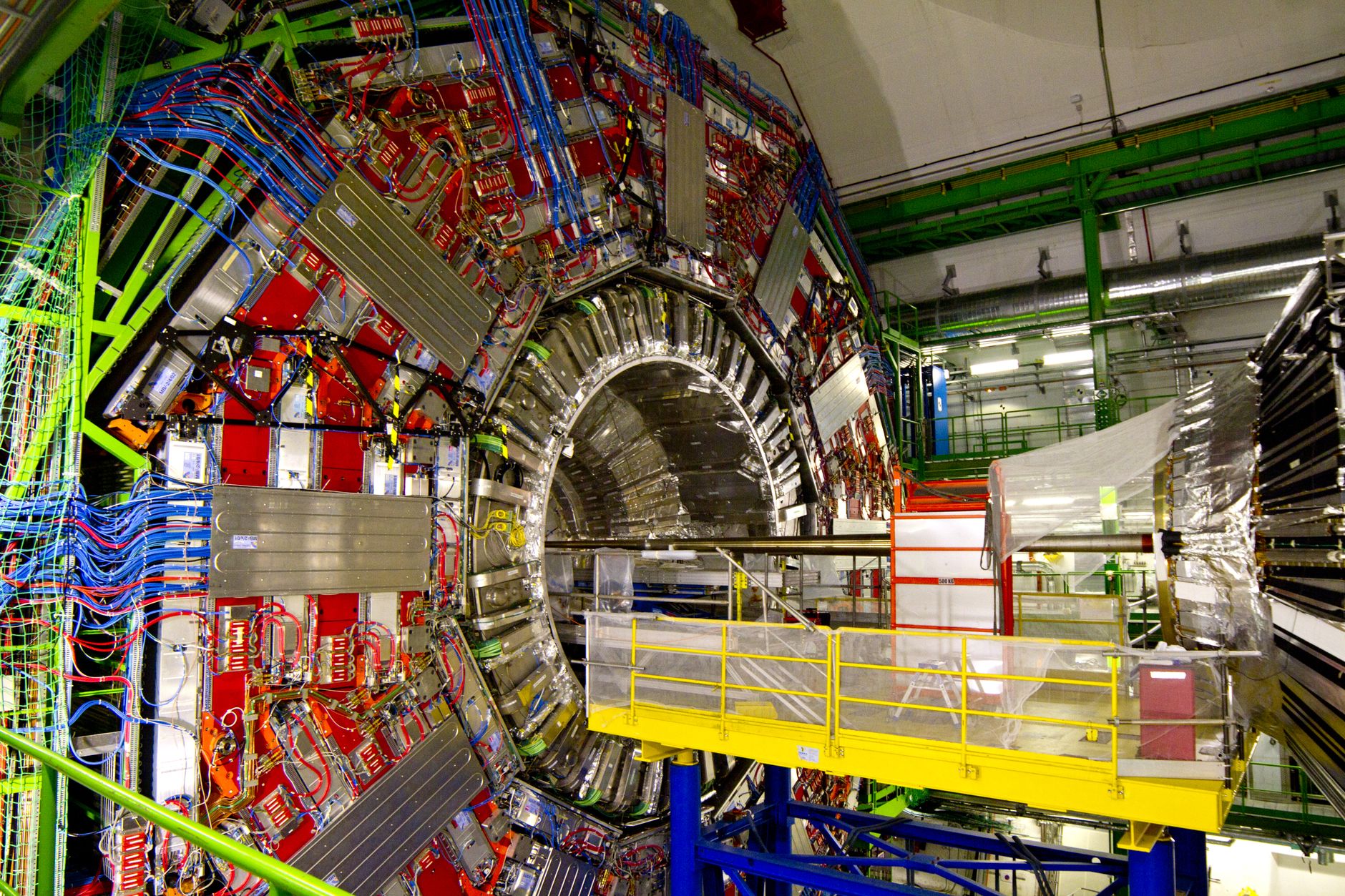
The decay was captured using LHCb’s high‑precision VELO (Vertex Locator) sub‑detector, positioned less than a finger’s width from the circulating proton beams. This proximity enables the instrument to track the fleeting products of near‑light‑speed collisions, where beauty quarks are produced in the spray of particles that follows each proton‑proton impact. The Bd mesons themselves exist for only about 1.5 × 10⁻¹² seconds before decaying, and only one in ten billion of those decays yields the muon pair that the experiment was designed to spot.
Implications and Future Work
Niladri Sahoo, a particle physicist at the University of Birmingham and convener of the LHCb Very Rare Decays working group, described the result as “a powerful new test of the Standard Model and a window into potential new physics.” While the measured decay rate aligns with Standard Model predictions, the observation tightens constraints on possible contributions from physics beyond the model at energy scales beyond the direct reach of the LHC.
Harry Cliff, a particle physicist at the University of Cambridge and leader of the analysis team, expressed enthusiasm, saying, “Seeing clear evidence for this rarest decay for the first time was thrilling. We’re knocking on the door of the zeptoverse now.” The term “zeptoverse” refers to a hypothesized realm of particles and forces operating at zeptometer scales—far smaller than the dimensions probed by everyday matter.
Although the 3.2‑sigma result is compelling, the particle‑physics community typically requires a 5‑sigma significance—equivalent to a one‑in‑3.5‑million chance of a statistical fluctuation—to claim a discovery. Achieving that benchmark will depend on future upgrades slated for the 2030s, which aim to increase the LHC’s collision rate by an order of magnitude and further enhance data‑collection capabilities.
In summary, the LHCb collaboration’s findings provide the first experimental evidence for the Bd → μ⁺μ⁻ decay, a milestone that both confirms Standard Model expectations and sharpens the search for new phenomena lurking in the ultra‑small “zeptoverse.” The result underscores the value of indirect searches—examining subtle variations in decay rates—alongside direct searches for new particles, echoing past breakthroughs such as the discoveries of the charm and top quarks.

Norman Pearlstine is the Executive Editor and Co-Founder at News Raise. With over two decades of experience across financial journalism, corporate governance, and market analysis, Norman leads the editorial direction and ensures strict adherence to journalistic accuracy and ethics.