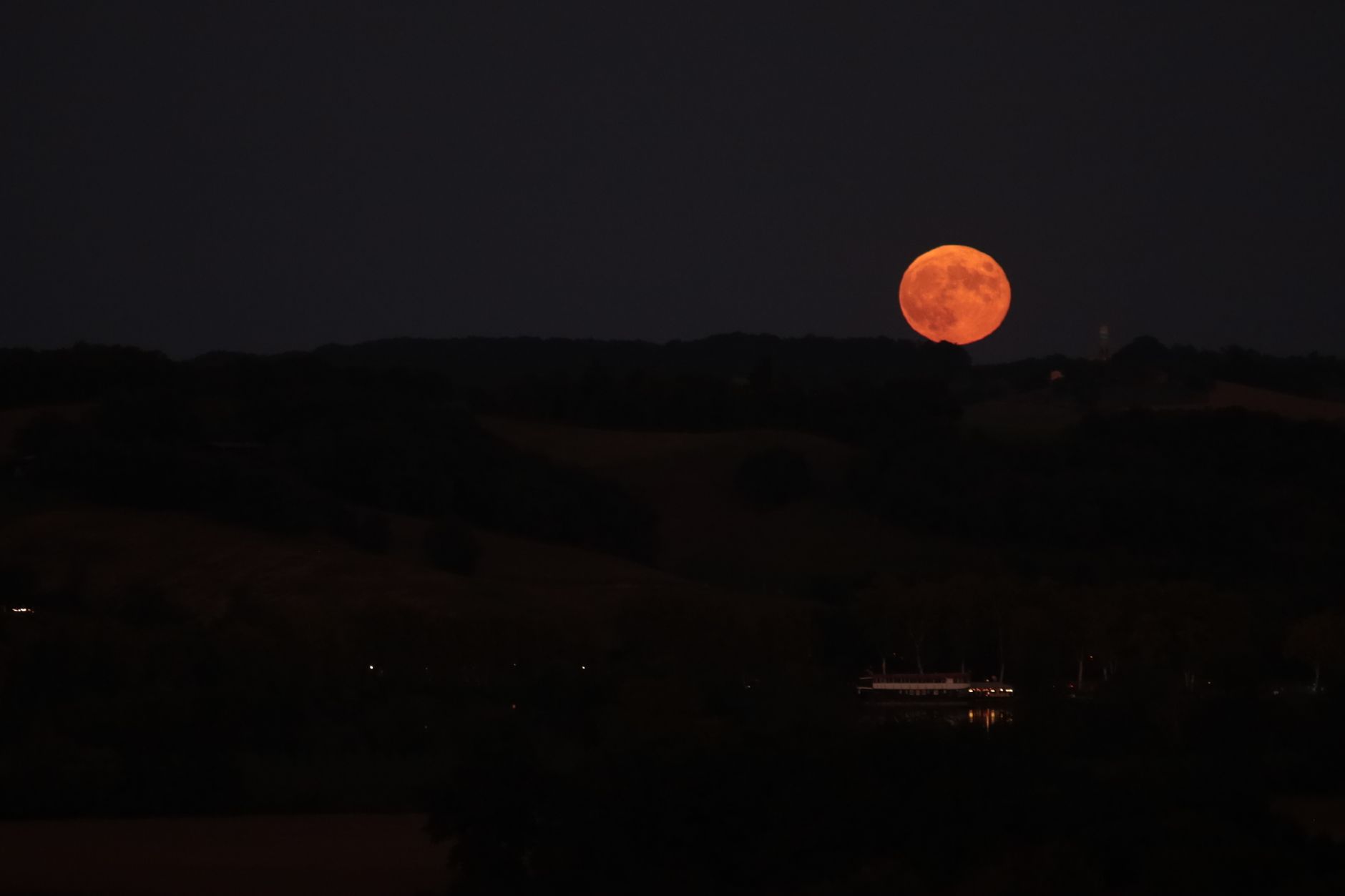
The full moon that rose on November 24, 2026, was billed as a supermoon and carried the traditional name “Beaver Moon.” The moniker reflects the time of year when beavers ready their lodges for winter and trappers historically set beaver traps before waterways froze. Because the moon was near the point in its 27‑day elliptical orbit where it passes closest to Earth, observers reported a noticeably larger and brighter disk climbing high in the autumn sky.
Photographers around the globe capture the event
Photographers from several continents submitted images that illustrate how the supermoon illuminated diverse landscapes. In Chiang Mai, Thailand, Pongmanat Tasiri photographed the moon rising above the roof of Wat Phra That Doi Suthep Buddhist temple, highlighting the cratered surface against a dark sky. Across the Pacific, Gary Hershorn captured two New York City scenes: a full yellow moon cresting the Chrysler Building and a later shot of the lunar disk glowing between the concrete canyon of 42nd Street just before moonset on the morning of Nov. 24.
In Europe, Space.com Skywatching Editor Daisy Dobrijevic used a Sony A7IV with a Tamron 50‑400 mm lens to photograph an almost‑full Beaver Moon over Nottingham, United Kingdom, on Nov. 23. She described heading out a day early after a disappointing forecast, finding the moon nestled between two houses and securing a clear close‑up. Aris Oikonomou snapped a striking image of the moon above the Parthenon in Athens as night fell over the Acropolis, while David Ake photographed the lunar disk over the Old Post Office Pavilion in Washington, D.C., with a pink sky and autumn foliage providing a colorful backdrop.
North America contributed several iconic skyline shots. Mert Alper Dervis captured the moon rising over Toronto, with a flock of birds crossing the foreground and the lunar surface appearing subtly warped by atmospheric refraction. Allen Berman photographed the moon hanging low over Los Angeles on Nov. 24 after positioning himself on a neighbor’s front lawn in Baldwin Hills; thin clouds over distant mountains added a “magical” quality to the scene.
Further east, Salih Zeki Fazlioglu recorded the Beaver Moon illuminating a thin veil of clouds above Istanbul, Turkey, where reflected sunlight competed with the city’s artificial glow. In Hungary, Robert Nemeti took a moody shot of the moon climbing above the medieval Boldogkő Castle, pondering how many full moons the fortress has witnessed. Wang Zhao in Beijing, China, used a powerful telephoto lens to capture a passenger jet’s contrail crossing the lunar disk, while Karar Essa photographed the moon between the minarets of the Imam Ali Shrine in Najaf, Iraq, with the 53‑mile‑wide Tycho crater visible near the lunar equator.
Astronaut documents the moon from orbit
NASA astronaut Anil Menon shared a series of images taken from the International Space Station on Nov. 24. The photos show the full moon slipping below Earth’s horizon, its outline distorted by atmospheric refraction. Menon noted that the pictures were taken with a 400 mm lens and were posted on X without any edits.
What’s next for supermoons in 2026?
The November supermoon marked the opening of a four‑event series. The final supermoon of 2026 is expected on Dec. 23, when the moon will pass just 221,668 miles (356,740 km) from Earth, making it the closest full moon of the year. Space.com invites readers to submit their own supermoon photographs and offers a guide to the best cameras and lenses for astrophotography.

Steve Lopez is a Senior Editorial Columnist and Health & Public Policy reporter for News Raise. Steve focuses on healthcare advancements, medical technologies, and public health policies.