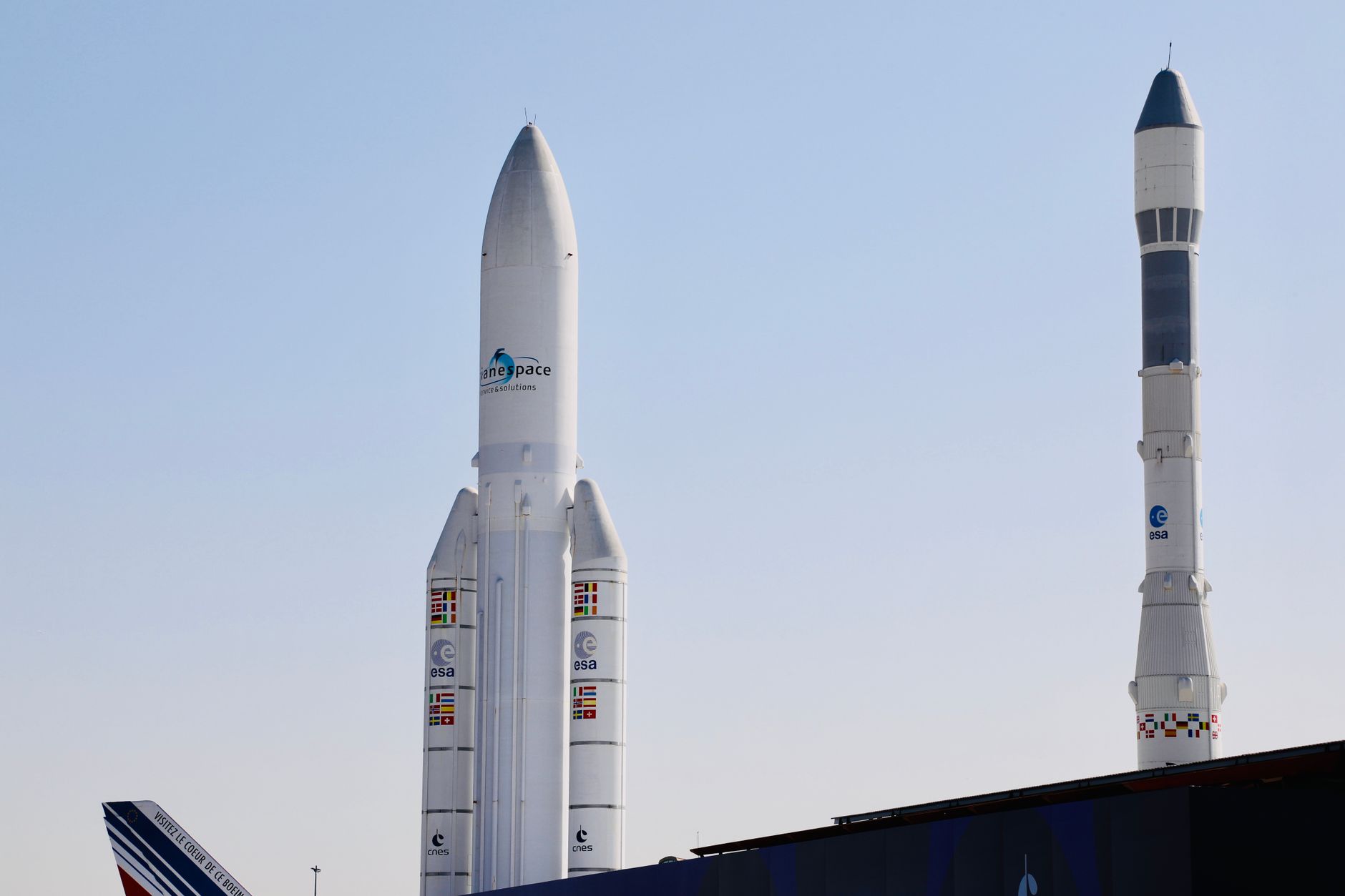
Europe’s heavy-lift rocket, Ariane 6, successfully launched 36 satellites for Amazon’s Leo constellation on June 17, setting a new European record for the most cargo sent to orbit in a single launch. The mission, designated VA269, lifted off from Europe’s Spaceport in French Guiana at 09:21 local time.
Upgraded Boosters Enhance Performance
The launch featured the debut of four new boosters based on the P160C solid-propellant rocket motor. These upgraded boosters each hold 14 tonnes more propellant than their predecessors, significantly increasing the rocket’s performance. This enhanced capability allowed for the delivery of 36 Leo satellites in one mission, an increase from previous Ariane 6 launches carrying Leo satellites. The P160C-based boosters can boost Ariane 6’s performance by 10% to 15%, depending on the target orbit.
The P160C motor itself is 14.5 meters tall and contains 156 tonnes of propellant. While it is a meter taller than the P120C motor, this does not impact its integration with Ariane 6’s central core or the overall height of the booster assembly. The motors used in Ariane 6’s boosters are also utilized on ESA’s smaller Vega-C rocket, a technological synergy designed to reduce costs and improve the supply chain for more frequent launches.
New European Payload Record
This mission marks the most powerful version of Ariane 6 launched to date and establishes a new weight record for cargo delivered to space by a European launcher. The previous record was held by Ariane 5 in 2013 during a mission for the European Space Agency’s International Space Station supply vehicle, ATV Albert Einstein.
Josef Aschbacher, ESA’s Director General, highlighted the rocket’s proven versatility. “Ariane 6 has proven itself yet again, cementing its versatility as a launcher that can deliver all types of missions to all orbits, giving us more confidence and possibilities for Europe’s autonomous access to space,” Aschbacher stated. He also noted Ariane 6’s modular design and the potential for further evolutions.
Géraldine Naja, ESA’s Director of Space Transportation, expressed pride in the achievement. “What an amazing experience – as well as a great pride – to witness the most powerful launch in Europe’s history,” she said. “It is a remarkable demonstration of European engineering excellence and of the teams constantly working to deliver and improve.”
European Collaboration Drives Development
The development of the P160C booster was a collaborative effort, with Europropulsion developing the motor under contract from ArianeGroup and Avio, the entities responsible for Ariane 6 and Vega launcher systems for ESA. The components of the boosters involve manufacturing across Europe, with structural elements produced in Italy, the engine nozzle in France, and the igniter in Norway. Fuel loading and final assembly of the boosters for Ariane 6 take place at Europe’s Spaceport in French Guiana.
Ariane 6’s development is presented as a prime example of European cooperation, involving an industrial network across 13 European countries. ArianeGroup leads as the prime contractor and design authority, while the French space agency CNES manages range operations in French Guiana. Arianespace served as the launch service provider for this specific mission to Amazon.

Steve Lopez is a Senior Editorial Columnist and Health & Public Policy reporter for News Raise. Steve focuses on healthcare advancements, medical technologies, and public health policies.