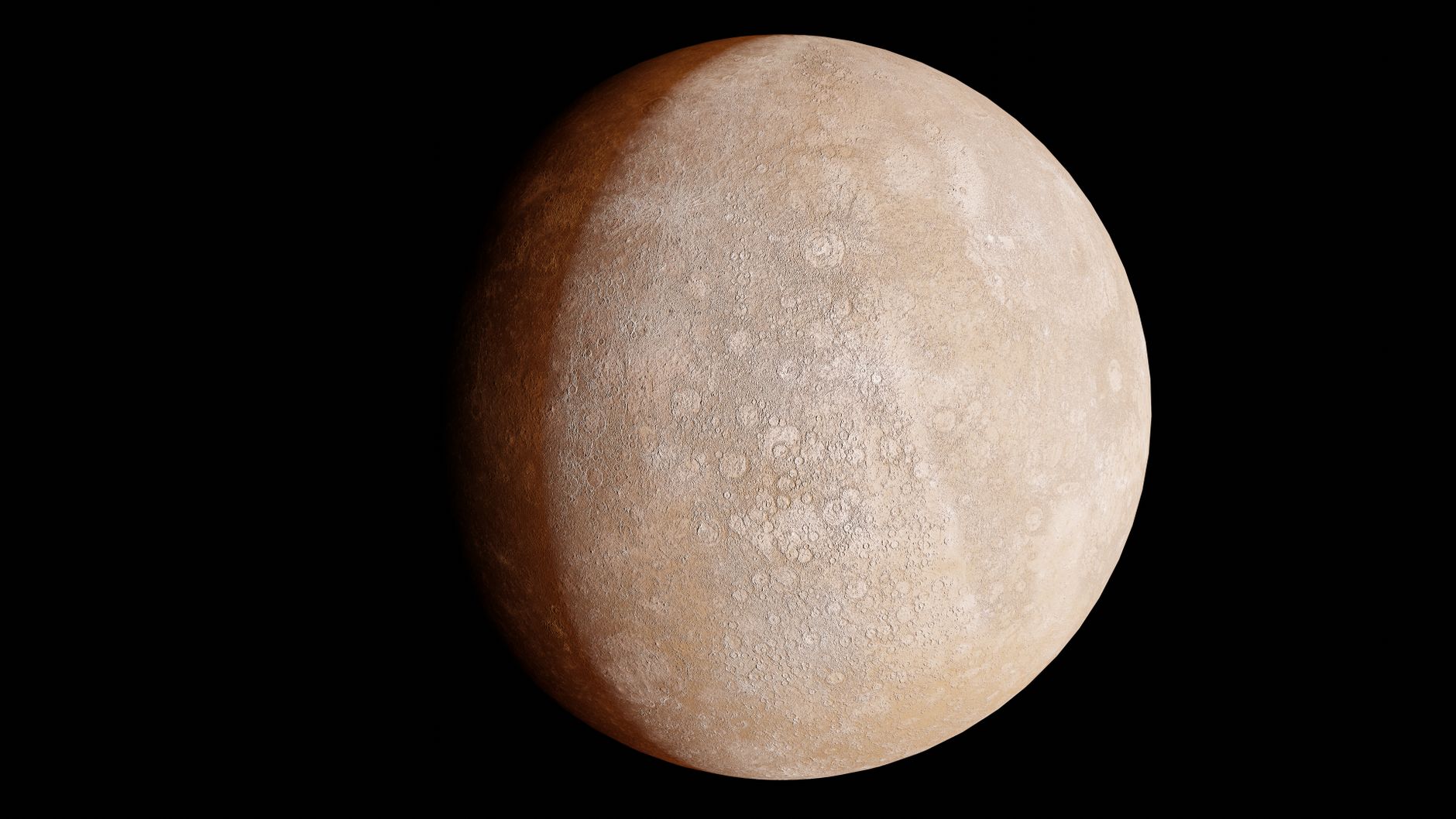
Mercury, the smallest planet in the inner solar system, is about one‑third the diameter of Earth, with a radius of 1,516 miles (2,440 km). After more than eight years in transit, the joint European Space Agency (ESA) and Japan Aerospace Exploration Agency (JAXA) BepiColombo spacecraft are poised to begin a new era of exploration. On September 3, the mission will perform a critical separation maneuver, detaching its scientific payload from the carrier that has brought it from Earth.
Previous Mercury Missions
Mercury has been visited only twice before. NASA’s Mariner 10 performed three rapid flybys in 1974 and 1975, delivering the first close‑up images of the planet’s cratered surface and confirming the existence of a thin exosphere and a magnetic field. Decades later, NASA’s MESSENGER entered orbit in 2011, with planetary scientist Sean Solomon of Columbia University serving as principal investigator. MESSENGER mapped the entire surface, descended to an altitude of just 15.5 miles (24.9 km), and identified bright, steep‑sided depressions known as “hollows.” It also detected higher abundances of volatile elements than on Earth, measured an unusually offset magnetic field, and highlighted a data gap over Mercury’s southern hemisphere.
Despite these achievements, many questions remain. Solomon notes that “the jury’s still out on exactly how Mercury got assembled,” and MESSENGER’s orbital geometry left the planet’s southern regions less well characterized.
BepiColombo’s Dual Probes
The BepiColombo mission comprises two distinct orbiters that will operate independently yet in concert. Europe’s Mercury Planetary Orbiter (MPO) carries eleven scientific instruments designed to map the planet’s topography, crustal composition, gravity field, hollows, and volcanic deposits. It will also study how solar‑origin charged particles interact with Mercury’s surface.
Japan’s Mercury Magnetospheric Orbiter, named Mio, focuses on the planet’s surrounding environment. Its payload will investigate the magnetosphere, the tenuous exosphere, and the dust population in Mercury’s neighborhood. Both spacecraft are equipped with magnetometers, enabling simultaneous measurements of different regions of Mercury’s magnetic field—a capability that surpasses the single‑point data gathered by earlier missions.
During the long cruise, BepiColombo completed six rapid flybys of Mercury, allowing a handful of instruments to collect preliminary data. However, the majority of the scientific suite was stowed for the journey and will become operational only after the MPO and Mio separate, an event expected in December.
Anticipated Science and Goals
Scientists expect a surge of new results once the orbiters settle into their respective trajectories, a sentiment echoed by Solomon: “There is a growing literature of new results that have come from the BepiColombo flybys, but I expect that will explode once they go into orbit.” A primary objective is to obtain high‑resolution observations of Mercury’s southern hemisphere, including the search for water‑ice deposits in permanently shadowed craters. Detecting such ice would fill a critical gap left by MESSENGER’s northern‑biased data set.
Planetary geologist Rachel Klima of the Johns Hopkins University Applied Physics Laboratory emphasizes the importance of MPO’s mineral‑mapping capability. Unlike MESSENGER, which relied on iron‑rich signatures, MPO employs technology able to analyze rocks without iron, potentially revealing new insights into Mercury’s formation and, by extension, the early solar system. Klima adds, “It certainly doesn’t get the love and attention that Mars and Venus and everywhere else gets,” expressing hope that BepiColombo will raise the profile of the overlooked world.
By April 2027, both orbiters are slated to be fully operational, delivering coordinated data sets that will address long‑standing mysteries about Mercury’s geology, magnetic field, exosphere, and possible ice reservoirs. The mission stands as the most comprehensive effort yet to decode the innermost planet.

Norman Pearlstine is the Executive Editor and Co-Founder at News Raise. With over two decades of experience across financial journalism, corporate governance, and market analysis, Norman leads the editorial direction and ensures strict adherence to journalistic accuracy and ethics.