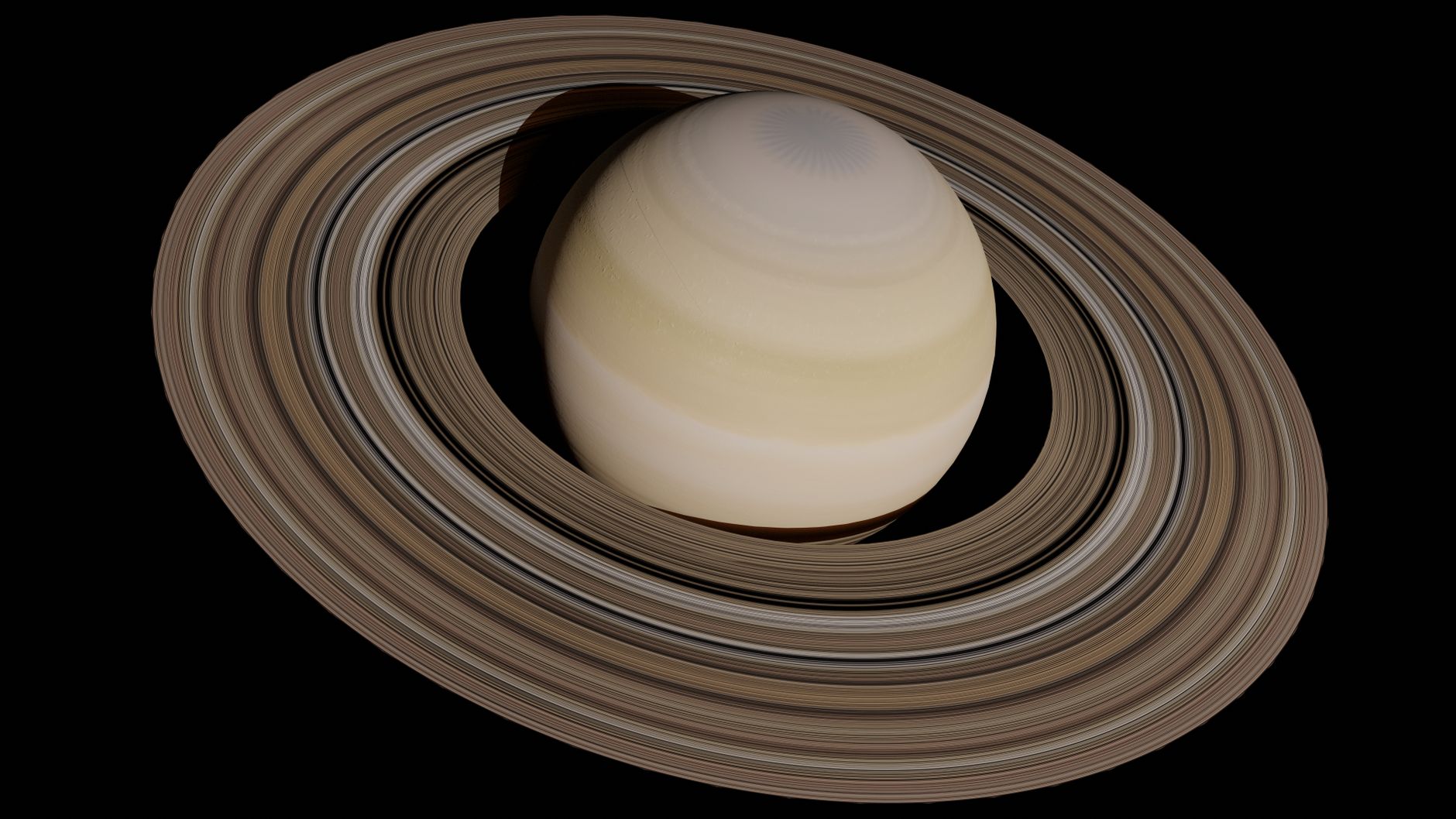
NASA and a multinational research team announced this week that the Hubble Space Telescope has confirmed the presence of a giant, regular ten‑sided atmospheric wave—known as a decagon—encircling Saturn’s south pole. The finding, led by Agustín Sánchez‑Lavega of the University of the Basque Country, appears in the September 2 issue of Science Advances. It represents the first large geometric jet pattern identified in the planet’s southern hemisphere.
North‑pole hexagon versus south‑pole decagon
Saturn’s north pole has been famous since the Voyager flybys of the early 1980s for its persistent hexagonal jet stream, a six‑sided structure wider than two Earths that has remained stable for more than four decades. In contrast, the south pole, observed in detail by the Cassini spacecraft from 2004 to 2017, showed only a massive hurricane‑like vortex at its center and ordinary circular bands, with no polygonal shape. Researchers therefore regarded the northern hexagon as a unique, perhaps isolated, atmospheric phenomenon.
How the decagon was discovered
Saturn completes an orbit around the Sun every 29.5 Earth years, causing its seasonal tilt to shift slowly. During most of Cassini’s mission and the years that followed, the south pole was angled away from Earth, plunging into a prolonged winter that limited visibility. As the planet entered a new season, the pole tilted back toward Earth, allowing fresh observations. In 2024, amateur astronomers contributing images to a Planetary Virtual Observatory noticed an unusual undulating band near the pole. By 2025, combined observations from Australia and France clarified the pattern as a clear ten‑sided shape. High‑resolution Hubble images later confirmed the decagon and, when the archive was examined, traced its earliest appearance to 2023—none of the earlier Hubble data or any of Cassini’s 13 years of close‑up monitoring recorded it.
Characteristics and significance
The decagon rides an eastward jet stream between roughly 58° and 63° south latitude, threading through multiple atmospheric layers. Unlike the stationary hexagon that is locked to Saturn’s rotation, the decagon drifts eastward and appears to be strengthening, indicating a younger, evolving structure. Just north of the polygon lies a 4,000‑kilometer anticyclone the researchers have named a “Red Spot,” a smaller analogue of Jupiter’s famed storm. Simulations suggest that this vortex may play a role in shaping the decagonal wave.
The absence of any polygon in Cassini’s extensive maps of the south pole provides a critical baseline: the decagon must have formed after the spacecraft’s departure in 2017. Its emergence highlights the dynamic and rapidly changing nature of Saturn’s atmosphere, offering a rare opportunity to observe a large‑scale polar pattern in the act of formation. Ongoing observations will determine whether the decagon will settle into a long‑lasting configuration similar to the northern hexagon or dissipate back into the surrounding jet stream.
Saturn now appears to host geometric storms at both poles—six sides on the north, ten on the south—visible from Earth only once every 29‑year orbital cycle. The discovery underscores how planetary weather can evolve on timescales that outpace even a dedicated spacecraft mission.

Helene Elliott is the Lead Science & Space Reporter at News Raise. She reports on aerospace missions, astrophysics discoveries, quantum research, and environmental technology.