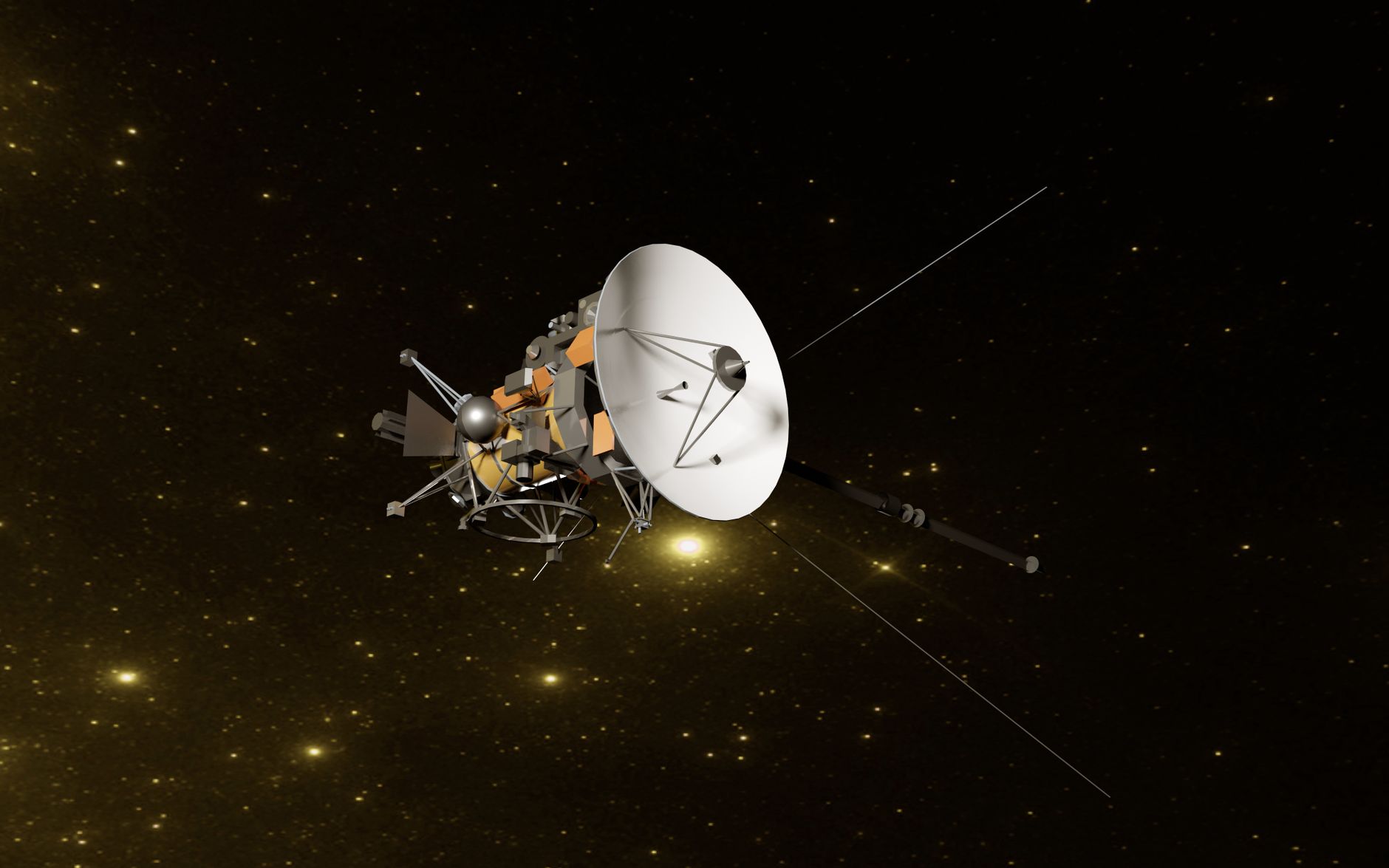
At 5:16 a.m. EST tomorrow, NASA’s Voyager 1 will cross the one‑light‑day threshold, placing it roughly 25.9 billion kilometres from Earth. A radio signal traveling at light speed will therefore require a full 24 hours to reach the probe, establishing a new distance record for any object built by humans.
A Milestone in Human Spaceflight
Voyager 1 has been journeying away from our planet for more than 49 years. Anthropologist Deana Weibel of Grand Valley State University notes that “it has taken longer than half of a typical human lifespan to reach that distance — so on that level it’s amazing.” She adds that the spacecraft is still only a tiny fraction of the way to the nearest star beyond the Sun, Proxima Centauri, which lies about 4.2 light‑years (over 1,500 light‑days) away.
Both Voyager 1 and its twin, Voyager 2, launched in 1977 to explore the outer planets. After successful fly‑bys of Jupiter, Saturn, Uranus and Neptune, the probes exited the heliosphere—the Sun’s protective bubble—years ago and now travel through interstellar space, where temperatures hover near –80 °C. Their radioisotope thermoelectric generators, powered by plutonium, are gradually losing output, forcing mission controllers to switch off many scientific instruments to conserve power.
Current projections indicate that Voyager 1 will lose communications with Earth in 2029, with Voyager 2 following in 2031 when their power supplies finally cease.
Voyager’s Ongoing Scientific Legacy
Even with a dwindling instrument suite, the Voyagers continue to deliver the only direct measurements of interstellar space ever obtained. They monitor the region between stars, capturing data on particle storms that emanate from the Sun and propagate far beyond the heliosphere. Between 1979 and 1989, the missions reshaped scientific understanding of the Solar System, discovering volcanic activity on Jupiter’s moon Io—the first known volcanism beyond Earth—and identifying a fractured water‑ice crust on Europa that suggests a subsurface ocean.
Voyager 1 travels faster than its sister craft and crossed the heliopause in 2012; Voyager 2 made the same transition six years later. In interstellar space, the probes have recorded how solar material can breach the heliosphere, generating shockwaves that alter magnetic fields, energetic particle populations, and other plasma conditions. For example, an incoming pressure front around 2020 caused magnetic field strengths near the spacecraft to surge dramatically before declining six years later, a pattern researchers are still trying to explain.
“I think people didn’t quite anticipate how far out these influences could be felt,” says Jamie Rankin, a space physicist at Princeton University and the Voyagers’ deputy project scientist. He suggests that stars other than the Sun may also shape the interstellar medium more extensively than previously thought, opening new avenues for astrophysical research.
Looking Ahead: Power Limits and Future Discoveries
As Voyager 1 approaches the one‑light‑day milestone, it underscores both the longevity of the spacecraft and the limits imposed by its aging power source. The probe’s remaining instruments will continue to relay data on magnetic fields, particle densities and other interstellar phenomena until communications cease, likely in 2029. Even after the signal is lost, the wealth of information already gathered will inform models of the Sun’s influence on the galaxy and guide the design of future deep‑space missions.
The achievement marks a profound moment in human exploration: a machine built on Earth now sits a full day’s light‑travel time away, venturing farther than any predecessor and still contributing to our understanding of the cosmos.

Norman Pearlstine is the Executive Editor and Co-Founder at News Raise. With over two decades of experience across financial journalism, corporate governance, and market analysis, Norman leads the editorial direction and ensures strict adherence to journalistic accuracy and ethics.