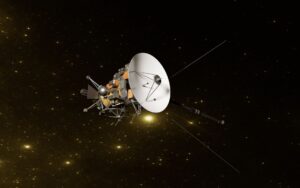
BepiColombo, the joint European Space Agency (ESA) and Japan Aerospace Exploration Agency (JAXA) mission, achieved orbit around Mercury on Nov. 21 after an eight‑year cruise, despite a software‑related interruption that placed the probe in safe mode during the critical insertion burn.
Mission background
The spacecraft was launched in October 2018 as a collaborative effort between ESA and JAXA. Since lift‑off, BepiColombo has traversed the inner solar system, using a series of gravity assists to gradually lower its trajectory toward the Sun‑bound planet.
Orbit insertion and safe‑mode glitch
On the day of the maneuver, mission control at ESA’s European Space Operations Center in Darmstadt, Germany, scheduled a brief loss of contact as the probe passed over Mercury. During this interval, four axial thrusters fired to decelerate the spacecraft, a burn intended to last roughly 37 minutes and bring BepiColombo within 400 miles of the planet’s surface.
Contact was re‑established before the burn completed, revealing that the sequence had been interrupted. The spacecraft automatically entered safe mode, halting all non‑essential functions. Analysis of trajectory data showed that only about 77 % of the planned thrust had been delivered.
“Upon finding Bepi in safe mode, it was like flipping a switch. Everybody was focused in understanding what had happened,” said Ignacio Tanco, flight operations director for BepiColombo. ESA traced the anomaly to a software issue affecting attitude guidance and thruster control, and the investigation remains ongoing.
Despite the incomplete burn, ESA engineers confirmed that the probe had successfully captured Mercury’s orbit. It took six hours from the start of the maneuver to verify the orbital insertion.
Next steps and scientific objectives
In the weeks ahead, BepiColombo will perform a series of small thruster burns to fine‑tune its path. The flight dynamics team will adjust each maneuver based on the spacecraft’s actual trajectory, aiming to reach an “optimum point” in orbit—a process ESA likened to “braking a car at just the right moment” to find the “sweet spot.” Multiple adjustments also help conserve fuel for the mission’s extended phase.
On Dec. 9, the probe will release two dedicated science orbiters. ESA’s Mercury Planetary Orbiter (MPO) will spend several months navigating to its final orbital slot, expected to be achieved in March 2027, with scientific operations slated to begin in April. MPO’s investigations will focus on Mercury’s interior structure, surface composition, and the environment surrounding the planet, according to Geraint Jones, the mission’s lead project scientist.
JAXA’s Mercury Magnetospheric Orbiter, known as Mio, will concentrate on the planet’s magnetosphere, interplanetary dust, and electric fields. Together, the two orbiters will provide a comprehensive picture of Mercury’s geophysical and space‑weather characteristics.
The successful orbit insertion marks a pivotal milestone for BepiColombo, positioning the mission to deliver unprecedented insights into the smallest planet in the solar system after more than a decade of planning, development, and interplanetary travel.

Norman Pearlstine is the Executive Editor and Co-Founder at News Raise. With over two decades of experience across financial journalism, corporate governance, and market analysis, Norman leads the editorial direction and ensures strict adherence to journalistic accuracy and ethics.