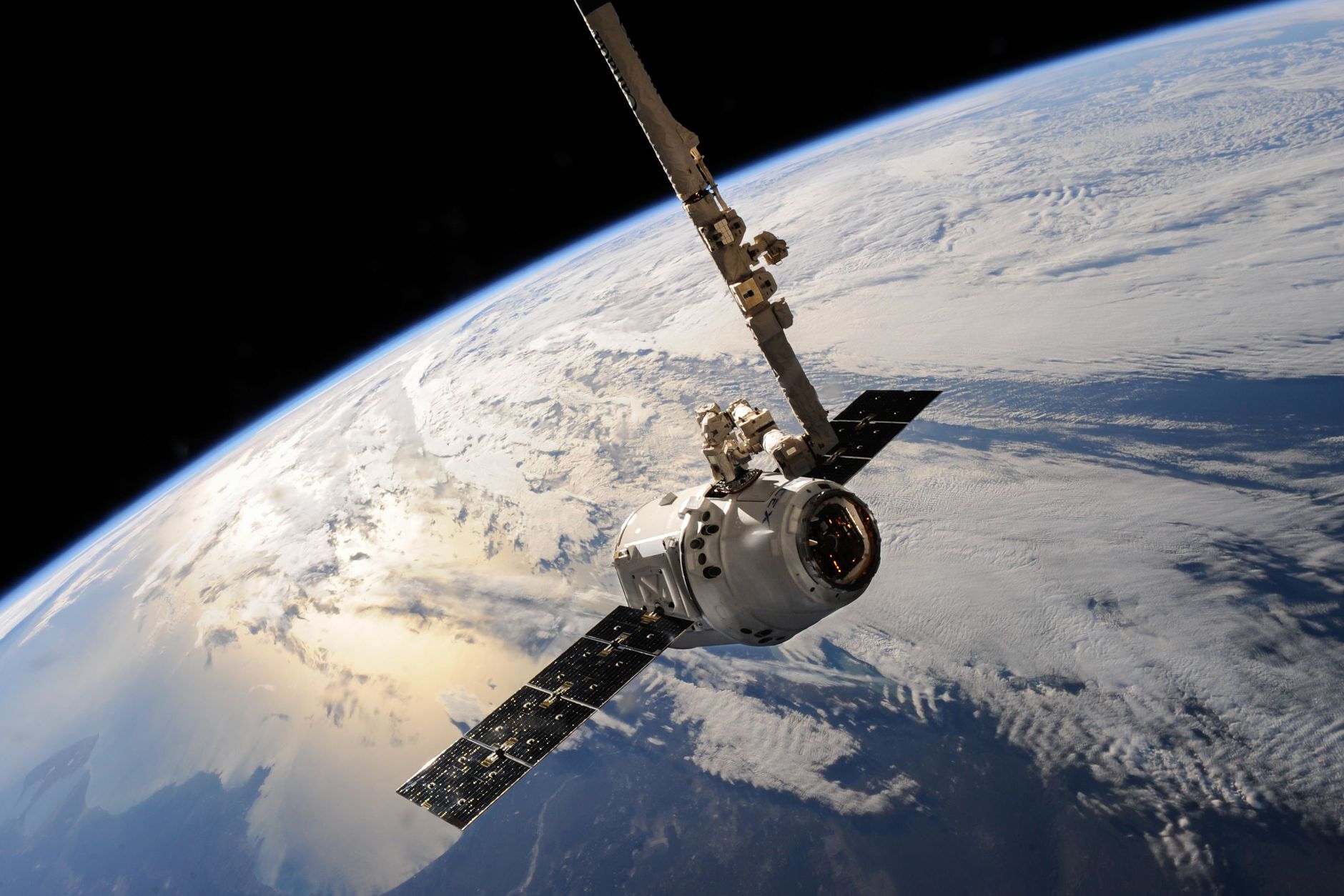
SpaceX announced that its Starship vehicle was captured in mid‑air by the giant mechanical arms, known as Mechazilla, at the Texas launch complex on Saturday. The spacecraft returned after a 22‑hour journey that included 14 orbits of Earth, making the catch the first successful mid‑air recovery of the vehicle. The achievement highlights progress toward the company’s goal of a fully reusable launch system, even as the Super Heavy booster that launched the vehicle was lost.
Mission profile and satellite deployment
The 407‑foot (124‑metre) launch vehicle lifted off late Friday afternoon from SpaceX’s Starbase facility near the U.S.–Mexico border. After liftoff, the two stages of the rocket separated as planned, allowing the upper‑stage Starship spacecraft to continue on a trajectory toward orbit. During the flight, Starship released 26 advanced Starlink communications satellites before settling into a low‑Earth orbit at an altitude of roughly 161‑165 miles (260‑265 kilometres). Over the course of more than 22 hours, the vehicle completed 14 full revolutions around the planet, a notable increase from the single or double laps achieved on the program’s earlier orbital attempt.
SpaceX reported that the spacecraft’s systems, including its heat‑shield tiles, performed as expected throughout the mission. The company noted that the heat‑shield, composed of black hexagonal tiles designed to endure the intense re‑entry environment, functioned well, though it is not yet fully reusable. Engineers are working on new tile designs that would require minimal refurbishment between flights.
Descent, mid‑air capture and booster loss
Starship began its return by firing an engine to initiate a controlled descent into the atmosphere. Traveling at orbital velocity—approximately 17,000 miles per hour—the vehicle experienced severe heating as it slowed during re‑entry. After passing through the cloud deck over the Starbase site, the spacecraft re‑oriented itself, reignited its engines to adopt an upright stance, and lowered toward the launch tower. At the precise moment, Mechazilla’s arms engaged and secured the vehicle, after which the engines shut down, leaving the charred spacecraft suspended above the ground.
SpaceX shared video footage of the event, showing the vehicle’s gradual approach, the moment of capture, and the subsequent still‑stand in the arms. In a post accompanying the video, the company wrote, “Mechazilla catches Starship! Congratulations to the entire SpaceX team on this incredible achievement!” Commentary from SpaceX’s broadcast team highlighted the moment, with Dan Huot exclaiming, “Can you believe it? Look at her! Baby, she’s back!”
While the upper stage was recovered, the Super Heavy booster that propelled the vehicle failed to complete its own recovery. According to SpaceX official Kate Tice, the booster’s engines ceased firing prematurely about ten minutes after liftoff. The guidance system recognized an off‑course trajectory, automatically diverting the booster toward the Gulf of Mexico, where it was destroyed. Buoys were deployed to cordon off the wreckage, and an investigation into the cause of the early engine shutdown is ongoing.
Implications for reusability and future missions
Elon Musk praised the team after the successful catch, and SpaceX officials said the event demonstrated the potential for Starship’s full reusability—a cornerstone of the company’s strategy to lower the cost of access to space. The achievement is also being celebrated by NASA officials; administrator Jared Isaacman described the catch as “almost magic” in a post on X, noting that it is “making more believers by the day.”
SpaceX’s existing Falcon 9 launch vehicle already reuses its first stage, having completed more than 700 launches since 2010. However, the Falcon 9’s second stage is discarded after each flight. Musk envisions Starship operating more like a commercial aircraft, with rapid turnaround and minimal refurbishment between flights. The system is intended to support the growing Starlink satellite constellation, future orbital data‑centre concepts, lunar exploration under NASA’s Artemis program, and eventually crewed missions to Mars.
NASA has contracted Starship as a lunar lander for its Artemis program, planning to use the vehicle for crewed missions later this decade and to help establish a permanent presence on the Moon. The agency expects Starship launches to shift to Florida’s Kennedy Space Center within the next few months, where the site will serve as the launch point for an upcoming Artemis mission that will remain in Earth orbit to practice lunar‑lander operations. For Artemis III, four astronauts are slated to dock with both SpaceX’s Starship and Blue Origin’s Blue Moon lander, with the two companies alternating crew deliveries to the lunar surface. NASA’s target for Artemis IV, which aims to land humans on the Moon again, is 2028.
While the mid‑air capture marks a significant step, SpaceX has yet to achieve simultaneous recovery of both stages in a single mission. The heat‑shield tiles also require further development before they can be considered fully reusable. Nonetheless, the successful catch underscores progress toward the company’s long‑term vision of a fully reusable launch system that could dramatically reduce the cost of space travel and enable ambitious projects such as a fleet of Starships bound for Mars.






Be First to Comment