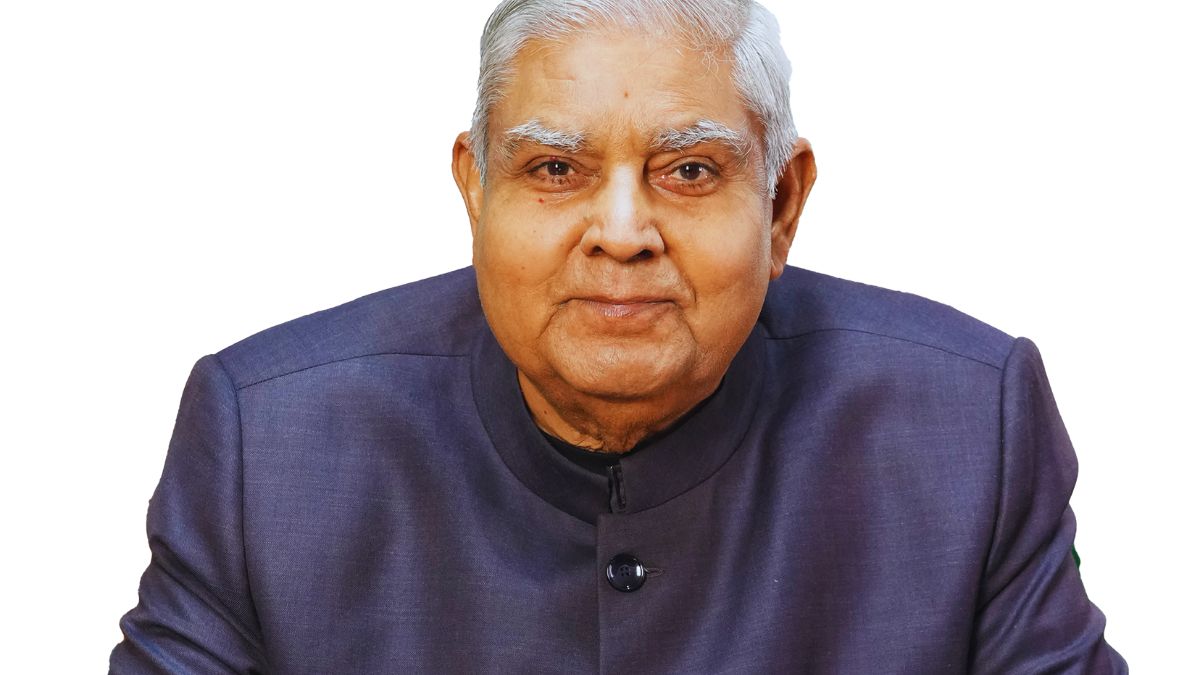
In an unexpected and shocking move, the former Vice-President of India, Jagdeep Dhankhar submitted his resignation on July 21, citing rising health concerns as the preliminary reason. This surprising move after an unannounced visit to the Rashtrapati Bhawan, has left the government officials pondering over the outcome that will follow through, thereby triggering speculation across political circles. His tenure as the country’s Vice-President and chairman of the Upper House, Rajya Sabha was marked by sharp interventions, frequent clashes with the opposition and his frank criticism of the judiciary system.
With the chair unoccupied now, there is a vacancy that must be tactfully filled, as the nation will await the appointment of Dhankhar’s replacement to take on the challenging role. Among the names being considered is Rajya Sabha deputy chairman Harivansh, who has held the post since 2020 and is known to have the government’s confidence.
In his resignation letter addressed to President Droupadi Murmu, Dhankhar stated that he was stepping down with immediate effect to ‘prioritize health care’. Some of the most notable and interesting facts about him were:
- The 74-year-old leader had taken office in August 2022 and was due to complete his five-year term in 2027.
- He was elected as the youngest president of the Rajasthan High Court Bar Association in 1987 and later went to practice in the Supreme Court too.
- In 2019, he was appointed as the Governor of West Bengal, and during his stint a rare impeachment motion against him was rejected by Rajya Sabha deputy chairman Harivansh – an unprecedented motion for removal – the first-ever attempt in independent India to oust a sitting Vice President.
While the government is yet to officially appoint and announce the new Vice-President of India, the Constitution does not explicitly specify who should perform the overall duties of the Vice President in the event of a vacancy or absence.
According to Article 66 of the constitution, the Vice President is elected by an Electoral College comprising members of both Houses of Parliament, through a system of proportional representation by means of the single transferable vote.
The ruling party Bhartiya Janta Party (BJP)-led National Democratic Alliance (NDA) holds a majority in the electoral college comprising members of both Lok Sabha and Rajya Sabha and is expected to contemplate on the potential candidates in the coming days.
Eligibility:
- A candidate must be a citizen of India, at least 35 years old, and qualified for election as a member of the Rajya Sabha.
- He/She must not hold any office of profit under the Government of India or a state government or any subordinate local authority.
Interestingly, Jagdeep Dhankhar joins former leaders V V Giri and Bhairon Singh Shekhawat as the only Vice Presidents to have resigned before completing their terms, wherein Giri resigned in 1969 to contest the presidential election, while Shekhawat quit in 2007 after losing the presidential race.





Be First to Comment