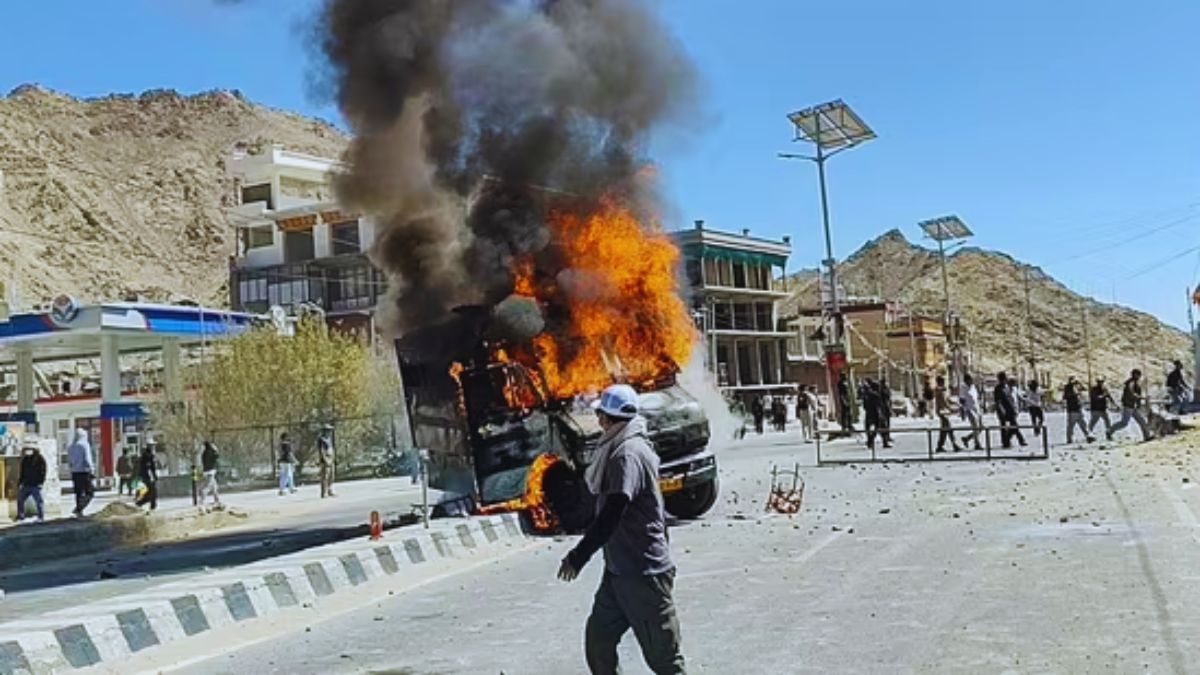
The Union Home Ministry announced that the situation in Ladakh was brought under control after large-scale protests in Leh turned violent, leaving at least four people dead and over 50 injured.
The agitation, primarily focused on demands for statehood and inclusion of Ladakh under the Sixth Schedule of the Constitution, spiraled into chaos despite ongoing talks with the Centre. According to officials, the government has been in continuous dialogue with the Leh Apex Body (LAB) and the Kargil Democratic Alliance (KDA). The ministry claimed that discussions on statehood and the Sixth Schedule have yielded phenomenal results but alleged that certain politically motivated individuals were not happy with the progress.
The MHA further accused climate activist Sonam Wangchuk of “provoking people” by drawing parallels with the Arab Spring and youth-led protests in Nepal. Wangchuk, who recently ended a 15-day hunger strike, had been a key voice in the movement pushing for Ladakh’s constitutional safeguards. Though he later appealed for peace, authorities alleged that his remarks contributed to the unrest.
Tensions in Leh worsened on Wednesday when groups of youth resorted to stone-pelting at the Bharatiya Janata Party (BJP) headquarters and the Ladakh Autonomous Hill Development Council office. Police and paramilitary forces, deployed in large numbers, responded with tear gas to disperse the crowd.
Eyewitnesses reported that protestors torched a security vehicle and set fire to furniture and documents inside the BJP office. At least 30 police and Central Reserve Police Force (CRPF) personnel sustained injuries. The ministry said forces had to open fire ‘in self-defense’ after the violence intensified.
Demands of Protestors
The agitation in Ladakh has been building for the past four years, spearheaded jointly by LAB and KDA. Their primary demands include:
-
Statehood for Ladakh to ensure political representation and administrative autonomy.
-
Extension of the Sixth Schedule, which currently applies to tribal regions in Tripura, Meghalaya, Mizoram and Assam. This constitutional provision grants greater financial and legislative powers to local autonomous councils, along with alternate judicial mechanisms and safeguards for tribal populations.
The Home Ministry confirmed that another round of talks with LAB and KDA representatives is scheduled for October 6, 2025, where these issues will be addressed further.
Responding to protest calls, Leh observed a complete shutdown on September 24. Large crowds gathered at the NDS Memorial Ground before marching through the streets, chanting slogans in support of the Sixth Schedule and statehood. What began as a peaceful rally quickly turned violent, culminating in clashes with security forces.
While the Centre has assured that dialogue is ongoing, the recent violence highlights growing frustration among sections of Ladakh’s population. With fresh talks on the horizon, both the government and local leaders face the challenge of steering the movement back to peaceful negotiations.



Be First to Comment