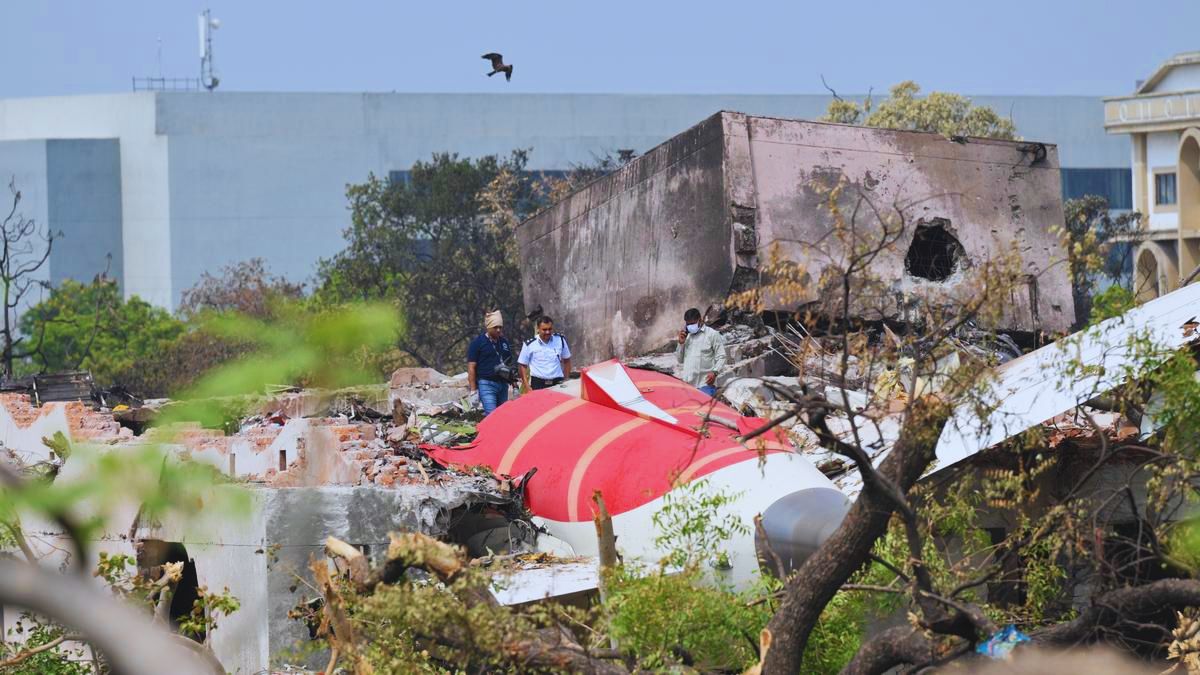
The Air India flight’s cockpit voice recorder reveals one pilot asking another why he switched off the fuel supply to the engine and the second pilot replied that he hadn’t done it.
One month after the tragic AI 717 plane crash, the AAIB (Aircraft Accident Investigation Bureau) has submitted its preliminary report, as per the data recovered from the Blackbox. The fatal crash, which took place on June 12 on a 242-passenger & crew bound flight from Ahmedabad to London, is cited as one of the worst crash incidents in recent history. Only 1 passenger had a miraculous escape, with 229 passengers and 12 crew members losing their lives, in the western city of Ahmedabad, seconds after the take-off. It was airborne for over 40 seconds before it plunged into a densely populated neighborhood and burnt to flames.
Now, the AAIB has shared details after carrying out the initial probe, from the recordings retrieved through the Blackbox, which states ‘a shift in fuel control switches three seconds after the Boeing 787-8 aircraft became airborne resulted in a loss of engine thrust and shutting down of both the engines’, which may have caused the unexpected crash.
Major Report Takeaways
- The report said both engines’ N2 values fell below minimum idle speed, as per data from the Engine and Flight Recorder (EAFR).
- The Aircraft Accident Investigation Bureau (AAIB) has released its 15-page preliminary report, which carefully examined the sequence of events and engine behaviour leading up to the unforgettable incident.
- The investigation team will also review some additional evidence currently being sought from stakeholders and will be reviewed in the following probe, the AAIB said in its preliminary report.
- At this stage, the AAIB has not issued any safety recommendations for Boeing 787-8 aircraft or the engine operators and manufacturers.
- While Engine 1 deceleration had temporarily halted and also showed signs of recovery after initial failure, Engine 2 could not arrest core speed deceleration, despite repeated attempts.
- As soon as the aircraft reached 180 knots IAS, both engines’ fuel cutoff switches moved from ‘Run’ to ‘Cutoff – which were returned to ‘Run’ within seconds, indicating a plausible attempt to relight the deviation.
- Engine and Aircraft Flight Recorder (EAFR) data showed a rise in Exhaust Gas Temperature (EGT) in both engines following the fuel switchback to ‘Run’, indicating combustion during relight attempts.
- The back flight recorder was found to be substantially damaged in the incident and could not be downloaded using conventional methods, as per the report detail submitted by the AAIB.
Based on the information shared so far, it can be concluded that engine failure was the preliminary factor that led to the loss of control and despite the pilots attempting their best to revive and remain unscathed through the situation, the damage was beyond irreparable for them to survive through. The detailed findings from the AAIB remain further awaited.






Be First to Comment