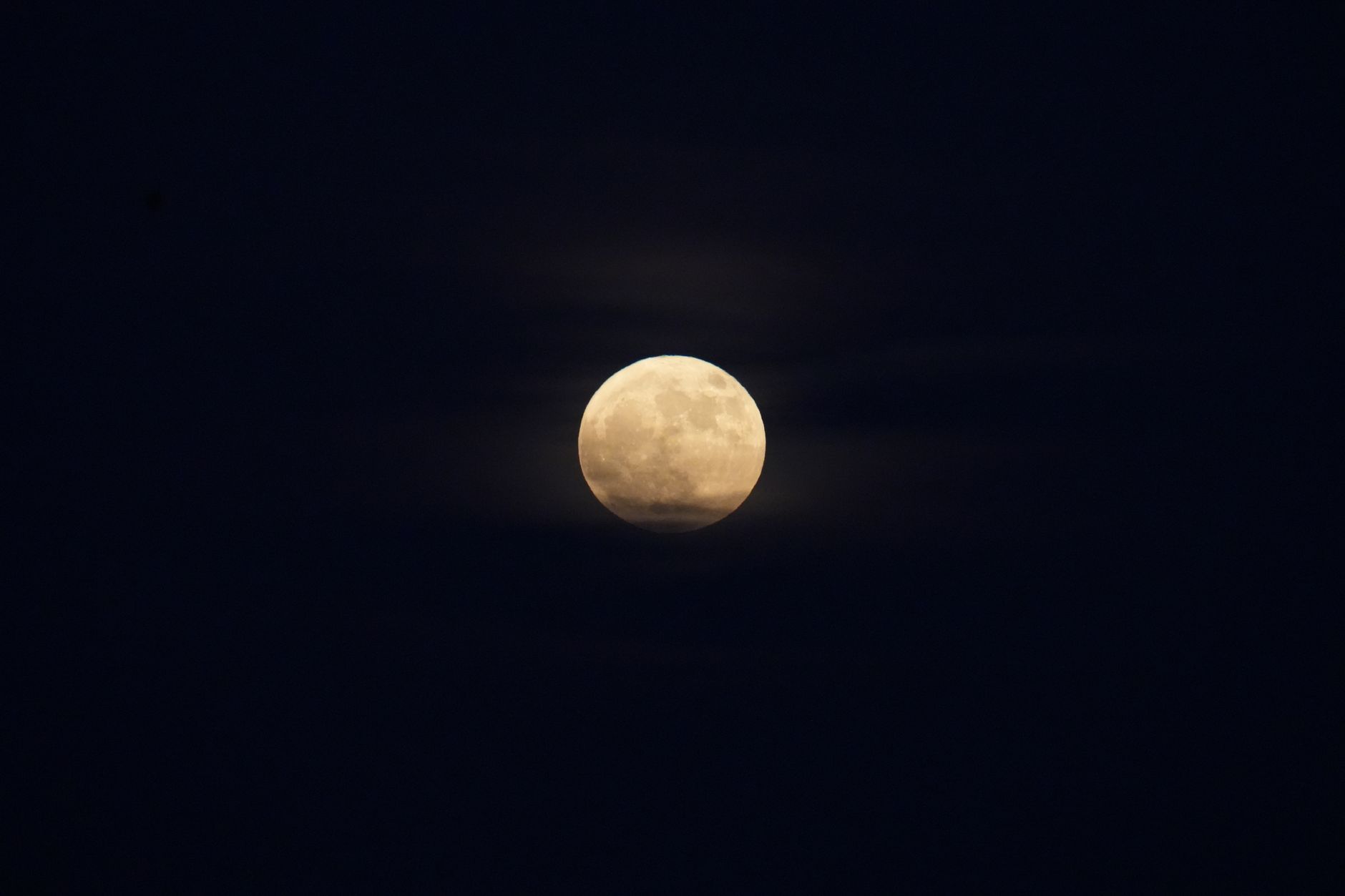
Tonight, the night sky will host November’s full supermoon, traditionally called the beaver moon. According to EarthSky, the moon reaches its maximum illumination at 9:54 a.m. ET tomorrow, but it will appear fully illuminated this evening, as well as on Tuesday and Wednesday.
What Makes This Moon Special
NASA’s Noah Petro, chief of the Planetary Geology, Geophysics and Geochemistry Lab at Goddard Space Flight Center, notes that this supermoon will look about 17% larger and 30% brighter than the year’s smallest full moon. The increased size and brightness result from the moon’s elliptical orbit, which sometimes brings it closer to Earth. Kevin Lewis, vice chair and professor of Earth and planetary sciences at Johns Hopkins University, explains that the moon’s orbit takes roughly 27.5 days to return to its closest point (perigee) and about 29.5 days to complete a full cycle of phases. Because these periods are similar, a supermoon can occur in consecutive months, making November’s beaver moon the first of three back‑to‑back supermoons.
How to See It Best
Petro recommends finding a dark location with an unobstructed view, away from trees, tall buildings and bright lights. While no special equipment is required, binoculars or a small telescope can reveal surface details such as craters and the dark plains, known as lunar seas, that were formed by ancient lava flows.
In the days surrounding peak fullness, the moon will rise around sunset and remain visible throughout the night, setting near sunrise. Observers are advised to look shortly after sunset when the moon is low on the horizon; the low angle can produce a striking visual effect. Lewis adds that the moon may appear larger than it truly is due to the “moon illusion,” an optical phenomenon linked to how the brain compares the moon’s size with nearby horizon objects.
The full moon also exerts a stronger gravitational pull on Earth’s oceans, contributing to higher tides. Lewis hopes the impressive display will encourage sky‑watchers to reflect on upcoming lunar missions that aim to return humans to the Moon and capture new surface images.
What’s Next in the Night Sky
Looking ahead, the final full moon of 2026, known as the cold moon, will be the year’s biggest and brightest supermoon, peaking on December 23, according to The Old Farmer’s Almanac. The first full moon of 2027, called the wolf moon, follows on January 22.
Meteor‑watchers still have opportunities: the Leonid meteor shower remains active through November 30, and two more showers will peak before year‑end—Geminids on December 13‑14 and Ursids on December 21‑22.
Petro encourages people to pause amid the holiday rush, bundle up, and spend a few minutes appreciating the celestial companion that has guided cultures for centuries.

Norman Pearlstine is the Executive Editor and Co-Founder at News Raise. With over two decades of experience across financial journalism, corporate governance, and market analysis, Norman leads the editorial direction and ensures strict adherence to journalistic accuracy and ethics.