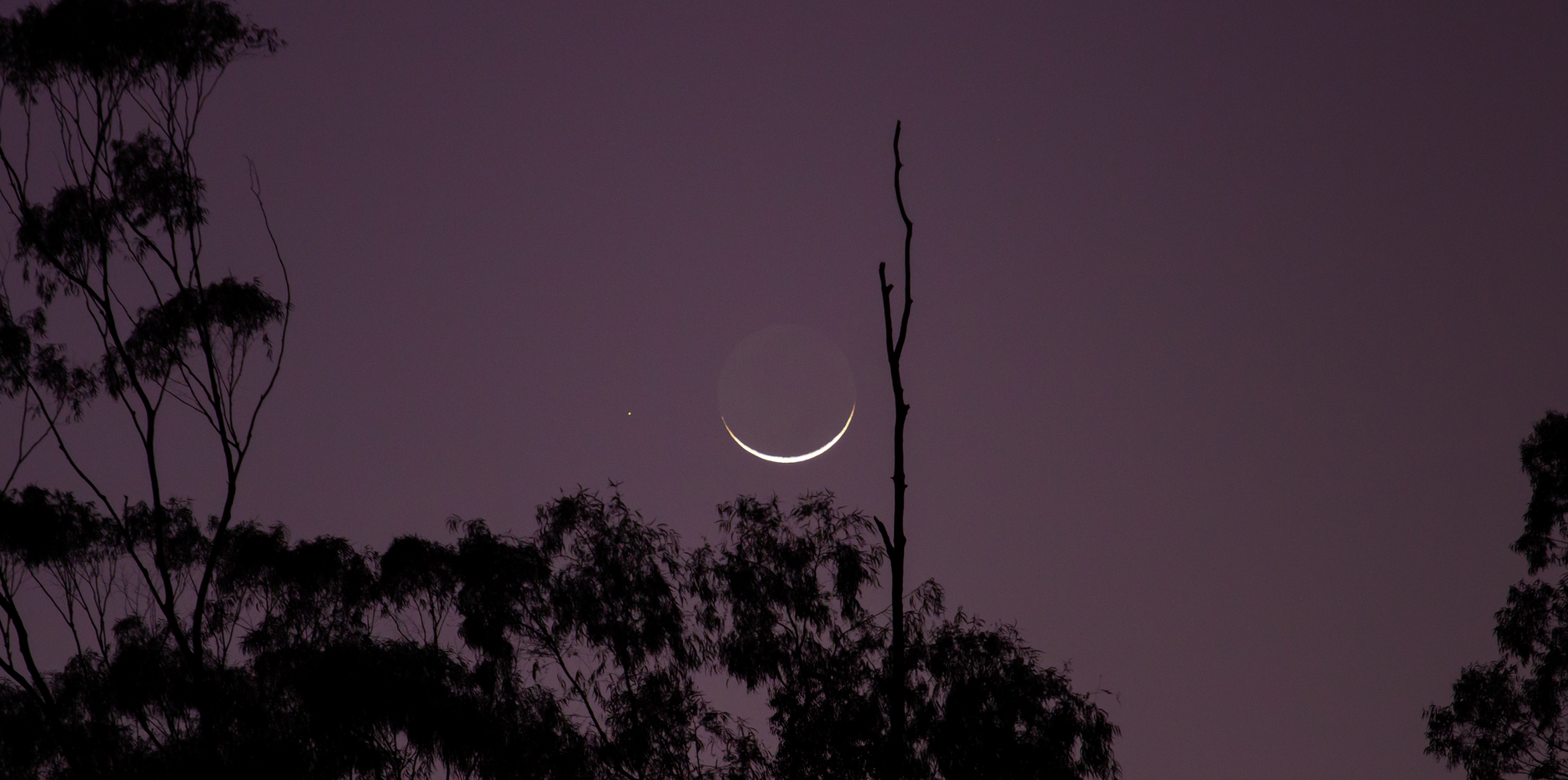
Sky enthusiasts in the western horizon on Monday will be treated to a thin crescent moon that appears to guide the eye toward a dazzling Venus. Although the two bodies seem close together in the night sky, they are separated by vast distances in space.
Distances and Apparent Separation
The Moon orbits roughly 240,000 miles from Earth, while Venus lies tens of millions of miles away. As the night progresses, the apparent gap between the Moon and Venus will widen, even though both objects remain visible low in the western sky.
Brightness, Magnitude and Viewing Window
Venus will continue to grow brighter through the week, reaching its peak luminosity on Friday, September 18, when it is expected to shine at an astronomical magnitude of about –4.8. On the magnitude scale, lower numbers denote greater brightness; for context, the full Moon records a magnitude near –12.7 and the Sun about –26.7. Because the scale is logarithmic, each one‑magnitude step corresponds to roughly a 2.5‑fold increase in brightness.
The optimal moment to glimpse the Moon‑Venus pairing on Monday arrives shortly after sunset, when both objects sit low in the western sky. In Raleigh, sunset occurs around 7:23 p.m., so observers should turn their gaze westward a few minutes later. A clear, unobstructed western horizon will provide the best conditions as the two bodies descend toward the horizon.
Venus’s current brilliance results from a combination of its relatively close distance to Earth and the high reflectivity of its thick cloud cover. To the naked eye, the planet looks like a single, intense point of light. Through binoculars or a telescope, however, viewers can see that Venus, like any inner planet, exhibits phases. At present it displays a crescent shape illuminated to about 25 percent, because it is positioned between Earth and the Sun. Full illumination occurs only when Venus passes behind the Sun from Earth’s perspective.
For those seeking additional reference points, the bright star Spica lies to the right of Venus, while the faint red star Antares—found in the constellation Scorpius, often called the “heart of the scorpion”—appears to the left. These stellar markers can help locate Venus more precisely, especially as the planet and Moon set.
Overall, Monday offers a convenient chance for amateur astronomers and casual observers alike to enjoy a classic planetary conjunction, with the slender Moon serving as a natural pointer toward one of the night sky’s brightest planets.

Norman Pearlstine is the Executive Editor and Co-Founder at News Raise. With over two decades of experience across financial journalism, corporate governance, and market analysis, Norman leads the editorial direction and ensures strict adherence to journalistic accuracy and ethics.