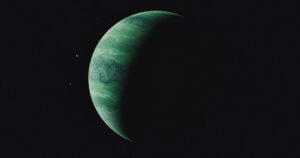
When a star exhausts its nuclear fuel and collapses into a white dwarf, the intense gravity often pulls in remnants of any surviving planets, leaving behind a polluted stellar atmosphere. In a recent study published in Nature Astronomy, researchers describe an unexpected find: a candidate planet that appears to have formed from the very material shed by its host white dwarf, HS 0209+083.
Discovery of an Unusual Planet
Data from NASA’s Transiting Exoplanet Survey Satellite (TESS) revealed a faint, periodic dimming of the star’s light every 4.4 days. The signal is consistent with a gas giant roughly the size of Jupiter locked in a tight orbit around the dead star. Because the planet would be so close, its atmosphere is likely being stripped away by the white dwarf’s radiation, with the escaping gas eventually accreting onto the star’s surface.
Co‑author Jamie Williams of the University of Warwick emphasized the rarity of such a find, noting that secondary, or “second‑generation,” planets are “incredibly rare” and that detecting one around a white dwarf was wholly unforeseen.
Chemical Clues from the White Dwarf
Spectroscopic analysis of HS 0209+083 showed an atmosphere enriched not only with common rock‑forming elements such as iron and silicon, but also with unusually high concentrations of heavier metals, including copper, zinc and, notably, niobium. The amount of niobium measured was more than a thousand times the level found in the Sun, marking the first detection of this element in a white dwarf’s spectrum.
University of Wisconsin‑Madison astronomer Nicholas Stone, another study co‑author, explained that this chemical fingerprint does not match that of a typical “first‑generation” planet. Instead, the presence of these exotic metals points to a planetary body that formed from the debris of the star itself.
Implications for Planet Formation After Stellar Death
The researchers propose that the planet’s existence required a very specific set of circumstances. A solitary dying star tends to eject its outer layers symmetrically, leaving little material to coalesce into a new world. In this case, the team suggests a companion star may have captured some of the expelled matter and redirected it into a stable orbit, where it eventually assembled into a giant planet.
Astrophysicist Boris Gänsicke of the University of Warwick described the system as having “given birth to a new world using the foundations of the old one.” If the scenario holds up under further scrutiny, it could provide astronomers with a new observational pathway: searching for heavy‑metal signatures in white dwarf atmospheres as a proxy for hidden second‑generation planets.
Williams likened the phenomenon to “finding a planet that has risen from the ashes of the very star it once orbited,” underscoring how the discovery challenges traditional views of planetary survival and formation after stellar demise.
Future observations will aim to confirm the planet’s presence and refine estimates of its mass and composition. Should the planet be verified, it would represent the first documented case of a world forged from the remnants of a dead star, opening a novel chapter in the study of planetary evolution.

Steve Lopez is a Senior Editorial Columnist and Health & Public Policy reporter for News Raise. Steve focuses on healthcare advancements, medical technologies, and public health policies.