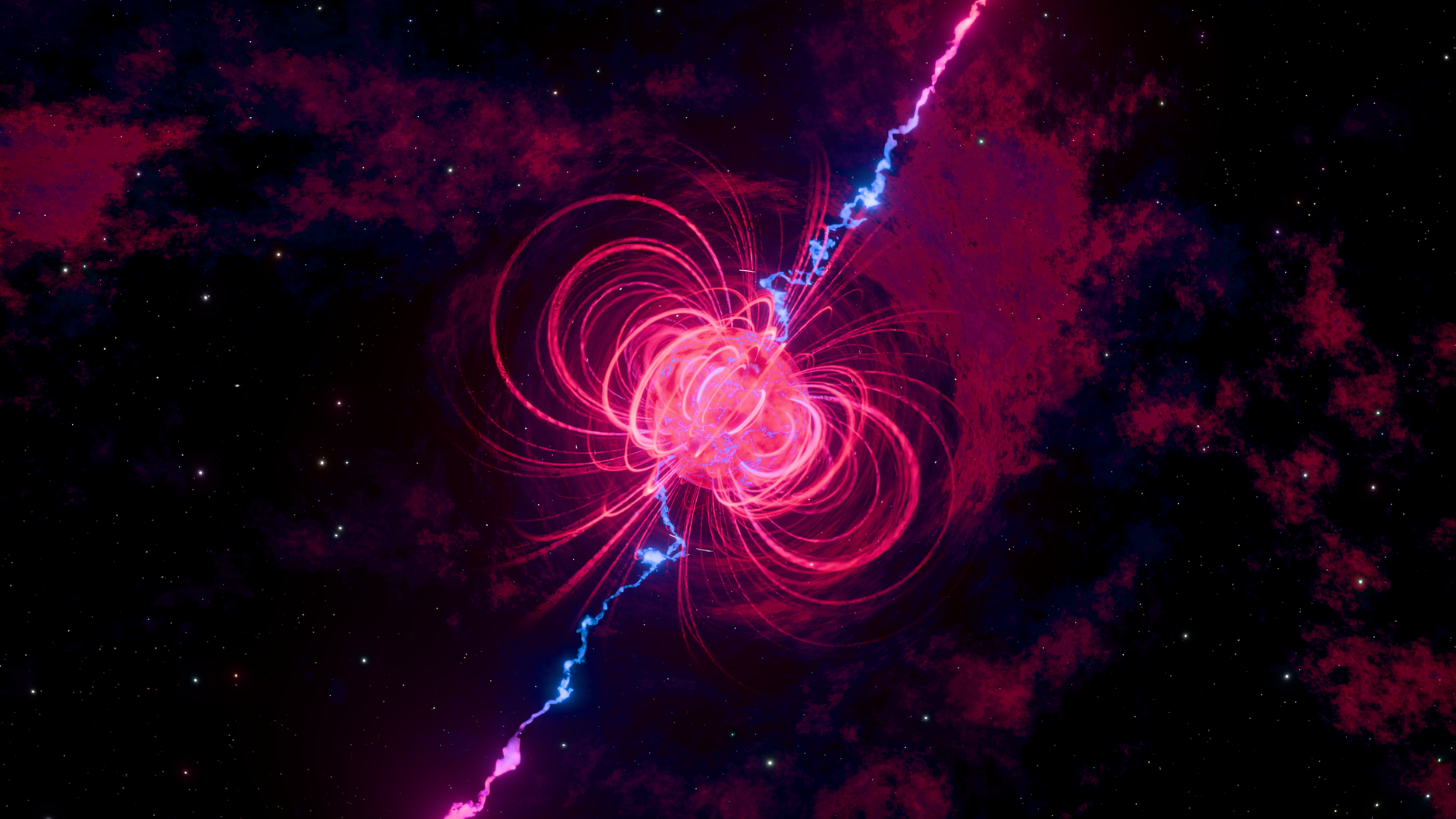
A collaboration between the Smithsonian Astrophysical Observatory and Harvard College Observatory has produced Lumina, the most detailed computer model to date of the universe’s first two billion years. The simulation offers a virtual window onto the formative era when the cosmos transitioned from a diffuse mixture of particles to the complex web of galaxies, filaments and black holes observed today.
Lumina begins with a cubic region of space roughly 1.5 billion light‑years on a side and follows its evolution from the universe’s infancy through the period when the first luminous structures emerged. By tracking both hydrogen and helium as they change from primordial forms into the atoms that later fuel stars, the model captures the chemical and dynamical processes that shape early cosmic architecture.
Scale and Scope of the Lumina Simulation
At an age of about 1.5 billion years, the universe was far from the orderly arrangement of galaxies we see now. It consisted of delicate filaments of dark matter interwoven with glowing gas, all bathed in a sea of high‑energy particles and radiation. Lumina allows researchers to watch these components interact in real time, rather than inferring their behavior solely from present‑day observations. The simulation resolves individual galaxies and nascent black holes while still covering a volume more than one hundred times larger than that of previous models.
Massive Computing Resources Required
Creating a model of this magnitude demanded extraordinary computational power. The team ran the simulation on Frontier, one of the world’s fastest supercomputers located at Oak Ridge National Laboratory, employing over 15,000 graphics processing units (GPUs). This hardware enabled the researchers to maintain fine‑grained detail across the enormous simulated space, preserving the ability to study both large‑scale structures and the formation of specific luminous objects.
“We feel incredibly fortunate to be building simulations like Lumina,” said Dr. Aaron Smith, a physicist at the University of Texas at Dallas and co‑author of the study. “For the first time, we can follow along as both hydrogen and helium changed into their modern form across such an enormous volume of the universe, while still resolving the galaxies and other luminous objects driving that transformation.”
Connecting Simulation to Observations
Scientists intend to test Lumina’s predictions against data from powerful telescopes such as the James Webb Space Telescope, which is already revealing galaxies and gas clouds from the distant past. When simulated structures align with actual observations, confidence in current theories of early‑universe evolution grows. Discrepancies, on the other hand, could highlight gaps in existing models or prompt revisions of fundamental assumptions.
Oliver Zier, the study’s lead author and a computational physicist with the Center for Astrophysics, described the work as opening a new frontier: “The early universe has become an exciting new frontier in astrophysics.” By providing a detailed, testable framework, Lumina stands to accelerate the interpretation of forthcoming deep‑space observations and refine our understanding of how the cosmos came to be.
As the astronomical community prepares for an influx of high‑resolution data from next‑generation observatories, the Lumina simulation offers a crucial benchmark. Its unprecedented combination of scale and resolution promises to illuminate the processes that transformed a near‑uniform primordial soup into the richly structured universe we inhabit.

Steve Lopez is a Senior Editorial Columnist and Health & Public Policy reporter for News Raise. Steve focuses on healthcare advancements, medical technologies, and public health policies.