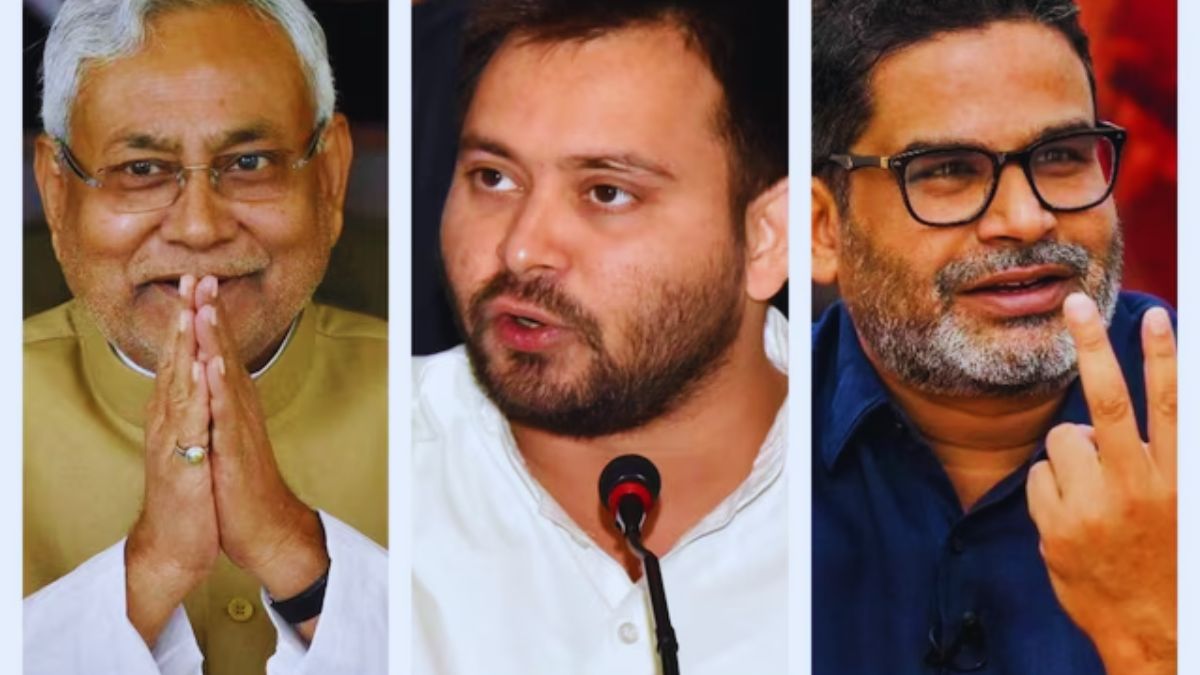
November 14—the much-awaited day of vote counting for the 2025 Bihar Assembly Elections—has unfolded as one of the most consequential moments in the state’s recent political history.
With trends steadily favoring a sweeping triumph for the National Democratic Alliance (NDA), powered by its two principal constituents, the Bharatiya Janata Party (BJP) and the Janata Dal (United), the spotlight has once again turned to Nitish Kumar. Poised for a remarkable fifth term as chief minister, his potential return underscores the political continuity and complexities that have long defined Bihar’s governance landscape.
This year’s election has been extraordinary for several reasons. Bihar recorded an unprecedented 67.13% voter turnout across the two phases of polling held on November 6 and 11—the highest participation since 1951. In a significant achievement for electoral administration, the Election Commission of India confirmed that not a single incident of malpractice or discrepancy was detected during post-poll scrutiny, resulting in no repolls anywhere in the state.
The 243-member Assembly election saw 74.2 million registered voters, including 39.2 million men and 35 million women, marking one of the most engaged electorates in Bihar’s democratic history. As counting trends firmed up, the focus narrowed to Nitish Kumar, Bihar’s longest-serving chief minister and one of India’s most durable political figures. Renowned for his strategic instincts and ability to maneuver through shifting alliances and volatile political climates, Kumar continues to be the axis around which Bihar’s politics rotates even after two decades in power.
Nitish Kumar: The Architect of Bihar’s Political Continuity
Born in 1951 and shaped by the JP Movement of the 1970s, Nitish Kumar emerged alongside leaders such as Lalu Prasad Yadav in a generation defined by socialist ideology and mass political mobilization. His entry into active politics in the 1980s paved the way for electoral victories from Harnaut in 1985 and later to multiple terms as a Member of Parliament from Barh and Nalanda.
As chief minister, Kumar cultivated an image of a governance-oriented leader. His emphasis on rural roads, electrification, women’s empowerment, education reforms, and improved law and order helped shed the state’s long-standing association and reposition Bihar as a developing region during the 2000s.
Yet his political journey has been anything but linear. Frequently shifting alliances—earning him the moniker ‘Mr. Flip-Flop’—have nevertheless demonstrated his unmatched survival skills. His break from the BJP in 2013, reunion with the RJD-Congress Mahagathbandhan in 2015, and return to the NDA in 2017 illustrate his tactical recalibrations based on evolving political imperatives.
In the 2025 polls, the JD(U) and BJP contested as equals, fielding 101 candidates each—a symmetry not seen since 2005—while bringing smaller allies such as the LJP (RV), RLM, and HAM(S) into the fold.
A Verdict Shaping a New Political Chapter
The 2025 election outcome does more than signal another NDA victory. It reflects a broader political undercurrent—one that may influence the trajectory of governance under the larger canvas of Modi-era national politics. Amid domestic challenges and global uncertainties, Bihar’s mandate appears to mark the beginning of a new phase, both for the state and for the coalition steering the country’s political direction.






Be First to Comment