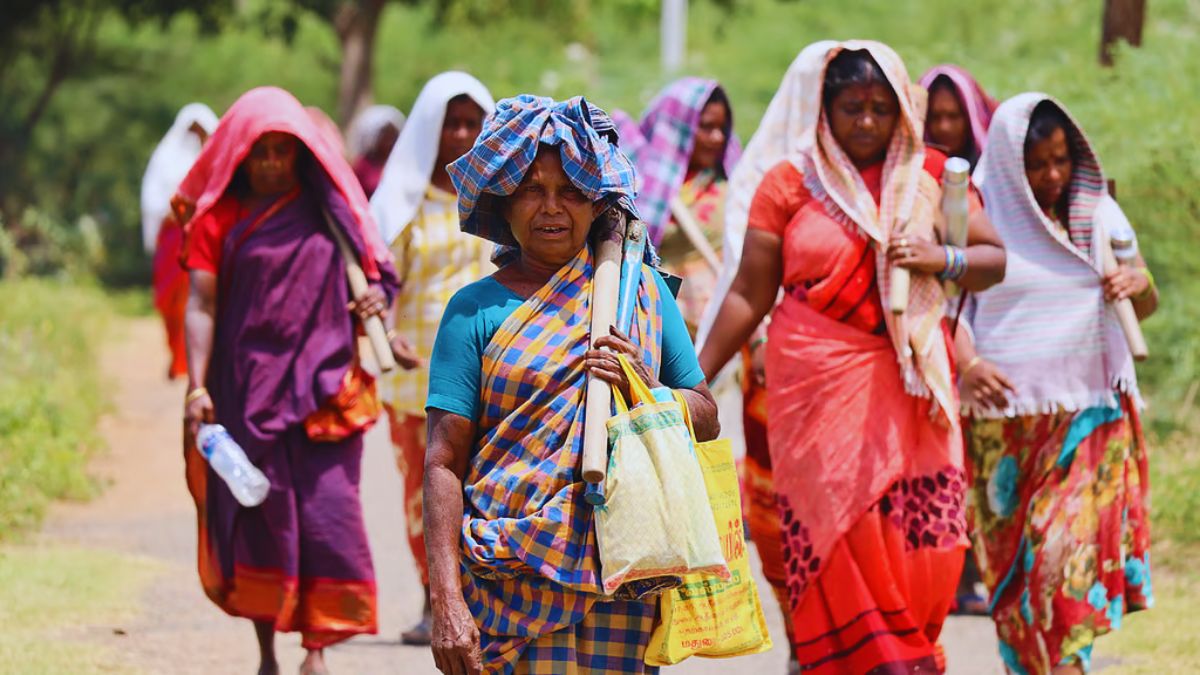
Centre Likely to Table New Rural Employment Bill to Replace MGNREGA
The Union government is expected to introduce the Viksit Bharat – Guarantee for Rozgar and Ajeevika Mission (Gramin) Bill, 2025, also known as the VB–G Ram G Bill, in the Lok Sabha this week. The proposed legislation aims to replace the Mahatma Gandhi National Rural Employment Guarantee Act (MGNREGA), a cornerstone rural employment scheme that has been in place for nearly two decades.
The government has positioned the new Bill as a reform-oriented framework to expand employment opportunities while restructuring funding responsibilities between the Centre and the states.
Key Changes Proposed Under the New Bill
1) Increase in Guaranteed Workdays
- One of the headline provisions of the proposed law is the increase in guaranteed wage employment for rural households.
- Under the new framework, eligible households would be entitled to 125 days of wage employment per financial year, up from the current 100 days under MGNREGA.
- While this increase has been highlighted as a major benefit, critics argue that the accompanying financial changes significantly alter the scheme’s core structure.
2) Revised Cost-Sharing Formula
- A major departure from the existing framework is the revised funding pattern.
- The Bill proposes a 60:40 cost-sharing ratio between the Centre and states for all states and Union Territories with legislatures.
- However, North-Eastern and Himalayan states, including Jammu and Kashmir, Himachal Pradesh, and Uttarakhand, will continue under a 90:10 Centre -state funding model.
Currently, the Centre bears the full cost of wages for unskilled labour under MGNREGA, along with most material costs. While the new Bill retains existing wage rates, it significantly increases the financial burden on states.
3) Normative State-Wise Funding
- The proposed legislation gives the Central government authority to determine state-wise normative allocations each financial year, based on parameters prescribed by the Centre.
- This marks a shift away from MGNREGA’s demand-driven model, where funds were released based on actual employment demand.
- Opposition leaders argue that this change introduces spending ceilings that could limit employment availability once allocated funds are exhausted.
New Oversight and Governance Structures
The Bill provides for the creation of a Central Gramin Rozgar Guarantee Council and corresponding State Councils to oversee implementation, monitoring, and evaluation.
- In addition, steering committees at both levels will advise on fund allocation norms, convergence with other schemes, and operational guidelines.
- Supporters say these measures will improve efficiency, while critics warn they could weaken local decision-making.
4) Agricultural Season Exemptions
A notable provision allows states to pause scheme implementation during peak sowing and harvesting periods, for up to 60 days annually.
- The government argues this will prevent labour shortages in agriculture, but opponents say it restricts workers’ right to employment.
5) Support for Vulnerable Groups
The Bill introduces a special schedule of rates for women, senior citizens, persons with disabilities, and individuals with serious health conditions, enabling their participation in suitable forms of work.
Unemployment Allowance and Wage Delay Compensation
The new framework retains the provision for a daily unemployment allowance if work is not provided within 15 days of application. States will bear the cost of unemployment allowances and compensation for delayed payments. Workers will also be eligible for compensation at 0.05% of unpaid wages per day if payments are delayed beyond the stipulated period.
The opposition has strongly criticized the proposed Bill, arguing that it dismantles MGNREGA’s rights-based foundation. He said the shift to a 60:40 funding model could force states to collectively spend over ₹50,000 crore annually, with Kerala alone facing an additional burden of ₹2,000–2,500 crore.
In addition, concerns have been raised on increased centralization, reduced role of Panchayats, reliance on digital monitoring systems, and the mandatory suspension of work during agricultural seasons. As Parliament prepares to debate the legislation, the proposed overhaul of India’s rural employment framework is expected to trigger intense political and policy discussions.






Be First to Comment