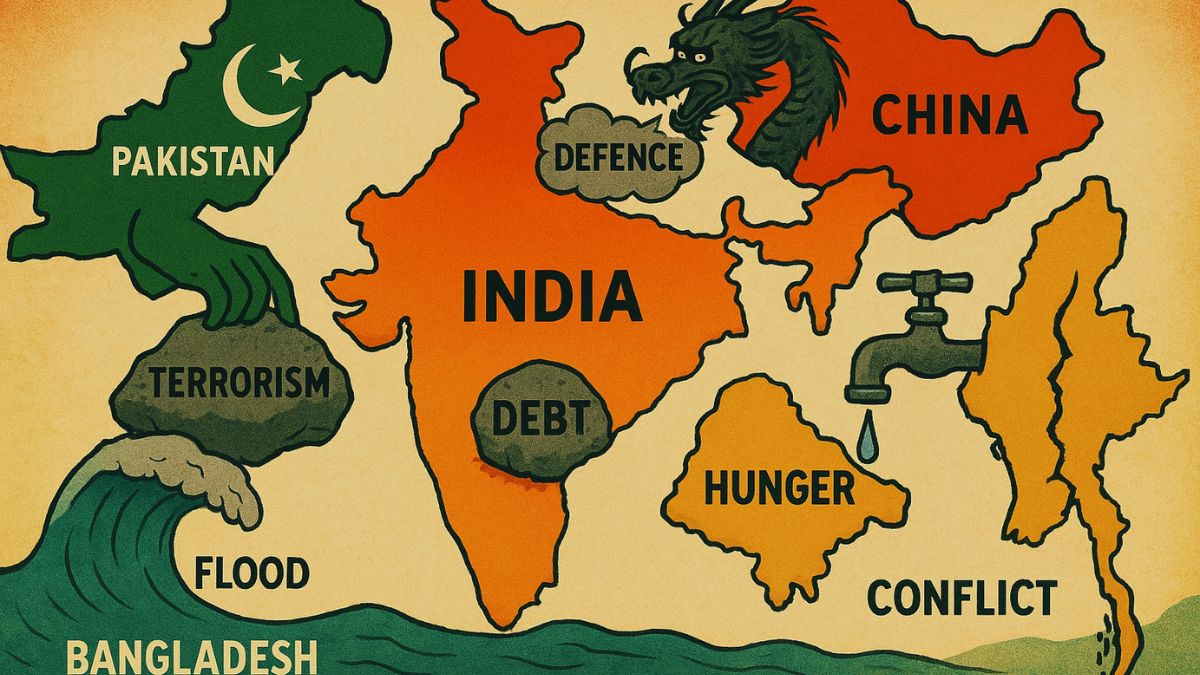
In the recent years, India’s neighbouring countries have witnessed unprecedented political and economic crises, that have shaken the very foundation of governance.
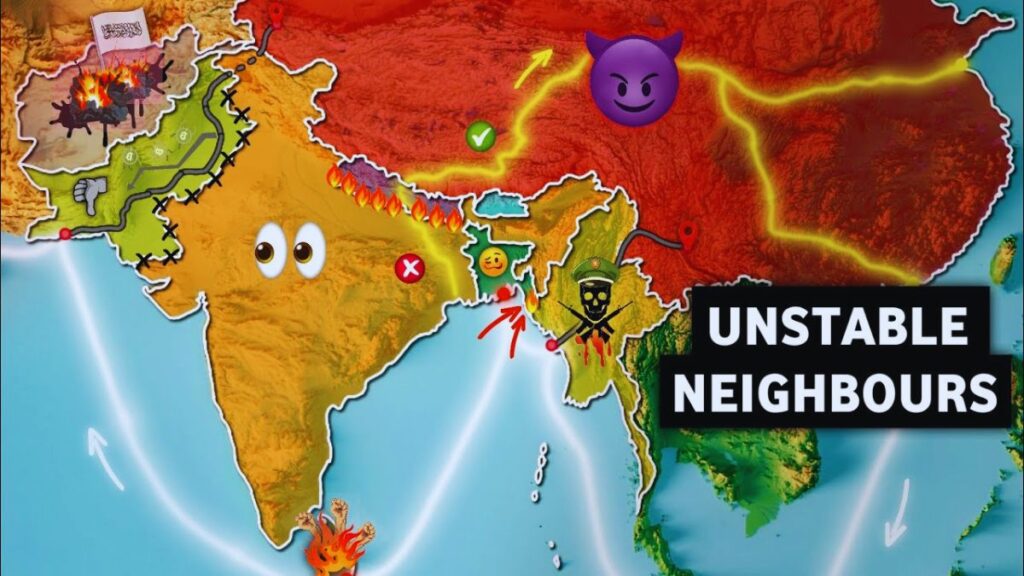
From Afghanistan’s Taliban takeover to Sri Lanka’s financial collapse, Bangladesh’s student uprising, and the current turmoil in Nepal, South Asia has been a hotspot of instability. These developments not only altered domestic politics but also affected India’s regional ties and security concerns.
Top Neighboring Countries Struggling: Regional Instabilities
1) Nepal’s Gen-Z Uprising and Political Turmoil (2025)
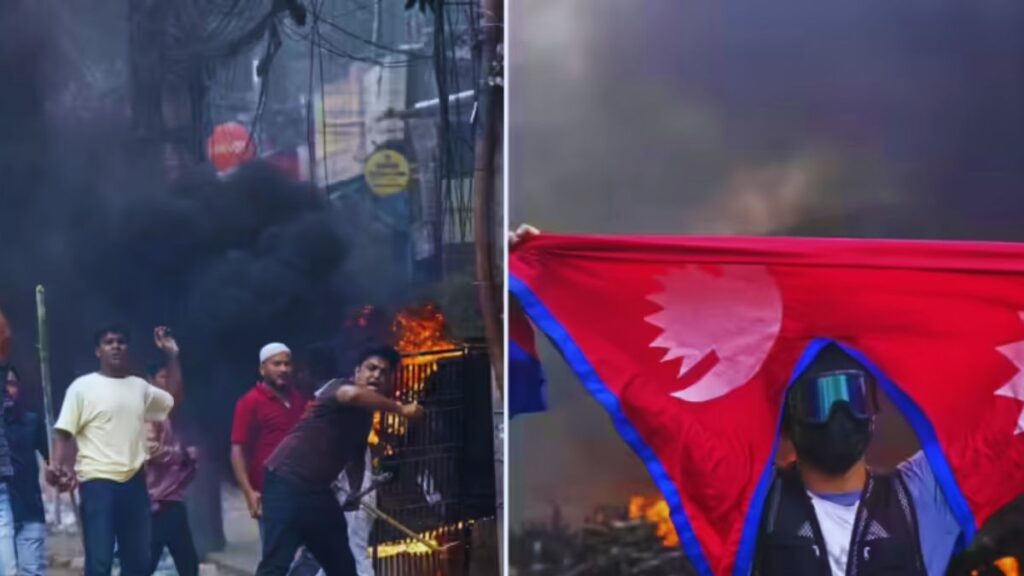
Nepal, India’s Himalayan neighbor, had plunged into chaos in 2025 with widespread protests led by Gen-Z youth. The trigger was a controversial ban on social media platforms, which quickly escalated into mass demonstrations against corruption and nepotism too.
- Protesters stormed the Parliament, the Supreme Court, and even set fire to ministers’ residences.
- Prime Minister KP Sharma Oli was forced to resign within 30 hours of protests erupting all over the capital city of Kathmandu.
- At least five ministers and 20 opposition MPs resigned, while opposition parties demanded the dissolution of Parliament and fresh elections.
- The Nepal crisis reflects the growing impatience of youth in South Asia against opaque governance and digital restrictions.
- Eventually, in the history of political trajectory, the Gen Z of Nepal elected Sushila Karki as the interim Prime Minister, through an online voting system.
2) Bangladesh’s Second War of Independence (2024)
In 2024, Bangladesh saw its most serious political turmoil in years when the long-serving Sheikh Hasina’s government fell to a student-led protest movement.
- Anger centered on corruption, human rights violations, and controversial reservation policies.
- Demonstrations turned violent when security forces opened fire, killing over 300 people.
- On August 5, 2024, Sheikh Hasina resigned and took refuge in India. The situation is in a ‘status quo’ mode till today.
- The military stepped in, declaring an interim administration under Army Chief General Waker-Uz-Zaman. This transition remains incomplete, as Bangladesh has yet to hold general elections, and political stability is still uncertain.
3) Sri Lanka’s Economic Collapse (2022)
Sri Lanka’s meltdown in 2022 was a direct result of mounting foreign debt, COVID-19 shocks, and dwindling tourism revenues.
- Severe shortages of fuel, food, and medicine triggered nationwide protests in Sri Lanka.
- In a symbolic moment, protesters stormed the Presidential Palace and Parliament, even swimming in the palace pool.
- The Rajapaksa family, who dominated politics, faced mass anger – leading to the Prime Minister’s resignation in May 2022. President Gotabaya Rajapaksa fled the country in July 2022 before officially resigning in September the same year.
- This episode marked one of the most significant people-led revolts in South Asia in decades, forcing a regime change amid economic desperation.
Sri Lanka as a region has been grappling with economic and communal instability – and seeking intervention from India at regular intervals.
4) Afghanistan: The Fall of Kabul (2021)
In August 2021, Afghanistan witnessed one of the most dramatic regime changes in modern history when the Taliban seized control of Kabul.
- After the US-Taliban peace deal (2020), foreign troop withdrawal gave the Taliban a chance to launch an aggressive offensive.
- By mid-2021, key cities had fallen, and on 15 August 2021, the Taliban entered Kabul to gain complete control over the capital. President Ashraf Ghani fled the country, while chaotic US embassy evacuations led to stampedes at Kabul Airport, killing over 170 people.
- The Taliban reinstated strict laws which involved restricting women’s rights, while the country slipped deeper into an economic and humanitarian crisis.
- Afghanistan’s turmoil remains unresolved, with instability and poverty persisting under Taliban’s rule until the present-day scenario.
5) Other Neighbours: Pakistan and Maldives
Beyond these immediate neighbouring regions, two other South Asian countries continue to grapple with some form of instability as well.
- Former PM Imran Khan’s removal triggered relentless protests from his supporters. Security threats worsened with frequent attacks by the Tehrik-i-Taliban Pakistan (TTP) and separatist Baloch Liberation Army (BLA).
- Drone bombings and insurgent violence in Balochistan have shaken the Shehbaz Sharif government for now – and with the recent Pahalgam attack carried out by LeT militants, relations between India and Pakistan have also strained to a great degree; resulting in the suspension of the Indus Water Treaty (IWT) Agreement.
 Maldives
- In 2023, Mohammed Muizzu won the presidency on an “India-out” campaign, sidelining pro-India leaders.
- His pro-China stance has raised concerns in New Delhi.
- Domestically, his government leans conservative, reshaping Maldivian politics in a way that could alter regional balances.
The past four years have shown that South Asia is a region in flux, where political uprisings, economic collapses, and power shifts have become increasingly common. From the fall of Kabul to the crisis in Nepal, India’s neighbours are struggling with governance challenges, corruption, and economic mismanagement.
For India, these developments mean recalibrating its regional policies to ensure stability, security, and diplomatic engagement in an increasingly volatile neighbourhood.

Helene Elliott is the Lead Science & Space Reporter at News Raise. She reports on aerospace missions, astrophysics discoveries, quantum research, and environmental technology.