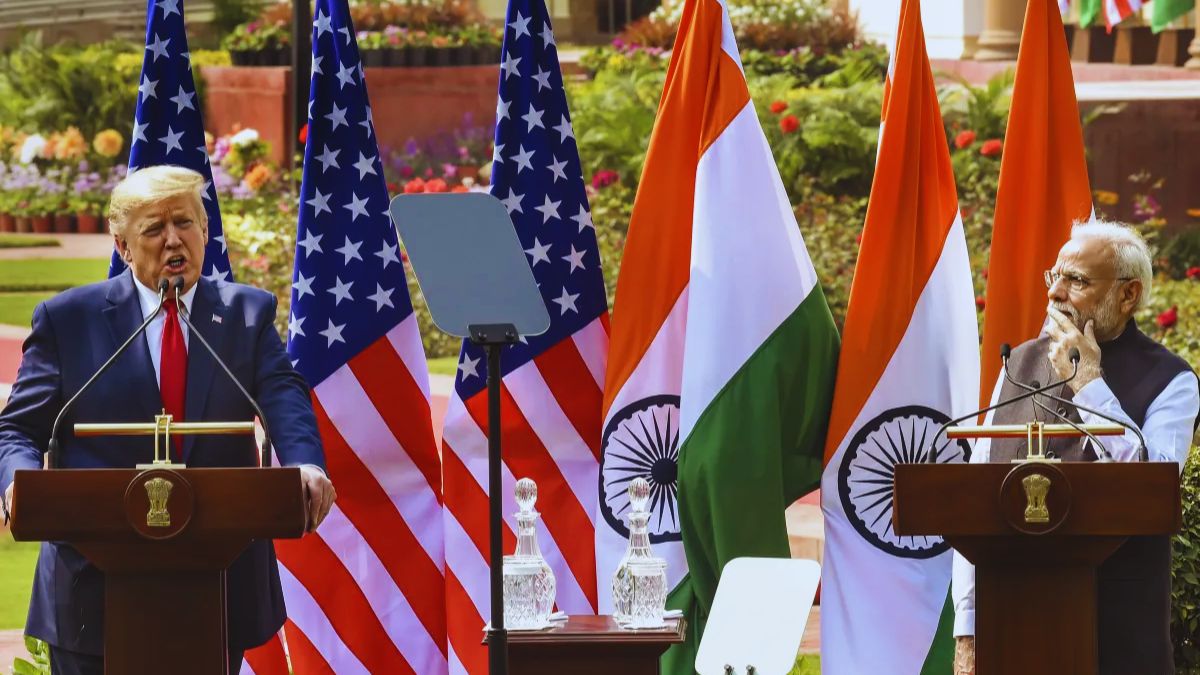
US President Donald Trump on Wednesday imposed an additional 25% tariff on Indian imports, bringing the total tariff to 50 per cent, an indication of growing distance between the two countries.
From branding India as the ‘Tariff King’ at one point, to levying high import duties, US President Donald Trump has consistently taken a tougher trade stance against New Delhi. These moves are being interpreted as pressure tactics to make India to concede into US demands, as part of a long-discussed Bilateral Trade Agreement (BTA).
Timeline of Trump’s Tariff Actions against India
- Oct 2019: Trump labels India the ‘tariff king’.
- Sep 2024: Trump calls India a “tariff abuser.”
- Apr 2, 2025: US formally announces a 26 per cent import tariff on Indian goods, effective April 9, 2025.
- Apr 5, 2025: White House released an executive order imposing a 10% baseline tariff on imports, with country-specific tariff rates (16 per cent in case of India) scheduled to begin April 9.
- Exemptions: Certain sectors are kept out of these duties – pharmaceuticals, electronics, and energy products.
- Apr 9, 2025: US pauses the implementation of country-specific tariff rates (16 per cent in the case of India) for 90 days, deferring it to July 9. The 10 per cent baseline tariff remained unchanged.
- July 8, 2025: Suspension period further extended to August 1, 2025.
- July 30, 2025: US announces 25 per cent tariff plus penalty on Indian goods. The penalty charge came in the wake of buying crude oil and military equipment from Russia, as US has lent its support to Ukraine.
- July 31, 2025: White House issues a second executive order for 25 per cent tariff to take effect from August 7. There is no mention of a penalty charge. The 10 per cent baseline duty and exempted sectors remained unchanged.
- Aug 5, 2025: Trump opines on elevating the trade tariffs even higher on Indian goods ‘very substantially’.
- Aug 6, 2025: Trump led Republican government announces and imposes an additional 25 per cent tariff, raising it to 50% on goods coming from India as a penalty for New Delhi’s continued purchase of Russian oil, which India refuses to discontinue.

What is the current import duty structure on Indian goods in the US?
Starting August 7, Indian goods entering the US markets are subjected to a 25% tariff (which includes a 10 per cent baseline duty), in addition to the MFN (Most Favoured Nation) rates plus trade remedy measures, if any. For certain exports, this has significantly raised the total charge being levied.
Are there any additional tariffs?
Yes, the United States has imposed sector-specific tariffs on three categories – steel and aluminum (50 per cent); copper (50 per cent), and auto parts (25 per cent). These are also additional duties (over and above existing levies, if any).
Which all sectors or product categories are exempted from these tariffs?
According to GTRI (Global Trade Research Initiative), the exempted categories from the 50% US tariffs on Indian exports are:
- Finished pharmaceutical drugs
- Active Pharmaceutical Ingredients (APIs) and other key drug inputs
- Energy products such as crude oil, refined fuels, natural gas, coal, and electricity
- Critical minerals
- Electronics and semiconductors, including computers, tablets, smartphones, solid-state drives, flat panel displays, and integrated circuits.
In FY 2024 – 25, the bilateral trade between India and the US stood at USD 131.8 billion, with USD 86.5 billion in exports from India and USD 45.3 billion in imports from the US.
Main Sectors to bear the High Tariff Charge:
Here are the key Indian export sectors affected by the 50% US tariff hike, w.e.f. August 7, 2025:
- Textiles and Clothing
- Gems and Jewellery
- Shrimp and Seafood
- Leather and Footwear
- Chemicals
- Electrical and Mechanical Machinery
Tariffs on India’s Trade Competitors:
Here are the tariffs on India’s trade competitors in the US market after the new levy:
- India: 50%
- Brazil: 50%
- Myanmar: 40%
- Thailand: 36%
- Cambodia: 36%
- Bangladesh: 35%
- Indonesia: 32%
- China: 30%
- Sri Lanka: 30%
- Malaysia: 25%
- Philippines: 20%
- Vietnam: 20%
In order to retaliate and provide a befitting response, the Indian PM Narendra Modi’s address at the M.S. Swaminathan Centenary International Conference, New Delhi included conveyed his thought of promoting the welfare of farmers as the nation’s highest priority, and that it would not be compromised by obeying the demands put forth by Donald Trump.
In addition, several politicians, industrialists and economic experts have come out in support of India becoming as self-reliant and independent as possible, during this critical juncture of rising tariff rates, and reduce its dependence on the US market for enhancing its forex treasury.











Be First to Comment