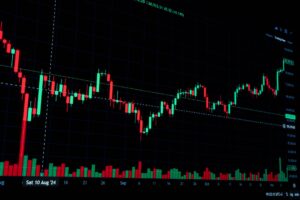
U.S. equity futures experienced a decline early Monday as investors evaluated developments in negotiations involving Iran and awaited a significant inflation report. The Federal Reserve closely watches this upcoming data point.
Market Movements and Global Trends
S&P 500 futures were down 0.5%, while Nasdaq-100 futures saw a 0.6% decrease. Dow Jones Industrial Average futures dropped by 187 points, or 0.4%.
In Asia-Pacific markets, performance was mixed. Japan’s Nikkei 225 reached a new record high, advancing 1.55% to close at 72,353.96. South Korea’s Kospi gained 0.69%, settling at 9,114.55. However, the Hong Kong Hang Seng Index fell 0.45% in late trading, and China’s CSI 300 was up 2.39% at 5,059.66. Australia’s S&P/ASX 200 benchmark was 0.14% lower, ending at 8,816.10.
Oil Prices and Geopolitical Factors
Brent oil futures turned negative on Monday following announcements from mediators Qatar and Pakistan, indicating that U.S. and Iranian officials had agreed on a roadmap for a potential deal within 60 days. International benchmark Brent crude futures for August, after gaining in early Asian trading, fell 0.38% to $80.26 a barrel. U.S. West Texas Intermediate futures for July pared an earlier 3% jump, trading about 1% higher at $77.52 per barrel.
Recent Market Performance and Outlook
Last week, the three leading U.S. stock indexes recovered from a mid-week sell-off driven by uncertainty over monetary policy. A rally in chip stocks on Thursday helped the indexes finish the week higher. The S&P 500 gained nearly 1%, marking its 11th winning week in 12. The Dow Jones Industrial Average also rose close to 1% for the week, while the Nasdaq Composite advanced more than 2%. The U.S. stock market was closed on Friday for the Juneteenth holiday.
Key Economic Data on the Horizon
A critical event for the market this week is the scheduled release on Thursday of the May personal consumption expenditures price index, the Federal Reserve’s preferred inflation measure. Economists polled by FactSet anticipate that core PCE, which excludes volatile food and energy prices, will show an increase from April’s figures. Following the Federal Reserve’s recent hawkish meeting, expectations for an interest rate increase have been brought forward to potentially as soon as October. Investors are keenly focused on any inflation data that might suggest the central bank could soon begin raising rates.
Despite potential market impacts from factors such as Federal Reserve task force implementations and supply chain disruptions related to the Strait of Hormuz closure, the overall market environment remains positive, according to Fundstrat Global Advisors. Tom Lee, the firm’s head of research, stated on CNBC that while conditions could shift abruptly later this year, resembling a bear market, the current environment is still favorable for stocks.

Helene Elliott is the Lead Science & Space Reporter at News Raise. She reports on aerospace missions, astrophysics discoveries, quantum research, and environmental technology.