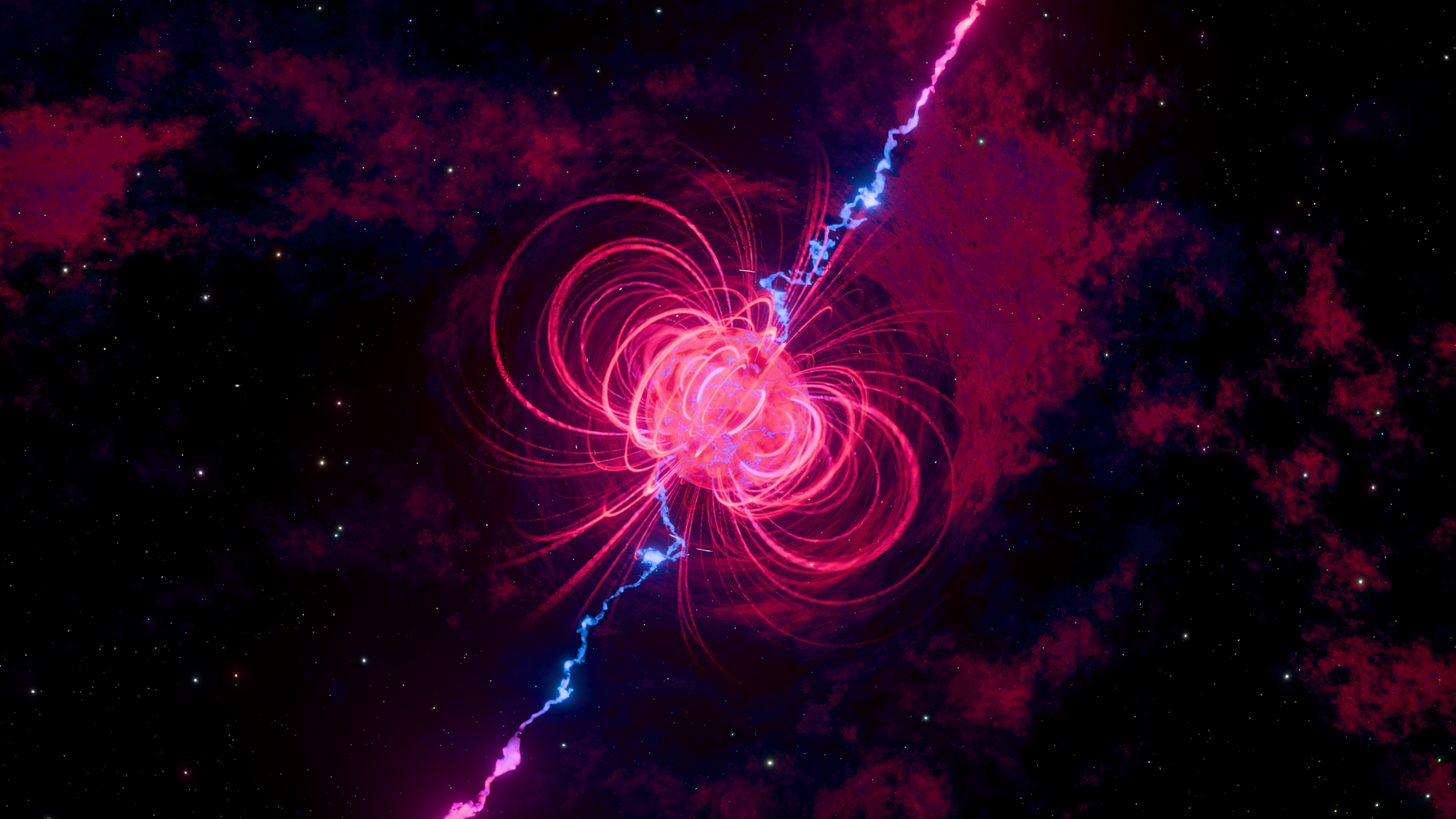
Researchers have unveiled a highly detailed computer model of the universe’s infancy, named Lumina, that captures both the grand cosmic web and the formation of individual galaxies. The study, appearing in the Monthly Notices of the Royal Astronomical Society, describes how the simulation reproduces the influence of the first stars and black holes on the reionization epoch—a period when ultraviolet radiation stripped electrons from hydrogen atoms, allowing light to travel farther and reshaping galaxy growth.
Unprecedented Scale and Computing Power
According to lead author Oliver Zier, a postdoctoral fellow at the Institute for Theory and Computation within Harvard’s Center for Astrophysics, Lumina covers a volume more than one hundred times larger than previous early‑universe models. The simulated region stretches roughly 1.5 billion light‑years in every direction, dwarfing the Milky Way’s 100,000‑light‑year span. Zier notes that this breadth lets scientists observe the large‑scale arrangement of matter—the cosmic web—while still resolving the internal structure of single galaxies.
The project demanded nearly three years of work and the use of over 15,000 graphics processing units on the Frontier supercomputer at Oak Ridge National Laboratory in Tennessee. The massive computational effort enabled the team to track the behavior of both hydrogen and helium, the two most abundant elements, throughout the early universe in a single run.
Testing Theory Against Observation
Lumina is designed to be compared with data from powerful telescopes such as NASA’s James Webb Space Telescope. Zier explains that agreement between the model and observations would reinforce current theories, while discrepancies could point to missing physics. “If they don’t agree, that means there’s something missing in our model, and that might give hints to missing physics,” he said.
Independent experts have praised the achievement. Julian Muñoz, an assistant professor of astronomy at the University of Texas at Austin, highlighted that most prior simulations were limited to small patches of the cosmos and short time spans. Lumina, by contrast, spans a larger region and follows cosmic evolution for a longer period, offering a more comprehensive view.
Ilian Iliev, a professor of astrophysics at the University of Sussex, added that the model’s size could reveal rare galaxies that smaller simulations overlook. He expressed anticipation that Lumina’s results, combined with forthcoming telescope observations, will refine the overall picture of early cosmic history.
Insights into Matter Dynamics
The simulation also explores how ordinary (baryonic) matter and dark matter moved differently after the Big Bang. Ordinary matter interacts with radiation, causing it to travel at a distinct speed compared with the invisible dark matter that dominates the universe’s mass budget. These differing motions left imprinting patterns across millions of light‑years, patterns that cannot be directly observed but can be examined within the virtual universe created by Lumina.
Although the full dataset has not been released to the public, the research team has produced videos that zoom from expansive cosmic structures down to individual galaxies, illustrating the relative scale of Earth, the Milky Way, and the broader universe. Zier cautions that even with its vast coverage, Lumina represents only a tiny fraction of the total cosmos.
By providing a detailed, large‑scale laboratory for testing theories of reionization, galaxy formation, and matter interaction, Lumina stands as a major technical milestone. Its ability to bridge the gap between telescope observations of distant, early galaxies and the underlying physics of the young universe promises to deepen scientific understanding of how the cosmos took shape.

Norman Pearlstine is the Executive Editor and Co-Founder at News Raise. With over two decades of experience across financial journalism, corporate governance, and market analysis, Norman leads the editorial direction and ensures strict adherence to journalistic accuracy and ethics.