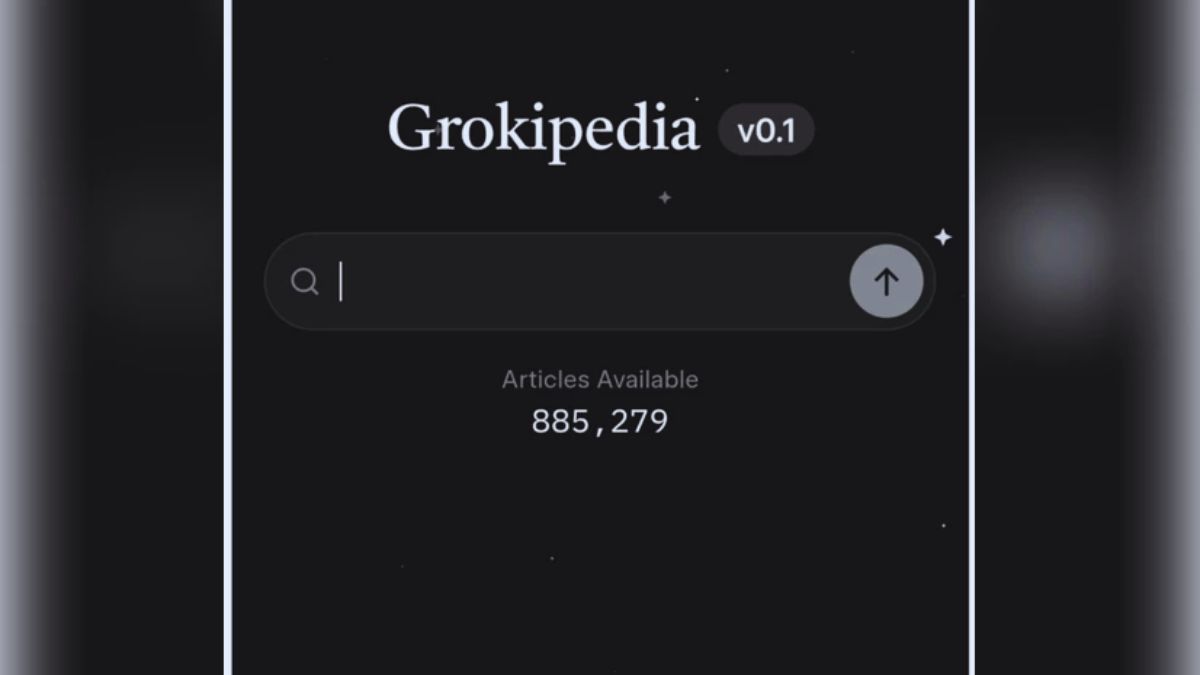
Billionaire entrepreneur Elon Musk has unveiled Grokipedia, an artificial intelligence–generated online encyclopedia that he claims will serve as a “less biased” alternative to Wikipedia.
The project, developed by Musk’s AI startup xAI, aims to offer a more open and truth-oriented approach to information, similar in structure to Wikipedia but distinctly different in tone and perspective. Announcing the project on X (formerly Twitter), Musk said, “We are building Grokipedia @xAI. It will be a massive improvement over Wikipedia and a necessary step toward understanding the universe.” His statement followed a post by U.S. President Donald Trump’s AI czar, David Sacks, who criticized Wikipedia as ‘hopelessly biased.’
According to The Washington Post, Grokipedia mirrors Wikipedia’s familiar interface — complete with searchable entries, cross-references, and minimalist design — but features a noticeably right-leaning editorial tone in several topics. It currently hosts nearly 885,000 articles, far fewer than Wikipedia’s eight million, and remains in its early testing phase under the label ‘Grokipedia v0.1‘.
Grokipedia vs. Wikipedia
The differences between the two encyclopedias are apparent even in how they define key topics. For instance, Grokipedia’s entry on ‘Gender’ begins with, “Gender refers to the binary classification of humans as male or female based on biological sex,” while Wikipedia opens with, “Gender is the range of social, psychological, cultural, and behavioral aspects of being a man, woman, or third gender.”
Critics argue that such differences highlight a political and ideological slant in Grokipedia’s content, reflecting Musk’s broader campaign to promote platforms that favor ‘free speech‘ and less moderation than mainstream tech products.
Inside Grokipedia’s AI System
Grokipedia is powered by the same large language model (LLM) that drives the Grok chatbot integrated into X. This setup allows it to access real-time information from X’s vast user base, potentially enabling the encyclopedia to stay up to date with the latest developments.
However, this close integration with social media data also raises concerns about accuracy and misinformation. Grok itself has faced backlash for spreading conspiracy theories and producing biased or false information, including claims about ‘white genocide’ in South Africa and AI-generated images misrepresenting users.
Controversies and Criticism
Upon launch, several users noticed that Grokipedia contained factual inaccuracies and content copied directly from Wikipedia. For example, its article about Elon Musk, praised his ventures and emphasized his truth-oriented approach to AI safety but included an error linking Ohio politician Vivek Ramaswamy to Musk’s ‘Department of Government Efficiency initiative — a claim unsupported by cited sources.
Despite such issues, Musk’s supporters celebrated Grokipedia’s debut as a bold step toward decentralizing knowledge and reducing ideological bias in online information.
Musk maintains that ongoing updates will improve content reliability and purge propaganda. With its launch, Grokipedia represents Musk’s latest effort to challenge mainstream digital platforms through AI innovation. Whether it can match Wikipedia’s credibility and scale remains to be seen, but its emergence underscores a growing divide in how technology leaders envision the future of online knowledge and neutrality.

Helene Elliott is the Lead Science & Space Reporter at News Raise. She reports on aerospace missions, astrophysics discoveries, quantum research, and environmental technology.