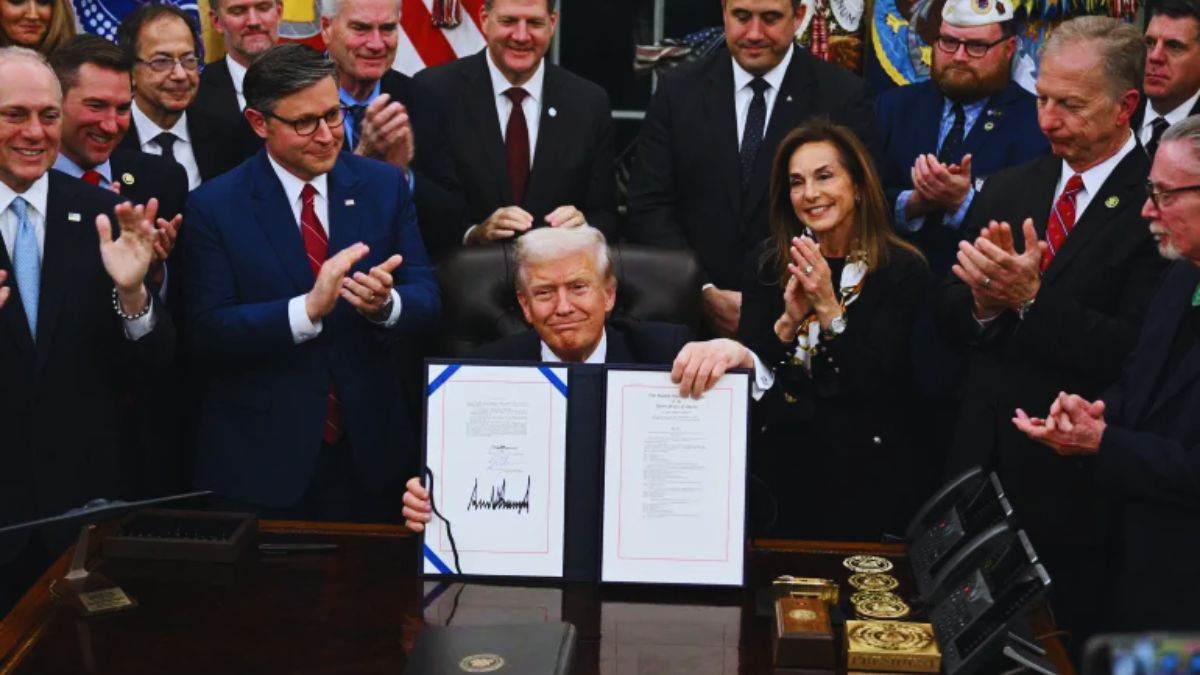
In a dramatic late-night move, U.S. President Donald Trump signed a new federal government spending bill, officially ending the longest government shutdown in American history.
The shutdown, which lasted for a record 43 days, had crippled government operations, delayed essential services, and left hundreds of thousands of federal workers without pay. “With my signature, the federal government will now resume normal operations,” Trump announced on November 12, promising renewed efforts to reduce the cost of living for Americans.
- The bill, which extends federal funding through January 30, was passed by a 222–209 vote in the Republican-controlled House of Representatives and cleared the Senate earlier this week.
- Its passage marks the end of a bitter political standoff that left the nation divided and key sectors, particularly air travel and public services, struggling to function.
Federal Workers to Return as Services Resume
- Following the President’s approval, approximately 670,000 furloughed federal workers are set to return to work as early as November 13.
- Another similar number of employees who continued working without pay will receive back pay in the coming weeks.
While the reopening of agencies is a relief to millions, experts say it could take time before the full range of federal services resumes normal operations. The shutdown had caused major disruptions to airports, food aid programs, and government-funded research projects across the country.
- The air travel sector, one of the hardest hits, is expected to recover gradually before the Thanksgiving travel rush later in November 2025.
- Similarly, the restoration of food assistance for millions of families ahead of Christmas is likely to bring some economic relief and encourage higher holiday spending.
Healthcare Dispute Still Unresolved
Despite ending the shutdown, the agreement does not resolve one of the most contentious issues that triggered the closure — the health insurance subsidies for 24 million Americans under the Affordable Care Act (ACA). The Trump administration has reiterated that it will not renew these subsidies when they expire at the end of the year. A Senate vote on the issue is expected by December.
Political Fallout and Public Opinion
The 43-day impasse saw both Republicans and Democrats trading blame for the shutdown. However, neither party emerged with a clear political victory. According to a Reuters/Ipsos poll conducted on this matter, almost 50% of Americans blamed Republicans for the crisis, while 47% held Democrats responsible.
- During the signing ceremony, Trump criticized Democrats for ‘causing unnecessary pain,’, declaring, “This is no way to run a country — and we can never let this happen again.”
- Echoing his sentiments, House Speaker Mike Johnson accused Democrats of engaging in a pointless and cruel political exercise.
- Economists estimate the shutdown cost the U.S. economy over a tenth of a percentage point in GDP every six weeks.
- Although much of that lost output is expected to be regained, the $1.8 trillion annual spending increase under the new bill will continue to add to the nation’s $38 trillion debt.
The bipartisan deal has also drawn criticism from within the Democratic camp. Illinois Governor JB Pritzker, a potential 2028 presidential hopeful, dismissed the Senate agreement as an ’empty promise’, reflecting the continuing divisions within both parties.
As the federal government reopens and Americans return to normalcy, questions remain about whether Washington can avoid another shutdown when the temporary funding extension expires early next year.

Helene Elliott is the Lead Science & Space Reporter at News Raise. She reports on aerospace missions, astrophysics discoveries, quantum research, and environmental technology.