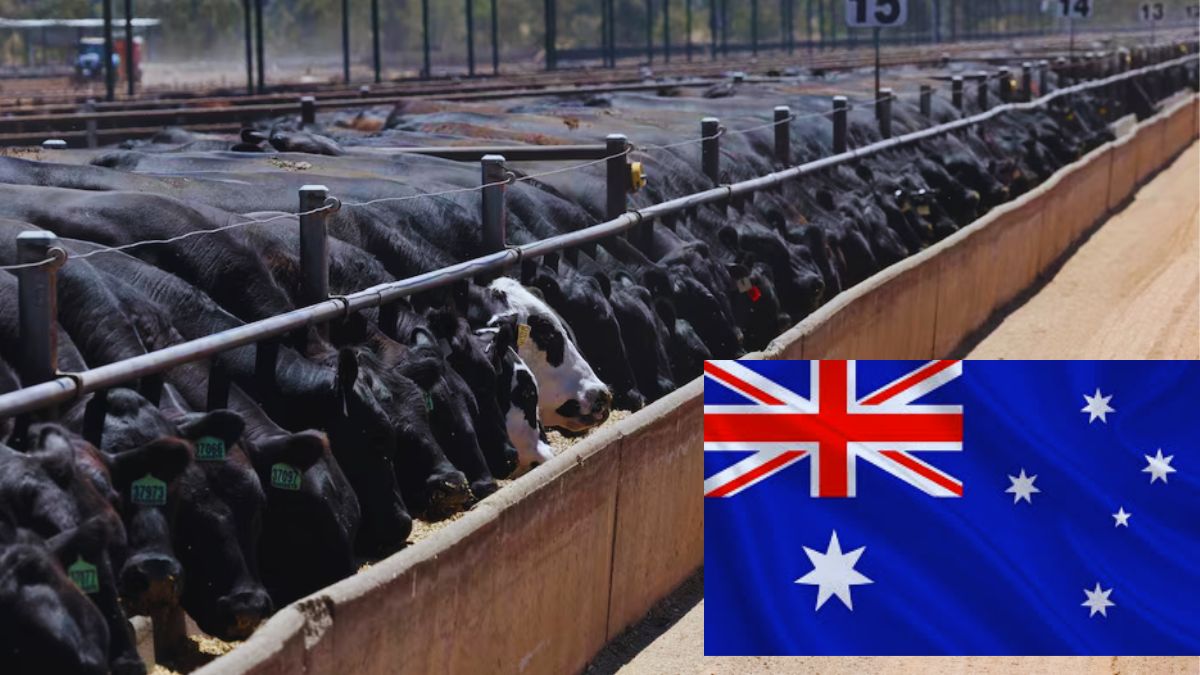
Australia’s Feedlot Boom Transforms Its Beef Industry as Global Demand for Grain-Fed Meat Surges
In just three months, the weight of Black Angus cattle has shown a soar by as much as 50%, reaching around 600 kg—an impressive transformation that reflects a major shift in Australia’s cattle industry and the world’s growing appetite for premium grain-fed beef, thanks to the chewing through a rich mix of rolled barley, cottonseed, and molasses.
Gundamain feedlot, located roughly four hours west of Sydney, perfectly captures this momentum. What was once a traditional cattle operation has become part of a broader structural change sweeping across Australia’s beef sector. With vast grazing lands and a relatively small domestic market, Australia has long been a heavyweight in global beef exports. In fact, from January to September of 2025. it shipped out $8.6 billion worth of meat.
Today, feedlots – once a smaller part of the supply chain—are emerging as key infrastructure that helps Australian producers meet rising international demand while maintaining year-round consistency in beef quality.
Feedlot Expansion Accelerates
The use of feedlots in Australia has skyrocketed. Industry data shows that the number of cattle on feed reached an all-time high of 1.6 million by June 2025, up from 1 million just five years ago. Analysts predict that this figure could climb to nearly 2 million by 2027.
- If that projection holds, around half of all cattle processed in the country would have spent time in feedlots, compared with about 40% today.
- Gundamain’s owners are already planning to scale up. The feedlot aims to double its capacity to 12,000 head in the coming years – a move driven entirely by supply chain requests and steady export orders.
Global Market Forces Behind the Shift
Australia’s feedlot boom comes at a time when the United States – the world’s largest producer of grain-fed beef is experiencing its tightest cattle supply in decades. The extended drought periods have pushed U.S. cattle numbers to their lowest level since the 1950s.
- As of November 1, the U.S. had just 11.7 million cattle on feed, a drop of 260,000 from the previous year.
- With U.S. production dipping, Australia has seized an opportunity to expand in markets that traditionally leaned toward American beef.
- Countries like Japan, South Korea, and China – where marbled, grain-fed beef is considered premium, now deeply rely increasingly on Australian suppliers.
Stability in a Climate-Challenged Industry
Another reason feedlots are gaining traction is their ability to stabilize output in a climate notorious for extreme rainfall variability. While grass-fed operations depend heavily on weather patterns, feedlots offer greater predictability. Australia’s grain production also helps support the feedlot industry. Even in tough seasons, the country typically grows more grain than feedlots require.
What the Future Holds
Major cattle operators such as Mort & Co, JBS, NH Foods, and Teys Australia (partly owned by Cargill) are driving the expansion. Still, experts believe Australia won’t follow the U.S. model, where over 90% of cattle are grain-finished.
- High capital costs and expectations of a U.S. production rebound in coming years will likely limit overexpansion.
- Australia remains one of the world’s leading suppliers of grass-fed beef – a segment prized for its natural, pasture-based image.
This dual strength positions Australia uniquely to cater to both premium grain-fed markets and consumers seeking more traditional, grass-fed options. With rising global demand, favourable market conditions, and a strategic industry shift, Australia’s feedlot revolution is securing its place as a global leader in both quality and volume.

Helene Elliott is the Lead Science & Space Reporter at News Raise. She reports on aerospace missions, astrophysics discoveries, quantum research, and environmental technology.