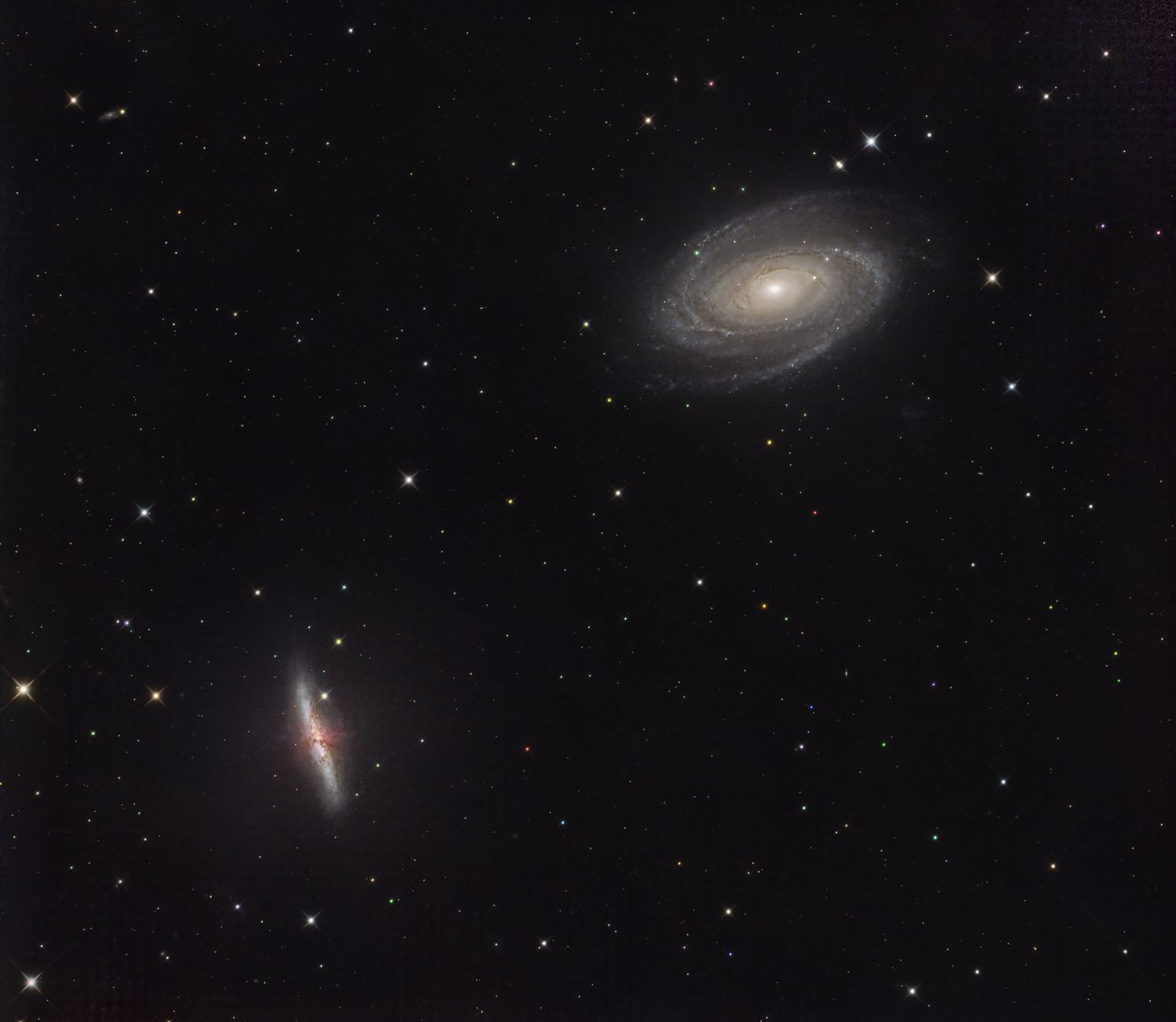
NASA’s James Webb Space Telescope has delivered a detailed view of the Messier 82 galaxy, also known as the Cigar galaxy, revealing millions of previously unseen stars and intricate structures within the intensely star-forming celestial object. Located 12 million light-years away, M82 is a spiral galaxy undergoing a period of rapid star formation, thought to be triggered by a past galactic merger.
Unveiling Hidden Details
A recent imaging survey utilizing Webb’s Near-Infrared Camera (NIRCam) spent 65 hours observing M82. This extensive observation time, combined with the telescope’s infrared capabilities, allowed it to penetrate the dense dust that has historically limited high-resolution views from other observatories like the Hubble and Spitzer space telescopes. The resulting images showcase the galaxy’s distended disk structure and an astonishing number of individual stars.
Astronomers estimate that Webb’s image captures approximately 16.5 million individual stars, appearing as luminous blue granules. These stars represent a fraction of the total stellar population, with many too faint to be detected. According to Benjamin Williams of the University of Washington, a member of the research team, the sheer number of resolvable stars provides a “detailed fossil record of the formation and evolution of M82.” The near-infrared light captured by Webb offers a snapshot of a process that has been unfolding over hundreds of millions of years.
A Unique Laboratory for Galactic Evolution
M82’s current phase of extreme star formation, which is occurring at a rate ten times faster than in the Milky Way, is considered a temporary event in astronomical terms, lasting a few hundred million years. This makes the galaxy a unique environment for studying galactic evolution. “M82 is an ideal galaxy evolution laboratory because it has properties that allow us to probe important physical processes, such as how stars form in such environments and how that activity drives outflows,” said Adam Smercina, principal investigator and a NASA Hubble Fellow at the Space Telescope Science Institute.
The galaxy’s asymmetrical disk and increasing brightness toward its center suggest a distorted shape, a common characteristic following intense galaxy mergers. Webb’s observations are expected to help scientists understand how star formation has shifted within M82 over billions of years and shed light on the triggers for its elevated star formation rate and the expulsion of material from its core.
Starburst Activity and Outflows
The intense starburst activity is also driving bipolar plumes of material outward from the galaxy’s disk. These outflows have an hourglass shape and a layered structure. Closer to the disk, yellow tendrils indicate ionized gas, while more distant orange material represents dust grains known as polycyclic aromatic hydrocarbons. These grains help trace the interstellar medium, the space between stars within the galaxy.
The data collected by Webb is part of a larger effort to piece together M82’s formation history. Kristen McQuinn of the Space Telescope Science Institute emphasized the importance of combining data from multiple missions. “When you marry the datasets, you expand what you can probe, and the questions that you can pose are even more complex,” she stated.

Steve Lopez is a Senior Editorial Columnist and Health & Public Policy reporter for News Raise. Steve focuses on healthcare advancements, medical technologies, and public health policies.