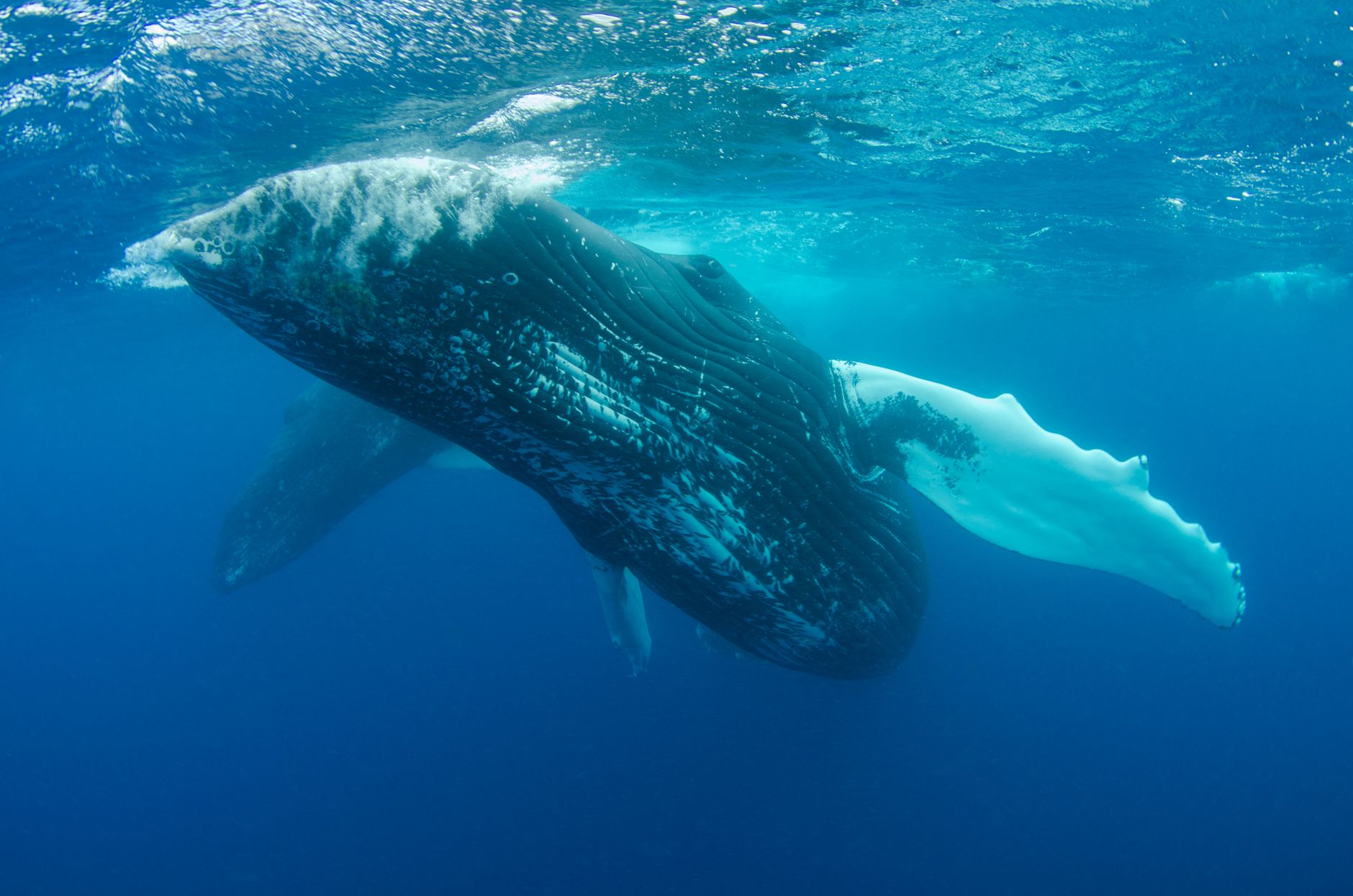
In July, divers recorded a heartbreaking scene one kilometre off Australia’s Gold Coast: a newborn humpback whale calf lay motionless on the seafloor while its presumed mother returned to the spot repeatedly for more than an hour. The adult gently touched the calf with her head and pectoral fin and rested beside it, keeping eye contact. Researchers describe the episode as the first documented case of a humpback whale mother caring for a deceased newborn.
Observations off the Gold Coast
The footage captured two adult humpbacks remaining in the same area for several hours after what appeared to be a stillbirth. The female released an ammoniac membrane shortly after the birth, but no placenta was observed, suggesting the calf died at or shortly after delivery. The calf stayed motionless on the seabed, and the mother approached it repeatedly, maintaining close proximity and touching it with her head and pectoral fin. A second adult, likely an escort, also lingered nearby.
Unlike typical post‑birth behaviour, the mother did not attempt to lift the calf to the surface for its first breath. Researchers interpret this as possible recognition of the calf’s death or an inability to raise it from the seafloor. Members of the public later reported seeing two adult humpbacks in the same vicinity for the next two days, although the research team could not verify that the individuals were the same as those in the video.
Implications for understanding whale behaviour
The observation adds to a growing body of evidence that cetaceans display “epimeletic” behaviour—careful, often protective actions toward distressed or dying companions. Humpback whales are already known to defend calves from killer whales, stay alongside injured individuals, and even intervene when other species are attacked. Similar post‑mortem attentiveness has been recorded in toothed whales; for example, a killer whale named Tahlequah carried her dead calf for 17 days in 2018, covering more than 1,500 kilometres.
Until now, such detailed accounts have been scarce for baleen whales, largely because newborns of these species sink quickly, making observation difficult. Humpback calves depend entirely on their mothers for nutrition, protection and guidance during the first months of life, and maternal bonds are reinforced by hormonal changes after birth. The new study, led by marine science research fellow Olaf Meynecke of Griffith University, suggests that these bonds may persist even after a calf’s death.
While the behaviours observed—remaining close to the calf, suspending travel and socialising, and repeated gentle contact—parallel how elephants, great apes and some toothed whales respond to death, scientists caution against attributing human‑like grief. The term “postmortem attentive behaviour” is preferred because emotional states cannot be directly measured. The actions could reflect grief, strong maternal attachment, confusion, or instinctual caregiving.
The findings highlight a research gap: most documented epimeletic events involve toothed whales, with baleen whales underrepresented. As whale populations recover and scientific equipment improves, researchers anticipate more opportunities to observe rare events such as births and stillbirths at sea, potentially revealing additional instances of post‑mortem care.
Overall, the Gold Coast observation provides a rare glimpse into how humpback whales may cope with loss, underscoring the complexity of their social lives and the need for continued study of marine mammal emotional capacities.

Steve Lopez is a Senior Editorial Columnist and Health & Public Policy reporter for News Raise. Steve focuses on healthcare advancements, medical technologies, and public health policies.