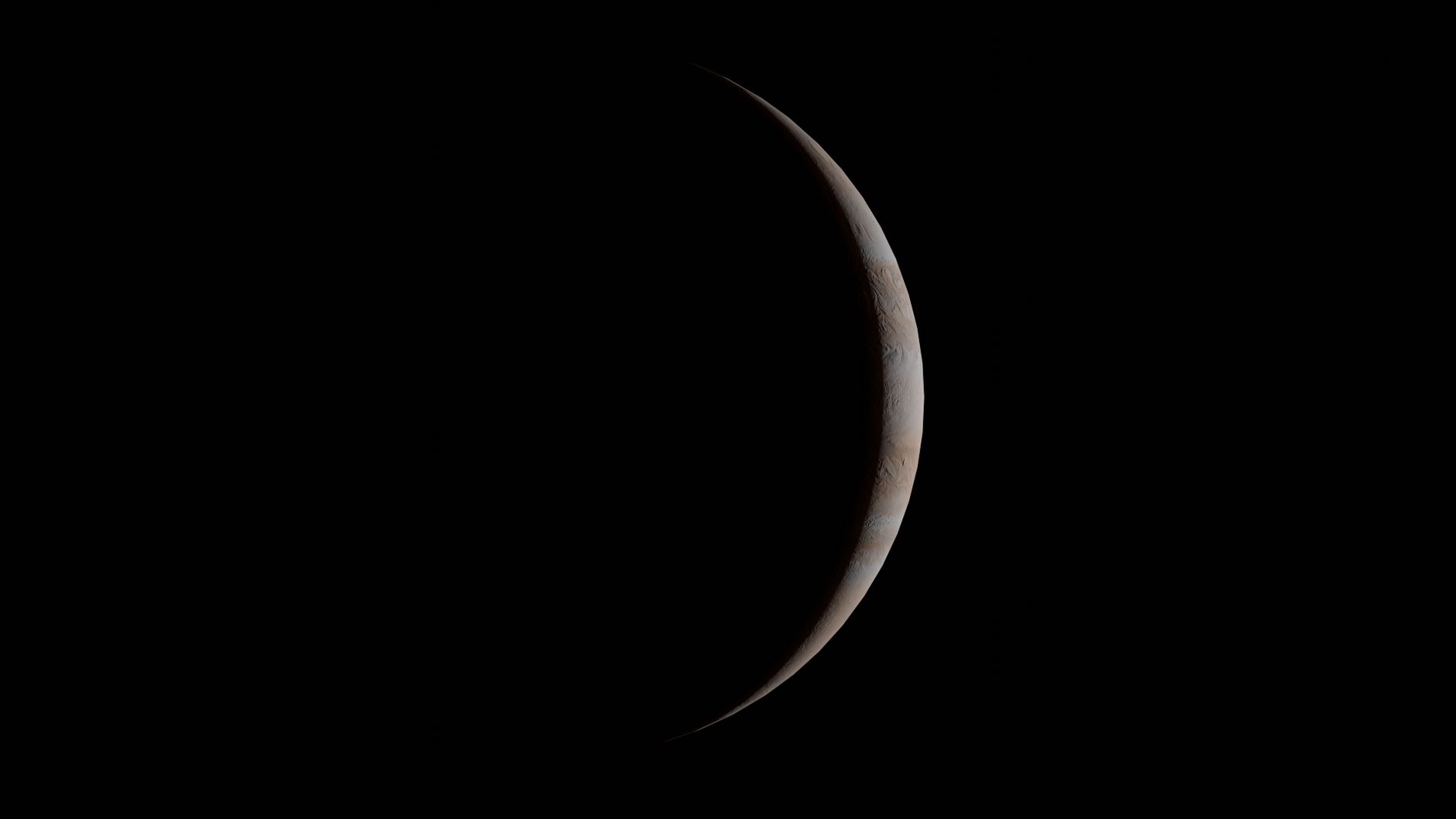
On the morning of Tuesday, Oct. 6, skywatchers across much of eastern North America will be able to see a waning crescent moon move directly in front of the planet Jupiter. The event, known as a lunar occultation, will cause Jupiter to disappear behind the moon for roughly an hour before re‑emerging, a configuration that will not repeat for another eleven years.
What the occultation looks like
At the time of the occultation the moon will be a thin crescent, illuminated only about 20 % of its surface. Jupiter, a bright point of light to the naked eye, will rise in close proximity to the moon in the eastern sky before the two bodies appear to draw together as the moon travels eastward against the background stars. When the occultation begins, Jupiter will be hidden behind the moon for about an hour. No telescope is required to notice the disappearance and reappearance, but binoculars or a small telescope will make the scene more dramatic. Through a telescope Jupiter will resolve into a tiny disc rather than a point of light, and it will take roughly a minute for the planet to be completely covered.
Viewing times across major cities
The International Occultation Timing Association provides local times for when Jupiter will vanish and reappear in ten major North American cities. In Chicago the occultation runs from 3:22 a.m. to 4:17 a.m. CDT. Atlanta sees the event from 4:15 a.m. to 5:17 a.m. EDT, while Detroit experiences it from 4:16 a.m. to 5:20 a.m. EDT. In Miami the planet disappears at 4:20 a.m. and reappears at 5:09 a.m. EDT; Washington, D.C. observes the same interval from 4:20 a.m. to 5:24 a.m. EDT. Philadelphia’s window is 4:22 a.m. to 5:26 a.m. EDT, New York’s 4:23 a.m. to 5:27 a.m. EDT, Toronto’s 4:25 a.m. to 5:22 a.m. EDT, Boston’s 4:26 a.m. to 5:30 a.m. EDT, and Montreal’s 4:30 a.m. to 5:26 a.m. EDT.
When the next occultation will occur
Outside the narrow occultation path Jupiter will not be completely hidden; instead, observers will see the planet skim the edge of the crescent moon, a close approach that can still produce striking photographs. The next lunar occultation of Jupiter visible from North America is not scheduled until Nov. 27, 2037, according to the When The Curves Line Up calendar.
The event is being reported by Jamie Carter, a freelance science journalist based in Cardiff, U.K., who contributes regularly to publications such as Live Science, Space.com, and New Scientist.

Norman Pearlstine is the Executive Editor and Co-Founder at News Raise. With over two decades of experience across financial journalism, corporate governance, and market analysis, Norman leads the editorial direction and ensures strict adherence to journalistic accuracy and ethics.