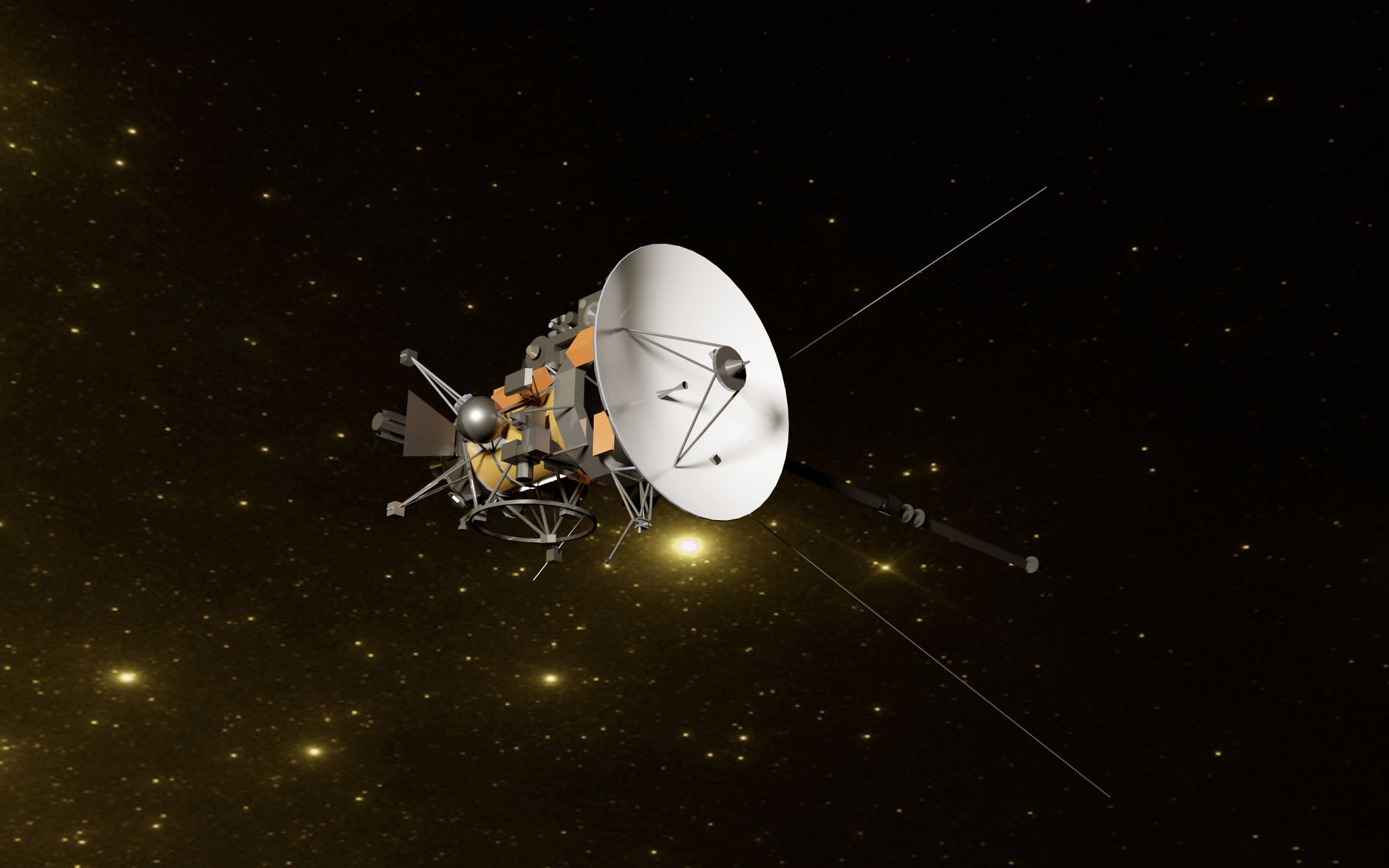
Voyager 1’s most celebrated photographs were captured within roughly two years of its launch, showcasing the outer planets before the spacecraft turned its cameras back toward the Sun on 14 February 1990. That final imaging session produced the famous “Pale Blue Dot,” a view of Earth from about 3.7 billion miles (6 billion kilometres) away, and marked the end of the probe’s visual record as the imaging system was powered down to conserve limited electricity.
Iconic planetary snapshots
During its fly‑by of Jupiter, Voyager 1 recorded erupting volcanoes on the moon Io, delivering the first direct evidence of active volcanism beyond Earth. The spacecraft also photographed the swirling Great Red Spot, a massive storm that continues to dominate the gas giant’s atmosphere. At Saturn, the probe revealed fine detail in the planet’s rings and investigated the thick orange haze that conceals the surface of Titan, Saturn’s largest moon. These images, taken in the early 1980s, remain some of the most vivid records of the outer Solar System.
Power constraints and instrument health
Voyager 1 relies on a radioisotope thermoelectric generator (RTG) that converts heat from decaying plutonium into electricity. The generator’s output declines by roughly four watts each year, forcing mission engineers to ration power carefully. Of the ten scientific instruments originally onboard, only two remain operational: a magnetometer that measures magnetic fields and a sensor that detects plasma waves.
The Low‑Energy Charged Particles experiment was shut down in April 2026 after an unexpected power dip during a routine roll maneuver. Later that year, engineers attempted a risky repair nicknamed the “Big Bang,” which involved turning off three devices in sequence and substituting lower‑power alternatives. If the power savings hold, the remaining instruments could stay functional through at least the mission’s 50th anniversary in 2027.
Recent communication glitches
In October 2026, contact with Voyager 1 was lost for about 48 hours before the probe re‑established a link on its own. On 14 November, a Deep Space Network antenna in Canberra, Australia, detected the spacecraft’s carrier tone but no accompanying science or engineering data. The tone confirms that Voyager 1 is still oriented toward Earth and that its transmitter functions, but the absence of data points to a failure in the onboard computer responsible for formatting instrument readings for transmission.
A similar fault in 2023 required months to resolve, and because commands take roughly two days to reach the probe and another two days to see the effect, this latest issue could also persist for weeks. The ongoing troubleshooting underscores the challenges of operating a spacecraft more than five decades from Earth.
Future trajectory toward a distant star
Voyager 1’s current path points toward the star designated AC +79 3888, also known as Gliese 445, a dim star in the far northern sky located more than 17 light‑years from Earth. The probe is expected to pass within about 1.7 light‑years of that star, but not until roughly 40,000 years have elapsed.
Traveling at nearly 38,000 mph (61,000 km/h), Voyager 1 can cross the United States from coast to coast in under five minutes. Yet light moves over 17,000 times faster. On 18 November 2026, the spacecraft crossed the one‑light‑day mark, having spent 49 years and just over two months covering the distance that light traverses in a single day.
Despite the dwindling power budget and recent technical setbacks, Voyager 1 continues to send back valuable data from interstellar space, embodying a mission that has far exceeded its original expectations and will keep venturing into the unknown for many generations to come.

Steve Lopez is a Senior Editorial Columnist and Health & Public Policy reporter for News Raise. Steve focuses on healthcare advancements, medical technologies, and public health policies.