For years, astronomers have been puzzled by a strange class of objects that pulse with radio waves on a clock far slower than anything they expected. Now a team has caught one of these cosmic timekeepers red-handed, and the culprit is a dead star quietly cannibalizing its neighbor.
The findings, published Monday in the journal Nature Astronomy, center on a system catalogued as ASKAP J1745-5051. Using Australia’s ASKAP radio telescope, operated by the national science agency CSIRO, researchers traced repeating bursts of radio energy to a tight pair of stars locked in a punishingly close orbit. Every roughly 1.4 hours, the system flares to life.
At the heart of the pair sits a white dwarf, the burnt-out, Earth-sized core left behind when a star like our Sun exhausts its fuel. Despite its small size, it packs roughly the mass of the Sun. Its partner is a faint red dwarf, a feeble star about a tenth of the Sun’s mass. The two whirl around each other in little more than an hour, and the dense white dwarf is steadily siphoning material off its companion.
That stolen gas is the key. As matter spirals toward the white dwarf, the system unleashes powerful blasts of both radio waves and X-rays. By watching the two kinds of radiation, the team noticed they do not peak at the same moment, a clue that they originate in different regions of the system rather than from a single source.
The bursts belong to a category astronomers call long-period radio transients, objects that repeat over minutes to hours rather than the fraction of a second typical of fast-spinning neutron stars. Only about a dozen such sources are known across the entire Milky Way, and their nature has been fiercely debated. Some researchers argued they were exotic neutron stars; others suspected interacting binary systems involving white dwarfs.
The new observation tips the scales decisively toward the binary explanation, at least for some of these objects. Because scientists can directly watch both stars and the accretion process at work, the system serves as a kind of decoder ring for the wider population, what the researchers describe as a stellar Rosetta stone. The hope is that it will let astronomers determine whether other mysterious repeaters behave more like pulsars or like these feeding white dwarf pairs.
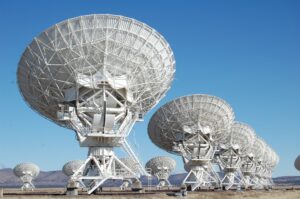
The work was led by a doctoral researcher at the University of Sydney as part of an international collaboration. ASKAP, a network of dish antennas in remote Western Australia, has proven especially adept at spotting these slow, repeating signals because it can survey enormous swaths of sky at once.
The discovery does not close the book on long-period transients. Most known sources remain unlocalized, meaning astronomers cannot yet say what powers them. But for the first time, scientists have a clean, well-understood template against which to test the rest. Each new detection now has a reference case, and that could finally turn a baffling menagerie of cosmic signals into something astronomers can systematically explain.