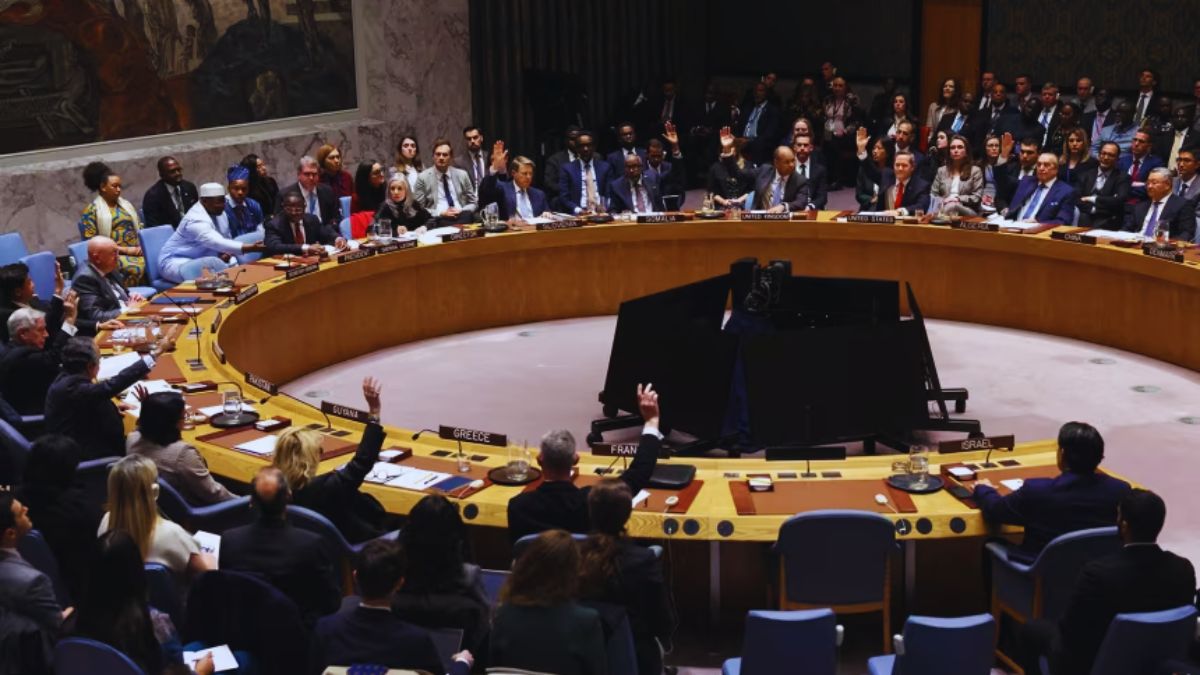
In a significant diplomatic development, the United Nations Security Council has approved a US-drafted resolution designed to shift Gaza from its fragile truce toward a more durable and long-term reconstruction.
The resolution, which supports central elements of US President Donald Trump’s 20-point Gaza plan, aims to establish new structures to stabilize this sensitive region. The 15-member council voted 13–0 in favor of the measure, with Russia and China choosing not to exercise their veto power. Their abstentions allowed the resolution to pass, giving it the international legitimacy Washington wanted.
A Major Boost for the US Gaza Initiative
The resolution provides formal UN backing for parts of Trump’s Gaza framework, which helped shape the ceasefire currently in effect. The president hailed the vote on social media, praising the decision and celebrating the creation of the “Board of Peace,” – a new transitional authority set to guide Gaza’s political and security environment.
Trump said he would chair the Board of Peace, noting that it would include “the most powerful and respected leaders throughout the world.” He added that further announcements about board members would be shared in the coming weeks.
According to the draft text, the resolution authorizes the creation of a temporary International Stabilization Force (ISF), which will operate in Gaza during the transitional phase.
International Stabilization Force to Play Key Role
US Ambassador to the United Nations, Michael Waltz explained that the ISF will be formed by a coalition of peacekeeping nations, including several Muslim-majority countries such as Indonesia and Azerbaijan. The force will function under a unified command and will be tasked with:
- Securing streets and maintaining order
- Overseeing demilitarization efforts
- Safeguarding civilians
- Escorting humanitarian aid through designated safe corridors
US officials, including Secretary of State Marco Rubio, have repeatedly emphasized the need for an international mandate to ensure the plan’s viability. Ahead of the vote, Waltz argued that opposing the resolution would effectively represent “a vote to return to war.”
Concerns Over Implementation and Timeline
While the resolution provides broad authorization, several diplomatic sources have raised concerns about the lack of detailed sequencing. Critics argue that the framework leaves major questions unanswered—particularly regarding how and when transitional authorities will transfer responsibilities to the Palestinian Authority (PA).
The draft states that the PA will assume control only after ‘satisfactorily completing its reform program’, though the US has not specified what those reforms entail. The Board of Peace and associated international bodies are authorized to operate until the end of 2027, but the steps leading to a full handover remain vague.
Key Provisions: Demilitarization and Reconstruction
- The resolution makes a notable—though cautious—reference to Palestinian statehood, suggesting that meaningful progress could eventually create conditions for a credible pathway to Palestinian self-determination and statehood.
- It also calls for a renewed US-facilitated dialogue between Israel and the Palestinians to establish a long-term political horizon.
Russia & China, both countries argued that the resolution lacks adequate emphasis on Palestinian ownership of the process. Meanwhile, Israeli Prime Minister Benjamin Netanyahu reiterated his stance, asserting that Gaza must be demilitarized and Hamas disarmed, whether the easy way or the hard way.

Helene Elliott is the Lead Science & Space Reporter at News Raise. She reports on aerospace missions, astrophysics discoveries, quantum research, and environmental technology.