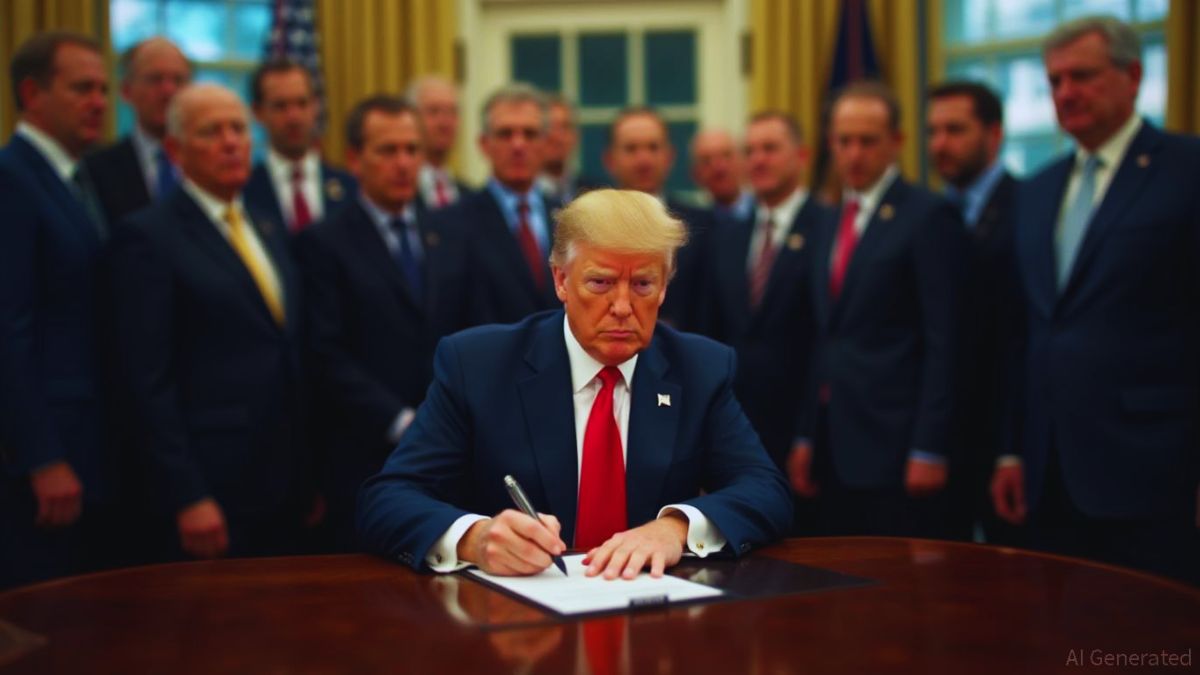
Trump Launches a highly ambitious plan to supercharge America’s AI Innovation
President Donald Trump has unveiled the ‘Genesis Mission‘, a sweeping federal initiative designed to accelerate artificial intelligence research and strengthen the United States’ global standing in advanced technology. The executive order, signed on November 24, makes it one of the most ambitious technological pushes yet.
A Nationwide Plan to Fast-Track AI Breakthroughs
The Genesis Mission aims to unify and strengthen AI research across government agencies. According to Michael Kratsios, Director of the White House Office of Science and Technology Policy, the effort will help federal teams share resources, access larger datasets, and leverage supercomputing tools to dramatically shorten the timeline for scientific discoveries.
Kratsios described the initiative as a turning point for American innovation, noting that “the power of AI is pushing America toward a new scientific revolution.”
Supercomputing Power at the Center of the Mission
A major pillar of the Genesis Mission involves tapping the world-class computing capacity housed in the Department of Energy’s national laboratories. These labs will play a central role in running advanced AI models, processing massive datasets, and enabling complex scientific simulations.
To support this, the administration is deepening partnerships with leading private-sector technology companies, including:
- Nvidia
- Dell Technologies
- Hewlett Packard Enterprise (HPE)
- Advanced Micro Devices (AMD)
These companies are expected to contribute towards additional high-performance hardware and supercomputing systems, helping build one of the most powerful AI research infrastructures in the world.
Accelerating Advances in Energy, Health, and Materials Science
As per the available reports, the Genesis Mission will directly fuel breakthroughs in several critical areas:
- Energy innovation
- Materials engineering
- Biomedical and health sciences
AI-powered simulations and data analysis are expected to streamline research, improve accuracy, and open doors to discoveries that traditionally required years of testing. The administration also highlighted the economic benefits of these advancements, saying AI-driven innovation could boost U.S. manufacturing capacity, expand energy production, and ultimately help ease consumer cost pressures.
With AI systems relying on enormous amounts of electricity, officials acknowledged concerns about increased strain on the U.S. power grid. Energy Secretary Chris Wright emphasized that the Genesis Mission is structured to tackle these challenges head-on. According to Wright, the initiative will prioritize technologies that make the grid more efficient, increase energy supply, and help stabilize and eventually lower the electricity prices.
Senior officials have positioned the Genesis Mission as one of the largest scientific mobilizations in American history, comparing it to the Apollo moon program, the Cold War space race, and even the Manhattan Project. The administration believes the global race for AI leadership is just as consequential. President Trump has frequently emphasized that AI innovation is a national priority, especially as global competitors like China continue to invest aggressively in the field.
Pushing for a Unified National Approach to AI Regulation
Beyond accelerating research, the president is preparing an executive order that would allow the Department of Justice to challenge state-level AI regulations deemed unconstitutional. The administration argues that a consistent national standard is necessary to avoid fragmented rules that could slow down innovation.
With the launch of the Genesis Mission, the United States is making a bold bid to reclaim dominance in AI, supercomputing, and scientific innovation. By merging federal research capabilities with private-sector technology and focusing on energy-efficient AI development, the initiative aims to reshape not just scientific progress, but also the nation’s economic and energy future.

Helene Elliott is the Lead Science & Space Reporter at News Raise. She reports on aerospace missions, astrophysics discoveries, quantum research, and environmental technology.