Astronomers have traced a high-energy neutrino, often called a “ghost particle,” to a distant star-forming galaxy known as Shadow Blaster, located 11 billion light-years from Earth. This particle began its journey when the universe was approximately 3 billion years old.
The discovery marks the first evidence suggesting that star-forming galaxies like Shadow Blaster play a significant role in producing high-energy neutrinos throughout the cosmos. These particles are nicknamed “ghost particles” due to their nearly massless, chargeless nature, allowing them to pass through matter with minimal interaction at speeds close to the speed of light.
Chasing Elusive Particles
While neutrinos have been detected since the 1960s, only a limited number of their sources have been identified. Neutrinos are the second most abundant particles in the universe after photons. The known sources are insufficient to explain their overall abundance, prompting a search for additional, particularly high-energy, neutrino sources.
The identified source, Shadow Blaster (officially designated JCMT0402−0424), is an intensely bright galaxy that emits infrared light. This galaxy is now considered a potential source for the high-energy neutrino designated IC 210922A, which was initially detected by the IceCube Neutrino Observatory in Antarctica five years prior.
This initial detection prompted astronomers to search for an electromagnetic counterpart to the neutrino event using various telescopes. However, no convincing gamma-ray, X-ray, or optical signals were found, nor could the event be linked to known phenomena like gamma-ray bursts, supernovae, or tidal disruption events.
Using Gravitational Lensing
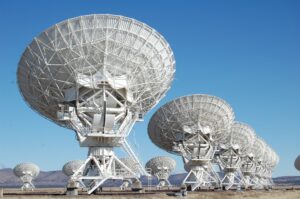
Researchers, including Yuji Urata of MITOS Science Co., LTD. in Taiwan, began their investigation using the James Clerk Maxwell Telescope (JCMT) and the Submillimeter Array (SMA). They identified Shadow Blaster as a galaxy in the correct position and with sufficient brightness to be associated with IC 210922A.
Further investigation using the Atacama Large Millimeter/submillimeter Array (ALMA) and data from the Gemini North telescope, equipped with its Gemini Multi-Object Spectrograph (GMOS) and Gemini Near-InfraRed Spectrograph (GNIRS), was crucial. The detection of Shadow Blaster was made possible by strong gravitational lensing, a phenomenon where a massive object between Earth and a distant source bends spacetime, amplifying the light from the background object.
Analysis revealed Shadow Blaster to be a galaxy with a compact core rich in dense gas and dust, fueling intense star formation. Such environments have long been theorized as powerful particle accelerators. Notably, this research indicates that these regions can act as cosmic accelerators even without a feeding supermassive black hole, provided they harbor sleeping black holes and lack the powerful jets associated with active galactic nuclei.
The findings suggest that intensely star-forming galaxies, which were common in the early universe, could account for a significant portion of the observed diffuse neutrino background. Urata stated that their analysis suggests this population could contribute up to roughly 20% of the measured neutrino background. The research was published in the journal Nature Astronomy.

Helene Elliott is the Lead Science & Space Reporter at News Raise. She reports on aerospace missions, astrophysics discoveries, quantum research, and environmental technology.